DIY high current power supply from car alternator

Thread Starter

Rahulk70

Joined Dec 16, 2016
538
Hi,

Recently I had posted about a thread related to a bench DIY high current transformer 12VDC supply that I'm trying to built. But due to some transformer and diode rectifier limitations that project may take a little more time to be completed until I get my hands on a much beefier transformer or two transformers combined enough to do the job. Meanwhile I have a used spare 100 or 120A alternator (I don't remember the exact current rating) in my possession. I was thinking that if I mounted the alternator with an AC induction or a brushed DC motor like from a treadmill I can use it to generate the max current capability of the alternator to run high current 12VDC motors that pulls close to 80-90Amps for a brief testing like under 10 seconds. I've a treadmill motor in my possession, which I think its rated for 90 or 100VDC that is rated for 3150rpm I guess. I can use a pulley system to run it to obtain higher rpms at the alternator. The voltage output of the alternator doesn't really matter too much for me as long as its more than 12VDC, since my goal is not to charge a battery.

What do you guys think about this project? Is it a good idea? Also what is the RPM range required to obtain that max. current capability of an alternator? If you need a specific alternator model I can look it up and let you guys know later.

Thanks,
R
 

dendad

Joined Feb 20, 2016
4,635
Having a battery for the alternator to charge will make it a lot easier, and the battery can supply the starting surge for the motor.
Also, most alternators need the battery connected for them to work well.
But to get the alternator to supply full power, you will need a couple of horsepower rated motor. 12 x 120 = 1440W. (Without losses taken into account) And that is the power you will need to input to the alternator if you do not include the battery.
 

Thread Starter

Rahulk70

Joined Dec 16, 2016
538
Having a battery for the alternator to charge will make it a lot easier, and the battery can supply the starting surge for the motor.
Also, most alternators need the battery connected for them to work well.
But to get the alternator to supply full power, you will need a couple of horsepower rated motor. 12 x 120 = 1440W. (Without losses taken into account) And that is the power you will need to input to the alternator if you do not include the battery.
One the reasons I'm planning to build this project is to eliminate the battery. But I can add a smaller motor cycle flooded battery to absorb the initial voltage spikes and also to power up the field coils. I plan to use a motor that is most likely to run on wall AC supply one thats rated for 115VAC or 230VAC like from an Air conditioning fan unit. It would be easier to use an AC motor I guess since it can run straight off the wall without the need for an additional supply for a DC motor, except of I use my treadmill motor.
 

Dodgydave

Joined Jun 22, 2012
11,395
You will need a Perminant 12V DC supply to power the Field windings for the Alternator, it wont work with a motor being used as the DC supply.
 

GetDeviceInfo

Joined Jun 7, 2009
2,270
Couple of years ago my local electronics ebayer was selling server supplies of 12v over 100amp. I bought two for $10 each. They sat around for a year then I sent them back to recycler with a box of other discards.
 

Thread Starter

Rahulk70

Joined Dec 16, 2016
538
You will need a Perminant 12V DC supply to power the Field windings for the Alternator, it wont work with a motor being used as the DC supply.
I'm aware about the need for 12V to power the field winding in the alternator. I was thinking of using a transformer + rectifier to active 12V for the field winding. But is the battery a must for regulation for the alternator?
 

Thread Starter

Rahulk70

Joined Dec 16, 2016
538
Couple of years ago my local electronics ebayer was selling server supplies of 12v over 100amp. I bought two for $10 each. They sat around for a year then I sent them back to recycler with a box of other discards.
I too had a chance to choose either between two server PSUs or 2 ATX (300W & 500W) PSU+ 2 UPS + one control transformer. I went with the later:D..I didn't think much about this project back then. Also the SMPS supplies have protection circuits and they trip even if I used it to runsome high current inductive devices like motors.
 

Dodgydave

Joined Jun 22, 2012
11,395
I'm aware about the need for 12V to power the field winding in the alternator. I was thinking of using a transformer + rectifier to active 12V for the field winding. But is the battery a must for regulation for the alternator?
Battery isn't needed, a DC mains supply is ok.
 

geekoftheweek

Joined Oct 6, 2013
1,429
If you just want to power motors you could probably get away without a battery. If you want to use the alternator to power anything else a battery will help smooth out the ripple generated by the alternator, along with absorbing the spikes when you shut the motors off and fill the void as the alternator adjusts when you turn them on. Alternators aren't quite instantaneous.
 

geekoftheweek

Joined Oct 6, 2013
1,429
Unfortunately to get an alternator to put out the 80 - 90 amps you are looking for it will take a few horsepower motor (more like 8) to spin the alternator and the alternator will need to run over 5000 rpm (from some digging online I did a few days ago). A treadmill motor probably won't cut it.

Edit--

I was remembering some info I found on a weldernator build for the 8 hp figure. Using 746 watts per horsepower at 12 volts and 90 amps would work out to 1.45 hp for your motor. Assuming 50% efficiency you will want at least 3 hp turning your alternator. I still may be wrong with the numbers, but something to think about.
 
Last edited:

drc_567

Joined Dec 29, 2008
1,156
DcNZB (1).png
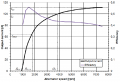
... Interesting graph showing alternator efficiency.
Maybe you should plan on extra power input, as suggested previously.
Maybe some convection airflow for cooling the alternator, also.
 

Reloadron

Joined Jan 15, 2015
7,866
Just winging it but 120 Amps at 12 Volts is 120 * 12 = 1440 watts in a perfect world that would be 1440 / 746 = 1.9 HP but in the real world (see the above chart) automotive alternators are not very efficient. You are going to need a good sized motor capable of a pulley drive. I have seen alternator test benches but have no clue the HP rating of the motors that drive them. With a comfort zone you are likely looking at a 4 ~ 5 HP motor to get 1500 Watts. Again, just winging it.

The above chart was taken from here.

Also worth consideration is the alternator is seldom having to deliver full load current but I would guess for test purposes a full load would be required.

Ron
 
Last edited:

Thread Starter

Rahulk70

Joined Dec 16, 2016
538
@Reloadron @drc_567 @geekoftheweek

Yes, looking at the graph it's pretty clear the efficiency curve is best at around 65-70A range at 1800rpms and the second best is around at 100A at 3800rpms for a 120Amps alternator. In the end I have decided that I would go ahead with this project only as a tester for loads that stay within 70Amps as the motor required to run above those amps need to be very powerful and quite large I assume. Also putting high loads, the voltage regulator and the tiny diodes inside the alternator may bot last for a long time. Look like making a power supply is going to be the only solution.
 
Top