Facebook
 Google
 GitHub
 Linkedin
Hi there -
I recently came across this article on building a diode function generator.
They talk about a relatively simple circuit, with two zener diodes facing each other, in the feedback loop of an inverting op-amp.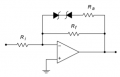
Since I'm not very good at the math side of this, I was hoping someone could help me understand what is happening.
My understanding is that as you approach the zener value, you slightly attenuate the voltage, so that it's not a hard "limiting" function, but rather a smooth, eased-into limiting. Is that accurate?
Apparently, when the zener voltage is reached, the gain drops to (||)/. I'm not sure what || means, though and I'd apprecite if someone could explain it in terms of this calculation.
I recently came across this article on building a diode function generator.
They talk about a relatively simple circuit, with two zener diodes facing each other, in the feedback loop of an inverting op-amp.
Since I'm not very good at the math side of this, I was hoping someone could help me understand what is happening.
My understanding is that as you approach the zener value, you slightly attenuate the voltage, so that it's not a hard "limiting" function, but rather a smooth, eased-into limiting. Is that accurate?
Apparently, when the zener voltage is reached, the gain drops to (||)/. I'm not sure what || means, though and I'd apprecite if someone could explain it in terms of this calculation.