Dinosaur sound system

Thread Starter

torpedochief

Joined Mar 30, 2008
128
Hello Friends,

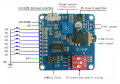
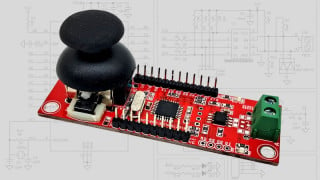
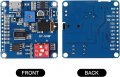
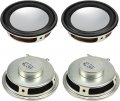
I have dinosaurs that I take to children's hospitals, orphanages, charity events, and parties. I want to put some sound to them. The goal is to play a new sound each time a switch is activated or a sensor is touched. Rita ( the large Raptor around my neck,) I can use my left hand to operate a switch. Val (the smaller Raptor will need a motion or touch switch as my right hand operates the controls, and there is no way to operate a switch. The same is true for the baby Triceratops. I have purchased the boards shown and the speakers they say are required. The directions talk about triggers and such that I don't know about. Could someone advise me on how to accomplish this? You might have to use a sock puppet and crayons to help me understand.

I and lots of kids 71IIJXRMFZL._AC_SX679_.jpg71TCZs4NSIL._AC_SX679_.jpg334677201_179883997845070_2363370000834896824_n.jpgappreciate any help you can provide.
Don
 

Attachments

Ya’akov

Joined Jan 27, 2019
10,231
Welcome to AAC.

This is the wiring diagram for the device provided by the manufacturer:
1705069423516.png
Which part(s) if this are you having trouble with? What specific questions do you need answered about this diagram?
 

Thread Starter

torpedochief

Joined Mar 30, 2008
128
Hello, and thanks. How do I wire the terminals 100 to 107? What does BUSY mean? How would I flash the individual sounds to be played?
 

Ya’akov

Joined Jan 27, 2019
10,231
Hello, and thanks. How do I wire the terminals 100 to 107? What does BUSY mean? How would I flash the individual sounds to be played?
These pads are marked “IOxx” for Input/Output. They are to connect the switches which share a common ground. In the diagram they are connected to each pin, to one side of a SPST (Single Pole Single Throw) NO (Normally Open, that is, it doesn’t conduct unless pressed) switch (usually a momentary pushbutton) and the other side of the switch is connected to the GND (Ground) via a single line that comes from it.

In practice, you can wire it bus fashion, as in the diagram, or individually back to the GND pad of the board (with a suitable scheme to handle more than one connection, like a terminal strip), or a combination. All that matters is that each IO pad has a way to conduct to the GND pad when you want that sample to play.

Note that this could mean embedding switches of various sorts in the puppet so you can activate them by manipulating that part (e.g.: one in the belly that made an appropriate sound when poked, and the like). If this has any utility, you can do it.

Since the diagram omits BUSY, you can ignore it for your purposes but my surmise—not looking at the datasheet for the device—is that BUSY goes HIGH (a logical value represented buy either 3.3V or 5V ± (something) in most cases. It is designed to let a microcontroller or some other logic know the device is playing or otherwise unavailable. As I said, not needed in your standalone application.

As far as placing the samples on the device is concerned, it probably works by plugging the device into a computer via USB. This should cause it to switch to mass storage mode and appear as a drive. Usually there will be sample files on it, and that will give you the naming conventions for files and directories.

Before doing anything, copy everything already there to back it up on your computer. The reason I said “probably” is because I can’t confirm it by reading the datasheet or manual for the board right now. If you are still lost when I get the chance, I will look for it and let you know.
 

MisterBill2

Joined Jan 23, 2018
27,436
Small glass reed switches and a hidden magnet in ones clothing could be an option. Simple, easy, very light weight,and reliable. Often not expensive, either.
 

Audioguru again

Joined Oct 21, 2019
6,826
The amplifier has a "stereo" input but only one speaker output.
You have 2 speakers, each 4 ohms, but if they are in series then the max output power is much less.
You must not parallel your two 4 ohms speakers. One 4 ohms speaker produces a max undistorted output of 2W to 2.5W.
A speaker without an enclosure sounds "tinny" and produces speech like a chipmunk.
 

MisterBill2

Joined Jan 23, 2018
27,436
A GOOD small, portable, battery powered amplifier in a backpack will do the job very well. Check out "Sweet water" for good portable battery powered amplifiers.
 
Top