Hi everyone,
I am constructing a dimmer circuit for heating purposes and i am looking for appropriate ZCD technique to fire the triac . Have any one tried to do such a thing ?
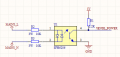
In order to fire the triac at zero or some delay after zero, you need to have a Zero crossing detector circuit, so your micro knows when its zero mains voltage, then it can fire the triac at any delay to create a dimmer.
If you use a zero crossing detector you will only be able to control the temperature by dropping half cycles. The other approach using thyristors is to make the phase of the firing pulses relative to the powerline voltage continuously variable. Is dropping half cycles the method you want or would you like the phase to be continuously variable.
What is it that you are planning to control the temperature of, and will the control circuitry be floating on the AC line or earthed?
In order to fire the triac at zero or some delay after zero, you need to have a Zero crossing detector circuit, so your micro knows when its zero mains voltage, then it can fire the triac at any delay to create a dimmer.
If you use a zero crossing detector you will only be able to control the temperature by dropping half cycles. The other approach using thyristors is to make the phase of the firing pulses relative to the powerline voltage continuously variable. Is dropping half cycles the method you want or would you like the phase to be continuously variable.
What is it that you are planning to control the temperature of, and will the control circuitry be floating on the AC line or earthed?
I am doing this circuit to control water temperature. I looking for controlling the voltage along the whole period not just the half of the power. Is triac suitable for that or it just controls the half of the power as you mentioned ?
In order to fire the triac at zero or some delay after zero, you need to have a Zero crossing detector circuit, so your micro knows when its zero mains voltage, then it can fire the triac at any delay to create a dimmer.
The triac can be used for applications in which full cycles are dropped and for continuously variable firing angle it can be turned on for a fraction of a cycle.
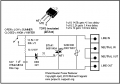
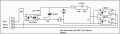
The circuit below is what I used to reduce the power going into my on-demand water heater for my shower. The water source is a tank near the surface of my lawn so the incoming watertemperature varies a lot between summer and winter, hence the Summer/Winter switch.
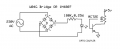
The circuit below is what I used to couple the line timing information and the triac drive signal to an earthed microcontroller. The purpose is to allow every nth half cylcle to be passed along to the motor. The circuit worked great but the motor did not like being run at a low speed with fully current every n half cycles. The controller is small ATTINY12 using its internal RC clock.
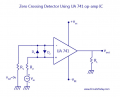
An opamp has a kind of metastable state when two voltages are identical on their input pins. Your slow moving AC voltage and the zero volt signal are identical for quite a while, causing this instability.

 Facebook
 Google
 GitHub
 Linkedin