Digitally Controlled LDO at FB Ground

Thread Starter

Aarondb96

Joined Jan 18, 2024
4
Hello,

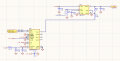
I am trying to add digital control to LDO MIC5353 by replacing Ground at the FB Divider with the output of an DAC (AD5696RBCPZ). The DAC will be controlled through I2C by a uC. My thought process on this idea is to digitally control "Ground" on the FB Divider and have the LDO self regulate to get the FB pin at the required voltage.

My question is simply: Will this work? Or am I better off using a current DAC connected on the FB Pin through a 12.7k resistor (same as R391)?
1745345500404.png
 

Rf300

Joined Apr 18, 2025
73
This might work up to a certain degree. You will not be able to get an output voltage much lower than 1.25 V, since this is the feedback reference voltage of the regulator and most regulators are not designed to deliver a lower output voltage than their reference. But wouldn't it be easier to use a digitally controlled pot instead of R387/R391 and the DAC? (e. g. X9258 from Renesas or something like that?)
 

Thread Starter

Aarondb96

Joined Jan 18, 2024
4
This might work up to a certain degree. You will not be able to get an output voltage much lower than 1.25 V, since this is the feedback reference voltage of the regulator and most regulators are not designed to deliver a lower output voltage than their reference. But wouldn't it be easier to use a digitally controlled pot instead of R387/R391 and the DAC? (e. g. X9258 from Renesas or something like that?)
Thanks. I've never really used digital pots because I'm just not sure of the resolution of them. I know with a DAC I can get high resolution.
 

schmitt trigger

Joined Jul 12, 2010
2,027
You should investigate from the datasheet whether the AD5696RBCPZ can sink current, even the modest amounts required by the resistor divider.
Otherwise I would buffer it with an opamp.
 

Rf300

Joined Apr 18, 2025
73
Thanks. I've never really used digital pots because I'm just not sure of the resolution of them. I know with a DAC I can get high resolution.
The type I mentioned has 256 steps (resp. 8 bit resolution). You have to check, whether that is sufficient for you or not. Also keep in mind the resistance values of the pot, because some regulators have restrictions for the values of the reference voltage divider (R387, R391). But even with a digital pot you can't go below 1.25 V.

If it is really necessary for you to go down to 0 V (as mentioned in your schematics), you have to use another regulator. You can use the LT3041 (not really cheap). You can drive this regulator with your DAC at the SET-pin. Your DAC can sink the 100 uA from the SET-pin without any problems.
 

Thread Starter

Aarondb96

Joined Jan 18, 2024
4
The type I mentioned has 256 steps (resp. 8 bit resolution). You have to check, whether that is sufficient for you or not. Also keep in mind the resistance values of the pot, because some regulators have restrictions for the values of the reference voltage divider (R387, R391). But even with a digital pot you can't go below 1.25 V.

If it is really necessary for you to go down to 0 V (as mentioned in your schematics), you have to use another regulator. You can use the LT3041 (not really cheap). You can drive this regulator with your DAC at the SET-pin. Your DAC can sink the 100 uA from the SET-pin without any problems.
Thanks for your help. I will keep that in mind.
 

RPLaJeunesse

Joined Jul 29, 2018
262
You might want to calculate how the DAC steps and DAC output affect the regulator output voltage. (I would use a spreadsheet to make it easy.) Right now the output voltage will be at zero with the DAC at about 1.8V, barely a third of full scale. Any DAC setting above that is invalid and wasted. I would have R391 connected to ground, then add a resistor from the DAC to the R391-ADJ pin node. Make the new resistor about 33.1 kOhms, and raise R391 value so it and the new resistor in parallel equal 12.7 kOhms. Now the DAC stepping from 0 to FS should give ~3.6V to 0V out. (Hopefully my quick calculations are close, my apologies if I'm off a bit.)
 
Top