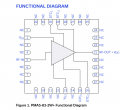
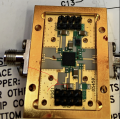
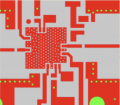
You know by looking at the schematic shown in the mmic or eval board datasheet.How can I know for each connection in the layout shown in the picture to what pin it connects to the chip?
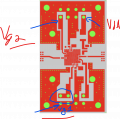
Vg2 on the right side of the bottom pin header would be the wrong one as it is connected to the N.C. pin 19 and there are also no populated components on the PCB.Hello,In the photo below we have layout.In my board they mark Vg2 on bottom.
How can I know based on the photo below what pin is the FALSE vg2?
Yes.Hello ,So I made a pin map as shown below,Is it ok?
With an Ampere-meter, for instance an analog or digital multimeter in DC current position. If you have a modern power supply that has a digital V/A display with decent resolution and accuracy use that.How do you reccomend to meausre the current going threw the drain?
That's normal, the chip is working in class-A and dissipates almost 5W with a quiescent current of 400mA. An extra heatsink is certainly a good idea.When tuning Vg1=-0.8V I got Id=400mA then After shutting down the biasing I noticed that the heat sink is very hot.
Unfortunately this is not good at all. The power on/off sequence from the datasheet is clear on that.next I just turned on the ampliyier straight away with Vg1=-0.8V( no -2V then going up to -0.8V)
Hi, I am interested about this fact that GaAs FETs can be unstable at low drain voltages. Could you maybe share some references that discuss this? I tried searching for it but couldn't find any meaningful results.That's normal, the chip is working in class-A and dissipates almost 5W with a quiescent current of 400mA. An extra heatsink is certainly a good idea.
Unfortunately this is not good at all. The power on/off sequence from the datasheet is clear on that.
You inadvertently set the final drain current long before Vgg2 and VDD were turned on and had time to stabilize.
I mentioned in an earlier posting that GaAs (power) FETs tend to be unstable at low drain voltages. To avoid instability, you put them first in pinch-off (Vgg1 = -2 V), turn on drain voltage, wait until it stabilized and only then adjust gate voltage to the final value (Vgg1 = - 0.8 V). This makes the neccessary sequencer more complex than the amplifier itself.
Apply - 2 V only to Vgg1 and measure with an Ohm-meter across C2. If it's a short then you are probably out of luck.
You could also go through the full power on/off sequence manually and try to set some average Id value to see of it is still possible to do that. Use a current limited power supply.