DeMorgans Laws

Thread Starter

mztrordinary

Joined May 25, 2016
54
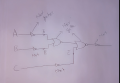
in 10 in the 4th step i was breaking the long line over the plus c and changing the sign which led to double bars over a or b and double bars over the and c. The double bars cancel out on both expressions then?
 

MrChips

Joined Oct 2, 2009
34,841
//C is the same as C.
That is beside the point.

Don't replace the + operator. If you can follow post #19 I can show you the next step.
 

Thread Starter

mztrordinary

Joined May 25, 2016
54
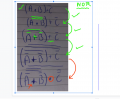
just one more question. In the fourth line of the second pic where i have the 2 long bars over it can these not be simplified even further no?
 

MrChips

Joined Oct 2, 2009
34,841
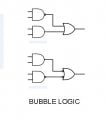
Here is a trick, something I call Bubble Logic.

The bubble represents a NOT gate (or INVERTER).
You can slide a bubble along a wire (like sliding beads on a string) without changing the logic function.

You can add two bubbles on a wire and they do not change the logic function.
bubble logic.jpg
 

MrChips

Joined Oct 2, 2009
34,841
just one more question. In the fourth line of the second pic where i have the 2 long bars over it can these not be simplified even further no?
No, because you want to preserve the OR operator.

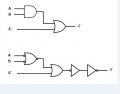
Going back to two inversions or two bubbles:

//F = F

There is a reason for inserting and retaining the double bars.
DeMorgans Theorem exercise 2.jpg
 

MrChips

Joined Oct 2, 2009
34,841
Here is another tip.

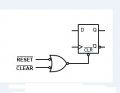
When drawing logic diagrams, the logic function should be displayed, not the gate that was used to implement the function.

In this example, the flip-flop is reset when either RESET OR CLEAR signal is present. The gate is implemented using a 7408 AND gate. The DeMorgan's equivalent (OR gate with inverted inputs and output) is shown instead.

Note that the bubbles match the negated signals (negative logic signal).
DeMorgans Theorem exercise 3.jpg
 

MrChips

Joined Oct 2, 2009
34,841
Was it stated in the requirements that all inputs must be positive logic?

I would assume that /C should be left as given.
 
Top