Dead Kitchen Power Outlet?

Thread Starter

Slayvoff

Joined Aug 19, 2017
9
Hi guys. I live in Manhattan (AKA an apartment) and a few days ago the power outlet on the fridge side of the kitchen lost its power. My power outlets have a green light on them when they're turned on, and the light was off. The reset button was unsnapped, so it was not pushed in. Of course I just tried to push it in to snap it into place, but it wouldn't snap into place. Just pushed it in and it slid out with my finger as I released. I tried pushing the black test button to make sure it was unlocked, tried again, same result.

I reset the circuits from the circuit board and went through the same process, same results. I tried doing it with the circuit off, same result. I have tried pushing really hard with a (non-metal) object, and it won't click into place. The outlet on the other side of the kitchen works just fine, snaps in easily, etc. As you will see in the picture, linked below, the outlet is right next to and in the same plastic casing as the cabinet lights. The fridge also works just fine with that outlet about 3-4 feet to the left. So I thought because that is a shared wall with neighbor maybe they had done something, but it's only affecting this single power outlet and not the fridge or lights.


Anyone have suggestions? I suppose my first guess would be that the outlet is simply dead, and I hope that is the answer because that is probably the cheapest and easiest to DIY.


Link to picture of outlet: http://imgur.com/a/5kbaV

Thanks!
 

MrChips

Joined Oct 2, 2009
34,809
Sounds like the GFI outlet (ground fault interrupter) is dead or the circuit breaker at the distribution panel has been tripped.
In order to pull the outlet and replace it you have to get at the distribution panel and cut the power to the outlet.
You need to contact the building superintendent.
 

MaxHeadRoom

Joined Jul 18, 2013
30,658
The outlet on the other side of the kitchen works just fine, snaps in easily, etc. As you will see in the picture, linked below,. The fridge also works just fine with that outlet about 3-4 feet to the left. but it's only affecting this single power outlet and not the fridge or lights.
Thanks!
According to the pic it does show a GFI, often the outlet in the fridge location is a dedicated outlet.
Max.
 

MrChips

Joined Oct 2, 2009
34,809
I don't know why a GFI outlet is used in the kitchen for a fridge.
GFI outlets are required by electrical code in bathrooms, jaccuzi and near sinks, i.e. any place where water is close by.
 

Thread Starter

Slayvoff

Joined Aug 19, 2017
9
Sounds like the GFI outlet (ground fault interrupter) is dead or the circuit breaker at the distribution panel has been tripped.
In order to pull the outlet and replace it you have to get at the distribution panel and cut the power to the outlet.
You need to contact the building superintendent.
I have the circuit breaker in my apartment I believe. It's the gray box with the black switches that turn power on and off right? So I can just turn the circuit breaker off for the kitchen and then remove the outlet and replace with a new one I buy off, say, Amazon?
 

MrChips

Joined Oct 2, 2009
34,809
I would ask the question, Why is there a GFI outlet in the kitchen?
Is there water close by?
What else in plugged into that outlet?
Would a standard duplex outlet be sufficient?
Which breaker do you turn off?
How do you know that the power is removed when you turn off the breaker?
Which wires do you connect to the replacement outlet?

Do you really want to DIY?
 

Thread Starter

Slayvoff

Joined Aug 19, 2017
9
I would ask the question, Why is there a GFI outlet in the kitchen?
Is there water close by?
What else in plugged into that outlet?
Would a standard duplex outlet be sufficient?
Which breaker do you turn off?
How do you know that the power is removed when you turn off the breaker?
Which wires do you connect to the replacement outlet?

Do you really want to DIY?
The sink is probably about 3-4 feet away, plus general kitchen appliances could splash water on the outlet I suppose.

I know which breaker to turn off, they're marked and I've tested it out. As for ensuring there is no more power, isn't there a test tool and measures the electricity coming through? So turn off circuit and make sure it's zero.

As for the wires to replace, don't know. I would probably just try to figure it out - is it a really difficult task that needs an electrician? I don't really know how much it would cost to have an electrician come as this is the first dead outlet I have ever experienced (first time home owner).
 

MrChips

Joined Oct 2, 2009
34,809
I don't. But if I were going to replace myself I would get one.
Are you going to get one before you replace yourself or after? Ain't that a tad late and redundant?:)

Ok, first time home owner, we can help you DIY without electrocuting yourself.

Yes, there is a test to check if the outlet is live. But that wouldn't work because you already know that the outlet is dead. It is the connecting wires that could still be live.

Step 1.
Go to your local hardware store and buy a neon tester, under $5

or a simple multimeter, under $15.


Get a duplex outlet


Note that this one is rectangular to match the cover plate.

Get appropriate tools:

1 miniature flat blade screwdriver


1 small flat blade screwdriver


1 medium flat blade screwdriver

After you have the necessary materials wait for further instructions.
 

Thread Starter

Slayvoff

Joined Aug 19, 2017
9
Are you going to get one before you replace yourself or after? Ain't that a tad late and redundant?:)

Ok, first time home owner, we can help you DIY without electrocuting yourself.

Yes, there is a test to check if the outlet is live. But that wouldn't work because you already know that the outlet is dead. It is the connecting wires that could still be live.

Step 1.
Go to your local hardware store and buy a neon tester, under $5

or a simple multimeter, under $15.


Get a duplex outlet


Note that this one is rectangular to match the cover plate.

Get appropriate tools:

1 miniature flat blade screwdriver


1 small flat blade screwdriver


1 medium flat blade screwdriver

After you have the necessary materials wait for further instructions.
question: why don't I want the same outlet that's in the kitchen now which has the test/reset buttons?
 

MaxHeadRoom

Joined Jul 18, 2013
30,658
As already mentioned, Normally a dedicated socket for a fridge is not GFI type.
The original installation may have been for extra safety.
These are normally fitted where portable equipment is used, either in a outdoor location, or areas in a residence where the portable appliance/user can come in contact with a water source.
Max.
 

Thread Starter

Slayvoff

Joined Aug 19, 2017
9
As already mentioned, Normally a dedicated socket for a fridge is not GFI type.
The original installation may have been for extra safety.
These are normally fitted where portable equipment is used, either in a outdoor location, or areas in a residence where the portable appliance/user can come in contact with a water source.
Max.
I may have been confusing with how I spoke earlier - the fridge is connected to a dedicated socket which is not a GFI type (it's behind the fridge, working perfectly. This dead socket is on the counter a few feet from the fridge.
 

MaxHeadRoom

Joined Jul 18, 2013
30,658
In that case it is most likely the GFI is bad, also if there is one main GFI socket that the dead socket is fed off of as a slave outlet then this one may be tripped, a voltage check is the best test, even a neon screwdriver will indicate the presence of power.
Max.
 

MrChips

Joined Oct 2, 2009
34,809
I may have been confusing with how I spoke earlier - the fridge is connected to a dedicated socket which is not a GFI type (it's behind the fridge, working perfectly. This dead socket is on the counter a few feet from the fridge.
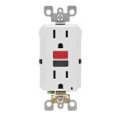
Now that that is clarified, i.e. the receptacle serves a counter top, get a GFCI duplex receptacle:

upload_2017-8-19_16-1-54.jpeg
 

MrChips

Joined Oct 2, 2009
34,809
Just in case I am not here to guide you along. Here are the first steps:

1. Turn off the power to that circuit at the service panel.
2. Remove the four screws holding down the receptacle cover plate. Remove the cover plate.
3. Remove the two screws securing the GFCI receptacle. Withdraw the GFCI receptacle outwards until you can access the terminal screws on the side of the receptacle.

You might see something like this:


Your installation may differ. If you are not certain of what you see, take photos on both sides of the GFCI and post them here.

On the lower screw terminals you should see a WHITE cable on the left hand side and a BLACK cable on the right hand side.
There will also be a bare copper wire which is the earth connection.

Here are the standard colors for AC mains in North America:

L = LINE = BLACK = brass screw terminal
N = NEUTRAL = WHITE = gray screw terminal
E = EARTH = COPPER = green screw terminal

Do not touch or disconnect any of the wires.


4. Test that the circuit is dead. If you are using a multimeter, set the range to highest ACV range, usually, 500-1000VAC. Otherwise use a neon AC line tester.

Do not allow your fingers to touch any of the metal wires or connections while testing.

Measure three ways:
L - E = 0VAC
N - E = 0VAC
L - N = 0VAC

5. Turn the circuit breaker ON at the service panel. Repeat the test measurements:

L - E = 120VAC
N - E = 0VAC
L - N = 120VAC

6. Turn the breaker OFF at the service panel and repeat STEP 4.

Do not proceed if your test results do not match the above.
 

MrChips

Joined Oct 2, 2009
34,809
How to replace the receptacle

If the bare copper ends of the WHITE and BLACK cables are wrapped under the screw heads then skip over this next step.


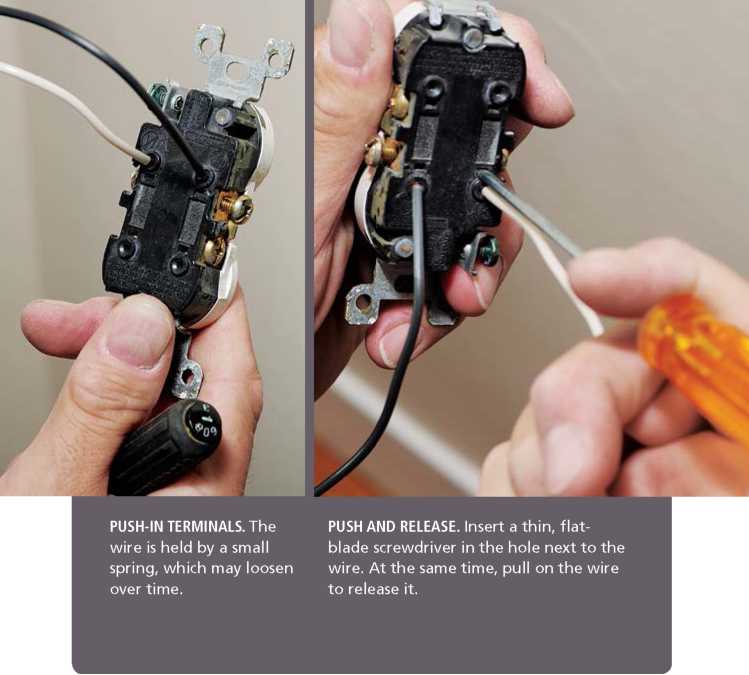
If the WHITE or BLACK cables are inserted into a hole on the back of the receptacle, you have to release the cables with the tiny screwdriver.


You push the blade of the tiny screw driver into the rectangular slot and pull the cable out of the hole.


Make a note of how the old receptacle was wired and install the new receptacle in same fashion.

Remember:

L = LINE = BLACK = brass screw
N = NEUTRAL = WHITE = gray screw
E = EARTH = COPPER = green screw

Install the receptacle with the two screws supplied.
Install the cover plate with the four screws.

Turn on the circuit breaker at the service panel.

Test the GFCI:
Press TEST. GFCI should click off. Press RESET.

Check that both outlets are working.

Go have a beer.
 

Thread Starter

Slayvoff

Joined Aug 19, 2017
9
I did it boys. New outlet in, lit up, and working great: http://imgur.com/a/eZ1g1

A couple of points to note: The power to the outlet was connecting using the two wires into the back of the device. The old outlet had a strip of electrical tape wrapped around the side, covering the screws on the respective sides. Is there any reason I would need to wrap the new one with electrical tape?

Also, when I first pressed the test/reset button and the reset button clicked in, it kind of made like a grinding sound for a split second. Did it a few more times and just clicked like normal. Very proud of myself of such a basic task lol
 
Top