DC/DC Buck Converter efficiency question

Thread Starter

russpatterson

Joined Feb 1, 2010
353
Thanks again for the info. I see what you mean about exceeding the Vgs in the simulation. I was reading the datasheet for that LT1910 highside MOSFET driver to try and figure out how you'd do the same thing in a real circuit.

GATE (Pin 5): The GATE pin drives the power MOSFET
gate. When the IN pin is greater than 2V, the GATE pin is
pumped approximately 12V above the supply
. It has relatively
high impedance (the equivalence of a few hundred
kO) when pumped above the rail. Care should be taken
to minimize any loading by parasitic resistance to ground
or supply. The GATE pin pulls LOW when the TIMER pin
falls below 2.9V.

So I guess the supply of the driver is powered off the node the MOSFET source is connected to?

I planned on using the PIC16F1827 which has 4 pwm peripherals. I have been using the PIC12F683 which only has one.

The Hall effect sensor sounds like the way to go. More expensive but no power losses. I can't seem to get my head around the fact that you move 20 amps through two leads on an 8-SOIC package.

I have separate wire runs for each panel. So I have a total of 6, 10 guage wires run down from the roof.

My original question was on efficiency based on voltage change in a buck converter. I have 30 volt, 7 amp panels but can trade them out for 20 volt, 7 amp panels. There's not much difference on the price since I got a deal on the 210 watt panels. The 20 watt panels are more commonly used to charge a 12 volt system. I think dollar wise I should stick with the 210's. Do you agree?


SgtWookie

Joined Jul 17, 2007
22,230
So I guess the supply of the driver is powered off the node the MOSFET source is connected to?
Ahh, in this case, with the LTC4440, I'll be powering it from the solar panel(s). It's certainly possible to power it from the batteries, or use diodes so that it can use power from either. However, there's not much point, because if the solar panel isn't generating power, you're not going to charge the batteries anyway.

I planned on using the PIC16F1827 which has 4 pwm peripherals. I have been using the PIC12F683 which only has one.
OK, that's fine. The newer PICs sure have lots of features on them.

The Hall effect sensor sounds like the way to go. More expensive but no power losses. I can't seem to get my head around the fact that you move 20 amps through two leads on an 8-SOIC package.
Incredible, isn't it? ;) Need to provide nice, fat traces though.
I have separate wire runs for each panel. So I have a total of 6, 10 gauge wires run down from the roof.
Well, you might wire the panels in series, if they're identical. That way you would carry 3x the power using just two wires (+ and return) and still have just 0.7v drop for 7A current, but 90VDC out. With that kind of conversion, might look at switching a 5:1 transformer to boost the current by 5x or so. That would be around 35A charging current, less losses. If it can be made 85% efficient or better, that would be ~30A.

My original question was on efficiency based on voltage change in a buck converter. I have 30 volt, 7 amp panels but can trade them out for 20 volt, 7 amp panels. There's not much difference on the price since I got a deal on the 210 watt panels. The 20 watt panels are more commonly used to charge a 12 volt system. I think dollar wise I should stick with the 210's. Do you agree?
If they can be wired in series to get 90v @ 7A, less the 0.7v drop in two wires, I think you're way ahead with the 30v panels.
 

Thread Starter

russpatterson

Joined Feb 1, 2010
353
The supply of the MOSFET driver is the power it uses to run the gate? I'm trying to figure out how much it boosts the gate drive voltage to. From the datasheet pin descriptions:

BOOST (Pin 6): High Side Bootstrapped Supply. An external
capacitor should be tied between this pin and TS
(Pin 4). Normally, a bootstrap diode is connected between
VCC (Pin 1) and this pin. Voltage swing at this pin is
from
VCC – VD to VIN + VCC – VD,
where VD is the forward voltage
drop of the bootstrap diode.

So what's VIN?

Parallel vs. series panels:
For this first high frequency converter I'd like to keep the input voltage low so that if I make a mistake I won't become an electrified statue in the backyard without muscle control. I see the efficiencies in the higher voltages but as I'm learning this I'd rather keep my mistakes to just burning up traces and parts. What is the magic number where the voltage potential will gladly use your body as an RC circuit?

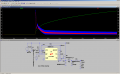
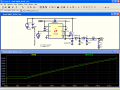
Also, when I ran the simulation with the LTC4440 I saw a ringing on the gate voltage before it went high and that seemed to make the output current oscillate too (picture attached)
 

Attachments

SgtWookie

Joined Jul 17, 2007
22,230
The supply of the MOSFET driver is the power it uses to run the gate? I'm trying to figure out how much it boosts the gate drive voltage to. From the datasheet pin descriptions:

BOOST (Pin 6): High Side Bootstrapped Supply. An external
capacitor should be tied between this pin and TS
(Pin 4). Normally, a bootstrap diode is connected between
VCC (Pin 1) and this pin. Voltage swing at this pin is
from
VCC – VD to VIN + VCC – VD,
where VD is the forward voltage
drop of the bootstrap diode.

So what's VIN?
That's the supply you've decided to use. It could be from a solar panel, or a battery, or a power supply, etc. It should be in a range of 8 to 18 volts.

In the schematic I posted, I'm using a simple resistor and Zener diode to create a 12v supply for Vcc; D3 is the diode that feeds the boost cap; C5 is the boost cap. The voltage on the BOOST input is pretty much tied to the charge on C5 + the source terminal voltage.

Parallel vs. series panels:
For this first high frequency converter I'd like to keep the input voltage low so that if I make a mistake I won't become an electrified statue in the backyard without muscle control. I see the efficiencies in the higher voltages but as I'm learning this I'd rather keep my mistakes to just burning up traces and parts. What is the magic number where the voltage potential will gladly use your body as an RC circuit?
Well, for n00bs, I like to keep the volts under 50. Don't get me wrong, you can still feel a tingle at 50v, but except for burns (due to parts getting hot, duing stupid stuff like wearing jewelry, rings, watches, etc) it's reasonably safe.

But, trying to run multiple solar panels in parallel to charge up batteries that are in a battery bank could get ridiculously complex. You'll also have to run 3x as much wire, duplicate the circuitry 3x over, and it will make control much more critical, as you could wind up having the multiple charge systems fight each other. Troubleshooting will get to be a headache. Reliability - well... if one breaks, you might still have the other two working, depending upon the failure mode.

Also, when I ran the simulation with the LTC4440 I saw a ringing on the gate voltage before it went high and that seemed to make the output current oscillate too (picture attached)
You tried to measure the gate voltage using ground as a reference.

You need to mark the source terminal as the reference.

To mark the reference:
1) With the schematic window active (click on the title bar), move the cursor over the wire that connects to the desired reference point; in this case a wire connected to the source terminal of the MOSFET.
2) When the cursor changes to a test probe, right-click.
3) Select "Mark reference" from the pop-up menu. You will see a black test probe appear, and it will stay put.
4) Move the cursor to the wire connected to the gate.
5) When the cursor changes to a test probe, left-click to plot the gate using the source for a reference point.

To clear the marked reference:
1) Right-click on a blank area in the schematic.
2) On the pop-up menu, select "Set probe reference"
3) Click on a wire that is connected to a ground symbol.

See the attached; I've added some node labels that are more meaningful than "N003", etc.

I suggest that at this point, we just get the thing working with one panel and one or two batteries, keeping in mind that eventually what you will want is to run three panels in series. 90VDC @ 7A maximum is not as hazardous as mains power. If you ever have doubts, you can always wait until sundown. :)

You can also install a great big knife switch to short the panel outputs together.
 

Attachments

Thread Starter

russpatterson

Joined Feb 1, 2010
353
That's the supply you've decided to use. It could be from a solar panel, or a battery, or a power supply, etc. It should be in a range of 8 to 18 volts.

In the schematic I posted, I'm using a simple resistor and Zener diode to create a 12v supply for Vcc; D3 is the diode that feeds the boost cap; C5 is the boost cap. The voltage on the BOOST input is pretty much tied to the charge on C5 + the source terminal voltage.
Isn't C5 going to charge up the voltage seen on panel, ~30V?

So Vcc is 12V based on the 1K resistor and the 12V Zener. But what's VIN?
I'm trying to understand how you tell the LTC4440 how much over the source voltage you want it to boost the gate voltage.


But, trying to run multiple solar panels in parallel to charge up batteries that are in a battery bank could get ridiculously complex. You'll also have to run 3x as much wire, duplicate the circuitry 3x over, and it will make control much more critical, as you could wind up having the multiple charge systems fight each other. Troubleshooting will get to be a headache. Reliability - well... if one breaks, you might still have the other two working, depending upon the failure mode.
I was just planning on hooking the two 12volt lead acid cells together and treating them as a single battery.

Thanks for the help on setting the voltage reference and marking up the schematic with the test points.

I suggest that at this point, we just get the thing working with one panel and one or two batteries, keeping in mind that eventually what you will want is to run three panels in series. 90VDC @ 7A maximum is not as hazardous as mains power. If you ever have doubts, you can always wait until sundown. :)

Agreed on the simple solution first. Isn't two panels in parallel just like one panel with more amperage?

I saw a demonstration at a school science night where the guy used a 9V battery and stepped it up (I thought to 60V) and most kids were not able to let go of the leads due to loss of nerve control over the muscles. That's what I'm concerned about with the higher voltages.

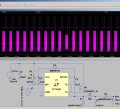
On the simulation (attached pic) I see some oscillations on the output current. Blue is current through the inductor and red is current through D2, (after the output cap). I assume that's to be expected and the battery will be ok with that?
 

Attachments

SgtWookie

Joined Jul 17, 2007
22,230
Isn't C5 going to charge up the voltage seen on panel, ~30V?
No, because Vcc is limited by the Zener's breakdown voltage. The rest of the voltage is dropped across the 1k resistor. (30v-12v)/1k = 18/1000 = 18mA current through R3; power dissipation is 18v * 18mA = 324mW; a 1/2W resistor would be a bit skimpy, a 1W resistor would work OK. It would be more efficient to power it from the battery side. Alternatively, a Zener could be selected that had a lower Izt.

So Vcc is 12V based on the 1K resistor and the 12V Zener. But what's VIN?
You could re-label node Vcc as VIN; because that's what it is.

I'm trying to understand how you tell the LTC4440 how much over the source voltage you want it to boost the gate voltage.
C5 is the boost cap, which gets charged via D3. The voltage across C5 will be VIN (aka Vcc) less the Vf of D3. Since D3 is a Schottky diode, it's Vf is pretty low, so C5 will charge to perhaps 11.5v or so. The act of turning the gate on and off will drain some of the charge from C5, but when the MOSFET turns on, C5 gets recharged.

I was just planning on hooking the two 12volt lead acid cells together and treating them as a single battery.
You can do that, as long as their initial voltages are very close to the same.
If one is fully charged and the other is nearly discharged, very high current flow will result; you risk melting the terminals or the interconnecting wiring, and/or explosion/fire.

Thanks for the help on setting the voltage reference and marking up the schematic with the test points.
Ahh, voltage reference? Do you mean the Zener? No problem. It could be simplified by using a 78L12 regulator; just one part. A 78L12 is a fixed 12v regulator, and is available in a TO-92 package. It doesn't require a minimum current draw, as it sinks ~5mA through it's ground terminal at all times. It has ~1.7v dropout from IN to OUT, so you'd need ~13.7v in to get guaranteed regulation for the output. Since the boost circuit will only draw a few mA current, power dissipation in the regulator will be fairly small.

Agreed on the simple solution first. Isn't two panels in parallel just like one panel with more amperage?
Basically, yes. However, if you run two panels in parallel, you double the current in your wiring, so you will drop ~1.4v at 14A instead of ~0.7v @ 7A, and you will also incur more losses in the MOSFET switch and the inductor. That's why I was going in the direction of using a flyback configuration; ie: a broadband transformer instead of an inductor.

I saw a demonstration at a school science night where the guy used a 9V battery and stepped it up (I thought to 60V) and most kids were not able to let go of the leads due to loss of nerve control over the muscles. That's what I'm concerned about with the higher voltages.
Of course. Still, increasing the voltage while keeping the current the same is the most efficient way to get power from the panels to the vicinity of the batteries. Like I said before, you can always use a switch to either open the circuit from the panels to the converter, and/or short the panel wires together.

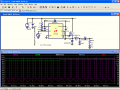
On the simulation (attached pic) I see some oscillations on the output current. Blue is current through the inductor and red is current through D2, (after the output cap). I assume that's to be expected and the battery will be ok with that?
I've slowed down the input switching speed by an order of magnitude so that the simulation runs faster. You can change V1's parameters back to 2.0uS and 6.6uS to see the difference.

As an alternative, an output filter could be added; say a 3.9uH inductor and another 1,000uF cap to ground before D2.

See the attached; I'm also changing Vcc to be powered from the battery, and starting the battery voltage @10.4v (you'd never want the batteries to get that low, but I'm just showing you how it's done.)

Note that the voltage at S (the source terminal of the MOSFET) must be near zero on start-up, or the boost cap won't get charged, and the LTC4440 won't start switching the MOSFET gate! Try replacing D2 with a piece of wire, and see what doesn't happen. :)
 

Attachments

Thread Starter

russpatterson

Joined Feb 1, 2010
353
C5 is the boost cap, which gets charged via D3. The voltage across C5 will be VIN (aka Vcc) less the Vf of D3. Since D3 is a Schottky diode, it's Vf is pretty low, so C5 will charge to perhaps 11.5v or so. The act of turning the gate on and off will drain some of the charge from C5, but when the MOSFET turns on, C5 gets recharged.
So the charge in C5 determines what the level over the Source voltage LTC4440 will boost to. So in this case 11.5 is plenty to get the MOSFET turned on?

Basically, yes. However, if you run two panels in parallel, you double the current in your wiring, so you will drop ~1.4v at 14A instead of ~0.7v @ 7A, and you will also incur more losses in the MOSFET switch and the inductor. That's why I was going in the direction of using a flyback configuration; ie: a broadband transformer instead of an inductor.
I've already got the 10 guage wire (six strands) run from the roof to the battery location, but I understand what you're saying about stepping up the voltage for transmission. I'm going to focus on just one panel to start with.


I've slowed down the input switching speed by an order of magnitude so that the simulation runs faster. You can change V1's parameters back to 2.0uS and 6.6uS to see the difference.
So reducing the frequency was just to make the sim run quicker? You still like the 150Khz for the real thing?

As an alternative, an output filter could be added; say a 3.9uH inductor and another 1,000uF cap to ground before D2.
Is the output filter necesssary or a nice to have? Wouldn't the capacitance of the battery smooth all that out for you?

See the attached; I'm also changing Vcc to be powered from the battery, and starting the battery voltage @10.4v (you'd never want the batteries to get that low, but I'm just showing you how it's done.)
The ".ic v(Batt)=10.4" says start this out at 10.4V where do I find all the definitions of those .ic, .tran type commands? Handy.

Note that the voltage at S (the source terminal of the MOSFET) must be near zero on start-up, or the boost cap won't get charged, and the LTC4440 won't start switching the MOSFET gate!
So will that C5 cap drain off to 0 when the circuit's powered off? There could still be a charge left on C1 and C2 right? I don't understand why C5 won't charge if Source is not near 0.

Try replacing D2 with a piece of wire, and see what doesn't happen. :)
Why is that?

I'm interested to learn how to use LTSpice to predict efficiencies.

Thanks for all your help on this!
 

SgtWookie

Joined Jul 17, 2007
22,230
So the charge in C5 determines what the level over the Source voltage LTC4440 will boost to. So in this case 11.5 is plenty to get the MOSFET turned on?
Here's a novel idea - look at the datasheet for the MOSFET, and decide on where the datasheet says that the MOSFET s ON. I can't keep spoon-feedign you this stuff.


I've already got the 10 guage wire (six strands) run from the roof to the battery location, but I understand what you're saying about stepping up the voltage for transmission. I'm going to focus on just one panel to start with.
That's OK.
So reducing the frequency was just to make the sim run quicker? You still like the 150Khz for the real thing?
It will depend on the IC used.

Is the output filter necesssary or a nice to have? Wouldn't the capacitance of the battery smooth all that out for you?
Batteries don't absorb variences in voltage instantaneously.
[eta]Charging a lead-acid battery is a chemical process. It takes time for that process to take place.

The ".ic v(Batt)=10.4" says start this out at 10.4V where do I find all the definitions of those .ic, .tran type commands? Handy.
Have you looked at the LTSpice Help?
1) Start LTSpice.
2) Press F1.

Spend time reading through it. Try some of the examples.

Speaking of examples, have you looked in that folder? Lots of good examples. I encourage you to look through them all.

So will that C5 cap drain off to 0 when the circuit's powered off? There could still be a charge left on C1 and C2 right? I don't understand why C5 won't charge if Source is not near 0.
When power is first applied, C1 and C2 provide the ground path for C5. If C1 and C2 are already charged to V(Batt), then the voltage across C5 will be zero.

There will need to be a discharge path for C1/C2 when the solar cell's voltage is high enough to start charging the batteries. It could be as simple as a transistor and a couple of resistors. For improved efficiency, the circuit could be re-worked to be a synchronous buck. A synchronous buck would replace D1 with another MOSFET, and the driver IC would change. The idea here is that D1 has a Vf when current is flowing through it; using a MOSFET as an "ideal diode" eliminates practically all of that power loss.

I'm interested to learn how to use LTSpice to predict efficiencies.
For that, you need exactly ONE voltage source (Vsolar, for example) and ONE current source that acts as the load. The current source is not on the schematic at this point. It would be in parallel or series with Batt.
 
Last edited:

Thread Starter

russpatterson

Joined Feb 1, 2010
353
So the charge in C5 determines what the level over the Source voltage LTC4440 will boost to. So in this case 11.5 is plenty to get the MOSFET turned on?
look at the datasheet for the MOSFET, and decide on where the datasheet says that the MOSFET s ON.
I guess I haven't phrased my question well in the past. My question is about how to operate the LTC4440. I'm still a bit confused by the description of the "Boost" pin. From the datasheet


BOOST (Pin 6):


High Side Bootstrapped Supply. An external

capacitor should be tied between this pin and TS
(Pin 8). Normally, a bootstrap diode is connected between

V
CC (Pin 3) and this pin. Voltage swing at this pin is from
V

CC – VD to VIN + VCC – VD, where VD is the forward voltage
drop of the bootstrap diode.


You could re-label node Vcc as VIN; because that's what it is.
Given Batt is 12V and Vf for the MBRS140 is 0.6V so voltage at at TG (gate pin) will go from TS (MOSFET source) to TS + 11.3V. Is that correct? If so then this equation from the datasheet still doesn't make sense: VIN + VCC – VD.

The N Channel MOSFET, FDS8962C, has a VGS(th) of 1.9V with a maximum of 3V. So the VGS seen in the simulation seems way too high.

I understand that the gate drivers are the way to go. I want to understand how they work.
 
Last edited:

SgtWookie

Joined Jul 17, 2007
22,230
I guess I haven't phrased my question well in the past. My question is about how to operate the LTC4440. I'm still a bit confused by the description of the "Boost" pin.
I had to cut out most of your text, because it was just too much work to edit out all of the font and color commands. I don't have that kind of time to spend on one reply.

The boost caps' low side is connected to the MOSFET's source terminal; so as the source terminal's voltage rises when the gate turns on, it gets added to the voltage on the boost cap. That's how the gate's voltage stays relatively constant even as the voltage on the source terminal varies.


Given Batt is 12V and Vf for the MBRS140 is 0.6V so voltage at at TG (gate pin) will go from TS (MOSFET source) to TS + 11.3V. Is that correct?
Yes.
If so then this equation from the datasheet still doesn't make sense: VIN + VCC – VD.[/COLOR][/FONT][/COLOR][/FONT]

The N Channel MOSFET, FDS8962C, has a VGS(th) of 1.9V with a maximum of 3V. So the VGS seen in the simulation seems way too high.
Look at the Id when the threshold voltage is reached. It's in microamperes.
Then look at the Rds(on) vs Vgs.

I understand that the gate drivers are the way to go. I want to understand how they work.
You have to understand how the boost cap and the diode work.

When the source terminal is at the same potential as ground, or lower than Vcc, the boost cap can charge via the diode.

When the MOSFET is turned on, Rds drops very low, so Id increases, and Vds becomes very low. This means that the source terminal voltage is nearly at the same voltage as the solar cell output voltage.

Since the boost caps' low side is connected to the source terminal, the source terminal's voltage is added to the boost cap's voltage.
 
Top