Dc circuit with slow start function

MrAl

Joined Jun 17, 2014
13,704
The part number will allways be on the top. The manufacturer has probably sanded it off to make reverse engineering more difficult. I have noticed that in post #10 you say that the voltage on the motor termonals does not ramp up as the motor speeds up. (If I understand your wording correctly.) I (And I suspect the others.) assume that that the motors are simple permament magnet brushed motors. Is this assumption correct ? Are there any other thin wires going to the motor units. The reason for this question is that the speed control could be done in the motor assemblies. (This is not very likely.) can you try connecting a normal 12 volt filament bulb (About 20 watts. Such as a car stop light bulb.) in place of one of the motors. Does this come on straight away at full brightness or does it take the 20 seconds or so to reach full brightness ? (This question is just in case your multimeter was reading the peak voltage of a PWM (Pulse width modulation. Google it if you do not understand PWM. ) signal. I have never seen a multimeter that would give false readings like this but it is the only way I can see why it would read 12 volts while the motor speed was ramping up. If you connect one of the motors directly to 12 volts does it reach full speed quickly ?

Les.
Hi,

Good idea about the light bulb. Put one right across the motor. That should allow 'seeing' the ramp speed.
 

Thread Starter

AdamSkachill

Joined Aug 8, 2018
13
The part number will allways be on the top. The manufacturer has probably sanded it off to make reverse engineering more difficult. I have noticed that in post #10 you say that the voltage on the motor termonals does not ramp up as the motor speeds up. (If I understand your wording correctly.) I (And I suspect the others.) assume that that the motors are simple permament magnet brushed motors. Is this assumption correct ? Are there any other thin wires going to the motor units. The reason for this question is that the speed control could be done in the motor assemblies. (This is not very likely.) can you try connecting a normal 12 volt filament bulb (About 20 watts. Such as a car stop light bulb.) in place of one of the motors. Does this come on straight away at full brightness or does it take the 20 seconds or so to reach full brightness ? (This question is just in case your multimeter was reading the peak voltage of a PWM (Pulse width modulation. Google it if you do not understand PWM. ) signal. I have never seen a multimeter that would give false readings like this but it is the only way I can see why it would read 12 volts while the motor speed was ramping up. If you connect one of the motors directly to 12 volts does it reach full speed quickly ?

Les.
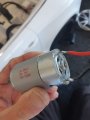
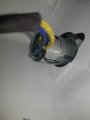
Hi Lee yes your assumption is correct motors are 12v DC brushed motors... Great idea about the bulb! I'm currently wiring this into the circuit now! The motors do have a little extra wire (see pic) but it doesn't make a difference if I use a different 12v motor...
 

Attachments

LesJones

Joined Jan 8, 2017
4,511
The steady 12 volt reading you got across the motors while the speed was ramping up is confusing but now we now know it is caused by your meter. This tends to confirm that PWM speed control is being used. I think you have gone as far as you can unless you are prepared to learn enough about electronics and programming to design your own controller for the car. I think this would take several years to achieve. One question you did not answer from post #6. Has the car had the problem from new or has it developed over time ?

Les.
 

Thread Starter

AdamSkachill

Joined Aug 8, 2018
13
Thanks again Les...
Yes had the problem from new and I have two cars that are exactly the same...

What if I did away with the parent control side of things and did... Battery>polarity switch>rocker switch(pedal)>motors... how hard would it be to create a slow start in this circuit? One that reached full rpm in say 3 seconds instead of 20 odd?
 

atferrari

Joined Jan 6, 2004
5,012
The steady 12 volt reading you got across the motors while the speed was ramping up is confusing but now we now know it is caused by your meter. This tends to confirm that PWM speed control is being used. I think you have gone as far as you can unless you are prepared to learn enough about electronics and programming to design your own controller for the car. I think this would take several years to achieve. One question you did not answer from post #6. Has the car had the problem from new or has it developed over time ?

Les.
A good reason or excuse to learn how to program a small micro taking care of few buttons and sensors while activating few lights and generating PWM signals.
 

crutschow

Joined Mar 14, 2008
38,507
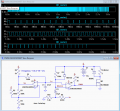
If you don't want to program, here's an example of an analog PWM ramp circuit that should do what you want:

The value of C2 determines the ramp time.

The value of C1 determines the PWM frequency, which is set to about 155Hz to speed up the simulation.
This may be too low for the motor so you may want to try a smaller value for C1 (perhaps 1-10nF).

What is the battery voltage?

upload_2018-8-12_10-49-15.png
 

Thread Starter

AdamSkachill

Joined Aug 8, 2018
13
Guess I'll have a read about programming :/
Crutschow is all 12v and I will have to learn a whole lot more before I can read even a basic diagram haha

We are lucky in Nz it's very easy to get almost any components for anything!

Appreciate all the input guys ;)
 

red8590

Joined Oct 28, 2013
2
The pink connector is like a ribbon cable that goes from one board to the other... I also think it's a current restriction rather than voltage if that makes sense as there is 12v at the motors as soon as the rocker switch on the pedal is pressed.

Thanks for all the input so far guys!!!
I have a very similar problem with my granddaughter's ride-on toy car. the delay start on this one is 8 seconds. Really is a problem. The difference is, on the one we have, there is zero volts at the motor when the power is switched on. When the gas pedal is depressed, the voltage starts at 1-volt and climbs to 10-volts is 1st gear. It climbs to 11-volts in 2nd gear and then to 12-volts in 3rd gear. Not sure how to eliminate the delay or if it can be. Any help would be appreciated.
 

red8590

Joined Oct 28, 2013
2
The pink connector is like a ribbon cable that goes from one board to the other... I also think it's a current restriction rather than voltage if that makes sense as there is 12v at the motors as soon as the rocker switch on the pedal is pressed.

Thanks for all the input so far guys!!!
The circuit board on my granddaughter's ride-on toy car is very similar to this one. I would also like to shorten or eliminate the delay. The main difference between this one and the one we have is, there is no voltage at the motors when the accelerator is depressed. It starts at zero and slowly builds to 12 volts over the next seven or eight seconds. It then goes maximum speed, depending on which gear it is in, 1st, 2nd, or 3rd. Hope this helps. thank you.
 
Top