Current Management

Thread Starter

DaleW

Joined Jul 25, 2025
16
i would put R6-R9 on the heatsink next to transistors. you are correct that this is a current sink (as is your circuit). since load is a spark, why would polarity matter?
You are mistaken by assuming the MOSFET's in the original post were part of or available for current management, they are not which is why they were subsequently removed to avoid confusion.

Control of the current must be on the high side .to work with the other circuits involved and freedom of implementation methodology is of little concern provided it works.

If you attempt to do current management on the low side then another circuit which monitors voltage would never be aware that high voltage is reduced during overcurrent or a short scenario so low side management isn't an option.
 

Thread Starter

DaleW

Joined Jul 25, 2025
16
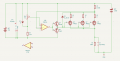
something like this...
you can of course size the components as you please, this is still just an example
View attachment 355918
Well, making some progress, 24V isn't available and adding it is another transformer and even if it was already available, it's a common ground system so re-inveting the wheel isn't appealing, the value of R is questionable as 1ohm would require 15W/ea (X3) and higher would require significant high power to prevent burning up and I'm not really sure if they are really required, maybe 0.1Ohms just for load sharing.

Replacing NPN/PNP with four IR4426S (inverted input mosfet driver IC) would allow driving 8 PMOS and keep LV/HV isolated since it's a common ground system and the drivers accept a Vs of 200V with 30uA of drive current.

Since we can get a voltage sample from the low side Rsense and we know it's value to be 0.045V@15A why can't we use it?

I'm guessing the first stage has a gain of 36:1 but I might be wrong on that.

The use of PMOS and gate drivers looks like a possible solution.

I need to figure out how to adjust the existing circuit and if it is 1.62V that would explain why I'm so far above it.

When I try to measure the voltage it appears my DMM has an effect on it so I'm guesing at the second stage requirement.


schem.png
 

panic mode

Joined Oct 10, 2011
4,979
Well, making some progress, 24V isn't available and adding it is another transformer and even if it was already available, it's a common ground system so re-inveting the wheel isn't appealing
why reinvent the wheel, use small PSU. it is only powering opamp and gate driver.

the value of R is questionable as 1ohm would require 15W/ea (X3) and higher would require significant high power to prevent burning up and I'm not really sure if they are really required, maybe 0.1Ohms just for load sharing.
value of R is to be determined to get load sharing. and it is not 3 channels - i only drew 3 to give you an idea, that was just an example. actual circuit may need 10 or 20 channels or whatever - it all depends on your PMOS selection.

do the math...
140V*15A = 2100W.
if your PMOS can handle 300W, you need at least 7 of them.
if your PMOS can handle 100W, you need at least 21 of them.

once you know how many of them you intend to use, you can tell current each will need to handle. and depending on transfer characteristics tolerances you can determine load sharing resistor so that circuit is balanced. you do not wan one PMOS to handle 80W and another to handle 120W because it will fail..

Since we can get a voltage sample from the low side Rsense and we know it's value to be 0.045V@15A why can't we use it?
you can... but why complicate? you wanted an idea for constant current source and you got one - everything is on high side.
the challenge is to convert the 0-45mV on low side to 0-45mV on high side. we are talking about mV signals in a place with high power circuits where 140V can fluctuate way more than those 45mV. so why not keep it simple? shunts are cheap.

I'm guessing the first stage has a gain of 36:1 but I might be wrong on that.
Now you are shifting to your modified schematics. U1A gain is 36:1 as determined by R67 and R63.


I need to figure out how to adjust the existing circuit and if it is 1.62V that would explain why I'm so far above it.
you really need to be specific. 1.62V ... where exactly? GND of U1A? or output of U1A? assuming you need it at output of U1A since 0.045V*36=1.62V. the problem i see is that you are trying to use LM358 there. i use same OpAmp all the time but i would never dream of using it in that circuit. it does not have rail-to-rail inputs or outputs and that alone completely disqualifies it for amplifying 0-45mV signal that is so practically at the GND level. you should at least use dual supply (U1 pin4 connected to some negative voltage, such as -5V). that way inputs are not going to be near rail voltages. next your input is 0-45mV which is tiny, while input offset of LM358 is significant... you may want to substitute that IC with something else. there are plenty of alternatives with compatible pinout.

When I try to measure the voltage it appears my DMM has an effect on it so I'm guesing at the second stage requirement.
no idea what that means... measure WHERE... using what kind of DMM?
 

panic mode

Joined Oct 10, 2011
4,979
also if U1A is supposed to scale 0-45mV to 0-1.62V, don't you want P1 to work in same range? why is P1 range 0.57-3.43V? that would correspond to current range 5.3-32A,and you need 1-15A
 

Thread Starter

DaleW

Joined Jul 25, 2025
16
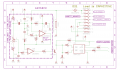
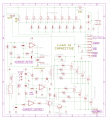
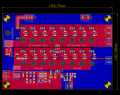
I believe I have figured it out, someone suggested a gate driver isn't necessary and that a zenor, a couple of resistors and a couple of transistors is all that is needed so I came up with the following.

MAX6100 is a 1.8V reference and my current adjustment range is 1-15A.

Thoughts, suggestion, recommendations?
schematic.png
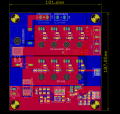
board.png
 

Thread Starter

DaleW

Joined Jul 25, 2025
16
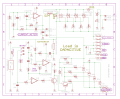
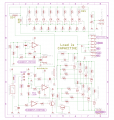
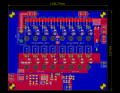
Sets of 4 mosfets isn't enough, too much heat so increased to sets of 8, all 3 op amps have been changed to TLV915x, RRIO 16V.

Any suggestions/recommendations for improvements???

schematic.png
board.png
 

Thread Starter

DaleW

Joined Jul 25, 2025
16
While I don't mind PM's, related responses should be public to help those reading/following understand what/why changes are made.

It was advised I add load distribution/sharing resistors so I added them to both sets of MOSFETs.

Are there any other additional, recommended changes or ideas that should be implemented?

schematic.png
board.png
 
Top