Current Management

Thread Starter

DaleW

Joined Jul 25, 2025
16
BACKGROUND:
In 1995 my original current management was a handful of 25Ohm/100W heatsink resistors and while this did work, when reduced current was required with my resistor network, I had to increase the HV supply voltage from 100VDC to 170VDC due to the voltage loss and space to house eight of those 100W heatsink resistor was difficult and definitely not how to do it in a modern era.

I've done a lot of work in the analog field and a little RF work where things are fairly simple.

I'm new to the OP Amp field and appear to be in way over my head as I just can't seem to figure it out what I need to do.

I basically figured out how to use a single op amp to provide 0-2.5VDC output for a meter to represent current in the 0-17A range (or any max current up to 62.5A

The LM358MX OP Amp circuit was provided to me as is and I was told that minimal changes if any are required to adapt it to my needs.

I have assembled a breadboard of the attached schematic, the output is used to invert the trigger of a 50A DC SSR. which is capable of high speed operation.

Issues I am experiencing, current setting is not stable as the +12V VCC is a linear PS and fluctuates slightly as other circuits and motors destabilize it drawing current and I can't get it to adjust in the required range.

Someone suggested adding a 2.5v VREF to where R68 is would reduce the max current, I removed R68 from the breadboard and replaced it with, VREF component and verified I had 2.5V at the junction but it still doesn't seem to work as the current is still above 30A at its lowest setting.

I'm not tied to this circuit or the SSR as the control mechanism, my only requirements are that current control is done on the high side and available VCC is +12V.

Any help would be greatly appreciated.
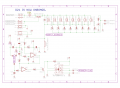

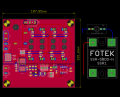
current_circuit.png
current_board.png
 

WBahn

Joined Mar 31, 2012
32,823
Let's start with the problem you are actually trying to solve, and completely ignore for the moment how you might go about achieving that solution.

If you were to go to Black Box Engineering and Associates and say, "I need a black box that does the following list of things and has the following behaviors." What would that look like for something that is minimally acceptable for your needs?

What are the inputs? What are the outputs? What are the required relationships between the inputs and the output? What are the constraints on the power for it? What is the needed accuracy and resolution?

That gives us a starting point for discussion.
 

Thread Starter

DaleW

Joined Jul 25, 2025
16
WOW, nice questions.

My black box parameters.

VCC is +12VDC
GND is 0VDC
HV SOURCE is 0VDC / +140VDC
GATE_TRIGGER is a pulsed input signal that turns on and off the GND for the HV SOURCE
HV_SSR is an output used to turn off/on (on is default condition) the HV SOURCE high side
CUR_ADJ is the 5K potentiometer that sets the current limit threshold from 1-17A.

Control of current by turning off HV SOURCE high side is required as another circuit is monitoring the HV SOURCE high side where it controls a motors operating state (FWD/REV).

Basically this is my requirement, the shunt (0.003ohm) is already available so I basically need a circuit that will disable the HV SOURCE high side until the current drops below the set threshold.

I considered using the low side MOSFET's and cutting off the GATE signal since they are on the board but since the HV SOURCE high side voltage would never drop and the motor would never reverse forcing a short circuits and halting the process.

Some have suggested a high side PWM circuit but I couldn't find any suitable reference design material to test and they don't appear to be a simple circuit so I opted for the SSR solution.

I considered using additional P-channel MOSFET's and a high side gate driver to respond quickly but the SSR appears to be a suitable option and conforms to KISS.

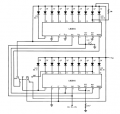
In 2017 I came across a low side current shunt circuit that allowed me to measure/display the current with minimal components and then in 2019 a 20 bar LED (LM3914 based) meter from it's application note that I adopted with small modifications (hard-wired for bar mode) and these have been extremely reliable and dependable (attached).

SEE: My Current Calculator.Current-sensor-circuit-with-external-amplifier.png
Meter.png


Sadly, all of my schematics and boards are in EAGLE format (I'm prehistoric) and I wouldn't object to sharing them with you if needed.

This is a hobby for me, improving my pet project over the years has its own rewards, some things I latch onto like a duck to water, others leave me mystified (OP Amps is one).


BTW: Yes, as a programmer I know BINARY, HEX, OCTAL, DECIMAL and a couple of others I've forgotten.
 
Last edited:

AnalogKid

Joined Aug 1, 2013
12,128
On the schematic, it is not at all clear how the 5K pot is connected. Please update the schematic with a standard potentiometer symbol. Note that on a pot, pin 3 is at the end of clockwise rotation.

What is the overall project? What is this device used for? Is the intent for the FETs to replace the 25 ohm resistors in your text?

ak
 

panic mode

Joined Oct 10, 2011
4,978
what are you trying to do? where is the rest of the circuit? what is the load? why os bridge rectifier used as a diode? what is "fast enough"? SSRs are much slower than mosfets.
 

Thread Starter

DaleW

Joined Jul 25, 2025
16
Look up the definition of black box and then answer @WBahn’s question again.
I googled it, it came back with too many different concepts, my assumption of the reference was a box I could buy that did what I needed which is what I gave.
 

Thread Starter

DaleW

Joined Jul 25, 2025
16
On the schematic, it is not at all clear how the 5K pot is connected. Please update the schematic with a standard potentiometer symbol. Note that on a pot, pin 3 is at the end of clockwise rotation.

What is the overall project? What is this device used for? Is the intent for the FETs to replace the 25 ohm resistors in your text?

ak
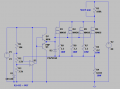
schematic.png
 

Sensacell

Joined Jun 19, 2012
3,784
Reading this I still have no idea what you are trying to do?
Please provide some big-picture context, have empathy for a person trying to help.

It's all obvious in your mind, but we do not have access to your vision.
 

Thread Starter

DaleW

Joined Jul 25, 2025
16
On the schematic, it is not at all clear how the 5K pot is connected. Please update the schematic with a standard potentiometer symbol. Note that on a pot, pin 3 is at the end of clockwise rotation.

What is the overall project? What is this device used for? Is the intent for the FETs to replace the 25 ohm resistors in your text?

ak
It's a combination of many projects, managing the current is a separate project however, if you really need me to provide the full schematic even though most of which are unrelated to managing the current and posting the entire schematic publicly is a concern.

The FET's shown in the schematic are not replaced by the SSR, in fact for all intensive purposes they can be entirely removed as they are not part of the current regulation.

The circuit needs to be able to maintain the set current, if a short occurs a voltage drop below 50 percept is detected and the sensing current can reverse the motor and raise the head (multifaucetted electrode).

The device is an EDM surfacing machine and,having four to seven different HV voltage power supplies is not cost effective so the reduced schematic is the one that needs to be used to manage the current on ELECTRODE+ (high side) only.

The purpose of D21 is to prevent reverse connection of the HV SOURCE only.

Here it is marked "INSERT CONTROL HERE" is where I would place the SSR +/- which is controlled by SSR_TRIGGER+/SSR_TRIGGER-.

Managing the current by the SSR was an idea given to me because I was told it responds in microseconds which is more than suitable for the need but as I said before, I am not married to it, it can be MOSFET's and PWM if you say it's better but whichever way it is done, it needs to be simple and stable.

This is a hobby for me, improving the design has taken me many many (40) years, current management has always been an issue and a handful of aluminum heatsink power resistors occupies a lot of real estate and generates a lot of heat at 15A and voltage stability issues I wish to avoid.

Typically the HV SOURCE is 100VDC (98VDC in a perfect world), yes I know the schematic shows 140VDC, it was one of the schematics I used as it is the same regardless of 98,112,126,140,154,168 VDC (70VAC-120VAC to DC).

A voltage drop of up to 20% is acceptable during operation as this can be compensated for in BURN control, with the resistors this seems to be an issue and compensated by increasing the HV SOURCE to 170VDC.

schematic.png
 

Thread Starter

DaleW

Joined Jul 25, 2025
16
Reading this I still have no idea what you are trying to do?
Please provide some big-picture context, have empathy for a person trying to help.

It's all obvious in your mind, but we do not have access to your vision.
I need to control HV SOURCE current 1-15A and disable the high side voltage source if the current exceeds the set value, if it shorts out. the ELECTRODE+ voltage drops below 70% and this is handled by another circuit that monitors the HV SOURCE voltage that reverses a motor to clear the short and is not a concern of current management, maintaining the current at a set value is the goal.

The current shunt is already available and the included current sensing circuit was provided to me which originally had a 0.003333 (3 x 0.01 Ohm in parallel) shunt which has been substituted for a single 0.003 Ohm shunt.

I don't understand how this op amp circuit works or what needs to be changed to get what I need from it, my options are, ask for help from those more knowledgeable or continue using the resistors and multiple supplies to manage current.
 

Thread Starter

DaleW

Joined Jul 25, 2025
16
what are you trying to do? where is the rest of the circuit? what is the load? why os bridge rectifier used as a diode? what is "fast enough"? SSRs are much slower than mosfets.
The high current bridge is for reverse polarity connection, the fet's are not there to replace the SSR, since they have nothing to do with current management they have been removed from the schematic.

The OP amp circuit was provided to me as a circuit to limit current, I'm not sure how it works or how to adjust it to give me the range I require as this type of circuit is all new to me, i tried to bread board it, I either have full current or no voltage depending on the position of the potentiometer.

The load is a spark.

I could reduce this to the basic HV SOURCE and the shunt resistor and ask for a complete circuit that would limit current on the HV SOURCE high side if the provided circuit is inappropriate or causing confusion.

The HV SOURCE used with this original circuit was 98V at 10-60A (70A continuous was available), my range is lower, 1-15A (17A continuous is available).

I have no issues replacing the high current SSR with eight P or N channel MOSFETS (to share the load as they are cheap) and associated circuit.
 

Thread Starter

DaleW

Joined Jul 25, 2025
16
If you feel I am not answering your questions correctly, it may be that my interpretation of your question is based on my knowledge of electronics which I would have to say is rudimentary compared to someone who works in the field or does it on a regular basis as a hobby and not someone who has a hobby where 10% of the hobby is based on electronics which might amount to 10 hours over the entire year..

I've just gotten to the point where I can understand a single op amp circuit used as a voltage amplifier and how to manipulate the circuit to fit a specific voltage need, this dual op amp circuit if confusing because the first part of it looks to be acting as a voltage amplifier while the second part appears to be acting like a switch but figuring out how to adjust it to suit my needs is beyond my comprehension and why i need help.
 

panic mode

Joined Oct 10, 2011
4,978
if i understand correctly you want circuit that will act as a constant current source where current value can be adjusted in range 1-15A. is that correct?
 

panic mode

Joined Oct 10, 2011
4,978
i would probably think about something like this (just an idea, but with more mosfets and load sharing resistors). the mosfets would of course require massive cooling.

Pd=HV * 15A

if HV=80V then Pd is 1200W. if your chosen mosfets are able to handle 120W, you would need at least 10 of them.
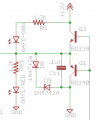
using resistors in source circuit would make better load sharing (negative feedback). Q1 and Q2 are low impedance driver since OpAmp alone is not the best way to drive bunch of transistors. zener is there to project the gates. D1 is there to limit setpoint voltage to about 0.6V.

1757940838760.png
 

Thread Starter

DaleW

Joined Jul 25, 2025
16
i would probably think about something like this (just an idea, but with more mosfets and load sharing resistors). the mosfets would of course require massive cooling.

Pd=HV * 15A

if HV=80V then Pd is 1200W. if your chosen mosfets are able to handle 120W, you would need at least 10 of them.
using resistors in source circuit would make better load sharing (negative feedback). Q1 and Q2 are low impedance driver since OpAmp alone is not the best way to drive bunch of transistors. zener is there to project the gates. D1 is there to limit setpoint voltage to about 0.6V.

View attachment 355895
Unfortunately you are managing current on the low side and this is not an option in my case.

Q1/Q2 could be BD140/BD139 (a suitable complimentary pair with plenty of drive) .
GATE_DRIVE.png

R4 looks like it's the current shunt and it's value is 0.003 ohms and can't change which means the voltage here is 0.051 max.

R6-R9 would need to be more than 10W to prevent the heat from scorching the PCB.

V1 is 12V and V2 wouldn't be 80VDC or anything less than 100VDC and most likely will be 112VDC and the MOSFETs or possibly IGBT's would be >250W if this proposed low side method could be acceptable which in my case it can't.
 

panic mode

Joined Oct 10, 2011
4,978
i would put R6-R9 on the heatsink next to transistors. you are correct that this is a current sink (as is your circuit). since load is a spark, why would polarity matter?
 

Thread Starter

DaleW

Joined Jul 25, 2025
16
i would put R6-R9 on the heatsink next to transistors. you are correct that this is a current sink (as is your circuit). since load is a spark, why would polarity matter?
As I said, it is a good attempt if low side current management were acceptable but is not suitable for my application.

There are many other circuits involved and current management must occur on the high side, it's non-negotiable, the only low side constant is the shunt for sampling but of course adding a shunt on the high side if needed is an option.

Also, I'm not sure if the capacitive load would require any special parametrics.

Surely there has to be a way to manage current on the high side?
 
Top