Current limiting resistor for motor circuit.

Status
Not open for further replies.

Thread Starter

ctrmint

Joined Dec 29, 2012
4
Hi,
I'm attempting to put a circuit together to drive a motor from a 12v supply but limit the current to approx 2A with a resistor. However I'm not sure of the resistance of the motor and thus unsure which resistor to use.

I'm thinking a 6 ohm 50W resistor would be about right.
Any ideas.

Sorry I don't have much info on the motor as its a sealed automotive part.

Thanks for the help
 

Audioguru

Joined Dec 20, 2007
11,248
An elecric motor that runs at 2A probably needs 20A to start and when it is stalled.
If you limit its current then it is useless.

If you need to limit the current (and limit the torque) then use a smaller motor or reduce the supply voltage.
 

Thread Starter

ctrmint

Joined Dec 29, 2012
4
i'm told the motor runs at 2A peak, its actually the drive on a specialist hydraulic pump and I very much doubt its pulling 20A.
It used to control clutch packs in a differential rather than propel.
 

Audioguru

Joined Dec 20, 2007
11,248
If the peak current of the motor is 2A then it runs at maybe 200mA.
Or maybe it is only used for a moment when it is at its peak current?

Why do you want to limit its current? An electric motor uses only as much current that it needs.
 

Thread Starter

ctrmint

Joined Dec 29, 2012
4
i was trying to prevent it from pulling too much current and damaging it, as sort of safety measure.
The component is approx 2k GBP, not the sort of thing to break.
 

Thread Starter

ctrmint

Joined Dec 29, 2012
4
i see your point about the fuse approach it does make sense.
But is there a way I can limit the current, i'm just wanting to be in full control of how it will run. Also not really keen on replacing fuses every 5 minutes if the current goes slightly over 2A.
 

bertus

Joined Apr 5, 2008
23,034
Hello,

How fast the fuse blows is depended on the type of fuse:

Speed

The speed at which a fuse blows depends on how much current flows through it and the material of which the fuse is made. The operating time is not a fixed interval, but decreases as the current increases. Fuses have different characteristics of operating time compared to current, characterized as fast-blow, slow-blow, or time-delay, according to time required to respond to an overcurrent condition. A standard fuse may require twice its rated current to open in one second, a fast-blow fuse may require twice its rated current to blow in 0.1 seconds, and a slow-blow fuse may require twice its rated current for tens of seconds to blow.
Fuse selection depends on the load's characteristics. Semiconductor devices may use a fast or ultrafast fuse as semiconductor devices heat rapidly when excess current flows. The fastest blowing fuses are designed for the most sensitive electrical equipment, where even a short exposure to an overload current could be very damaging. Normal fast-blow fuses are the most general purpose fuses. The time delay fuse (also known as anti-surge, or slow-blow) are designed to allow a current which is above the rated value of the fuse to flow for a short period of time without the fuse blowing. These types of fuse are used on equipment such as motors, which can draw larger than normal currents for up to several seconds while coming up to speed.

This is from the wiki page on fuses:
http://en.wikipedia.org/wiki/Fuse_(electrical)


Bertus
 

Ron H

Joined Apr 14, 2005
7,063
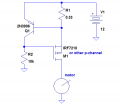
Here is a 2 Amp limiter that puts only 0.33Ω in series with the motor when the current is below 2 Amps.

You can make the series resistance even lower if you replace the PNP with an op amp (not just any op amp, though).
 

Attachments

Audioguru

Joined Dec 20, 2007
11,248
I don't think a motor should have its current limited. When it starts it uses a LOT of current for a moment. If you limit the current then the motor might just sit there without starting and continuously drawing the limited amount of current until it burns out.

Maybe you should have a circuit that detects when the motor is stalled (drawing a very high current and getting extremely hot) then the circuit disconnects the power.
 

Ron H

Joined Apr 14, 2005
7,063
I don't think a motor should have its current limited. When it starts it uses a LOT of current for a moment. If you limit the current then the motor might just sit there without starting and continuously drawing the limited amount of current until it burns out.

Maybe you should have a circuit that detects when the motor is stalled (drawing a very high current and getting extremely hot) then the circuit disconnects the power.
I feel the same way. I just think the OP might have to see it to believe it.
 

Audioguru

Joined Dec 20, 2007
11,248
Which smokes the most, the current limiter or the motor?
Both smoke the same amount?

My electric RC model airplanes have a circuit that disconnects the motor when it gets stalled. One airplane's brushless motor makes music when it is turned on and it SHRIEKS and disconnects when it is stalled.
 
Last edited:

Ron H

Joined Apr 14, 2005
7,063
Which smokes the most, the current limiter or the motor?
Both smoke the same amount?

My electric RC model airplanes have a circuit that disconnects the motor when it gets stalled. One airplane's brushless motor makes music when it is turned on and it SHRIEKS and disconnects when it is stalled.
Yeah, you would need a BF heat sink for the MOSFET if the motor shorted out, or maybe even stalled.:eek:
 

Jaguarjoe

Joined Apr 7, 2010
767
Measure the resistance of the armature when the motor is stationary. This, along with I=E/R will be its peak current. I never had much luck fusing 12v DC motors, some fan motors start at 130+ amps and settle down at 10 or so. A circuit breaker is a better choice.
 

RodneyB

Joined Apr 28, 2012
698
Here is a 2 Amp limiter that puts only 0.33Ω in series with the motor when the current is below 2 Amps.

You can make the series resistance even lower if you replace the PNP with an op amp (not just any op amp, though).
The 0.33R resistor what is the wattage
 

MrSoftware

Joined Oct 29, 2013
2,280
Which smokes the most, the current limiter or the motor?
Both smoke the same amount?

My electric RC model airplanes have a circuit that disconnects the motor when it gets stalled. One airplane's brushless motor makes music when it is turned on and it SHRIEKS and disconnects when it is stalled.
The brushless motor is most likely a 3-phase AC motor. The controller feeds it high frequency power to make the "music". I believe the logic in the controller probably stops the output when the motor is stalled.

For the other motors you might be referring to an auto-resetting fuse.
 
Status
Not open for further replies.
Top