Current control using 0-10V signal

Thread Starter

Sam1984

Joined Feb 2, 2015
3
I am looking at using a peltier for temperature control to run some experiments on LEDs. I have a PID temp controller that outputs 0-10V control signal which can be swapped dependant on heating or cooling. I also have a 15.7V 6A 59.4W peltier module and a 12V power supply.

I want to be able to control the current of the peltier device using the 0-10V signal from the controller. I am only interested in cooling from the peltier as i can apply separate heat and let the peltier continue to control it.

I understand electrical theory but lack knowledge in the electronic area, so can someone kindly talk me through the best way to approach this?
 

MikeML

Joined Oct 2, 2009
5,444
A 12V source cannot get 15.75V into the Peltier unless you use a SMPS?

If you are happy with 12V max, then a linear amp made from an opamp and NFET on a huge heatsink would work, but the heat sink requirements are formidable.

Running a Pulse Width Modulator to regulate the current through the Peltier would be the next option. Do you know for a fact that the Peltier will accept PWM? If so, what rate?
 

MrChips

Joined Oct 2, 2009
34,807
If you have a 0-10V signal you can try driving an NPN power transistor such as a 2N3055 on a big heat sink in an emitter follower configuration.

Collector is connected to +12V.
Peltier is connected between emitter and GND.

How much current can the controller supply? You may have to use an extra transistor or darlington to if there is not enough base current.
 

MikeML

Joined Oct 2, 2009
5,444
If you have a 0-10V signal you can try driving an NPN power transistor such as a 2N3055 on a big heat sink in an emitter follower configuration.

Collector is connected to +12V.
Peltier is connected between emitter and GND.

How much current can the controller supply? You may have to use an extra transistor or darlington to if there is not enough base current.
And with a Darlington emitter follower, with 10V max input, the max voltage to the Peltier will be only ~8.2V (hardly enough)
 

Thread Starter

Sam1984

Joined Feb 2, 2015
3
I am not to worries about the efficiencies of the peltier with only 12v, it should have plenty of power for an LED.

The current from the controller is not much but will have to look it up when I collect it in a few days.

Someone mention just hooking the 0-10v straight into a mosfet but it seems like it wont have much control.

Will look into it all more tonight, thanks.
 

MikeML

Joined Oct 2, 2009
5,444
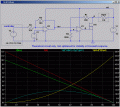
Here is an approach. The LTSpice sim has not been tested for stability or transient response, but shows what would be required to make a high-current 0 to 12V driver with a 0 to 10V input. It requires two stages. The first is just a simple inverter U2, offset to 5V. V3 is just a 5V reference, which could be a voltage divider off the 12v supply, if it is stable enough.

The second stage is the high-current driver(U1 and the NFET) , but it is inverting, so that is why the U2 stage is needed. Since U1 has M1 inside its feedback loop, this circuit is potentially unstable, but can be stabilized with an added RC network.

Follow the plots, which are all plotted vs the 0 to 10V control signal. V(inv) green is just the inverted control signal. V(d) red is the drain voltage on M1, so the voltage across the Peltier is 12-V(d). The yellow trace is the power into the Peltier. The blue trace is the power dissipation in M1. Note that it peaks at 14W, so that determines its heatsinking requirements.


140.gif
 

wayneh

Joined Sep 9, 2010
18,104
I approached this differently. (See my Completed Project calorimeter). I used simple thermostatic control of a TEC, simple on/off like your furnace. With care this can achieve control down to ±0.1° or so. I see no need to play with current control or PWM. Just flick it on and off. I chose to run my TEC at 5V (old computer PSU), where it draws about 4A and this is well below its rated 12V, 10A maximums. A TEC is more efficient at less-than-max current. Even at this low level, I believe my limiting factor is taking the heat away with an old CPU heatsink and fan.
 

MikeML

Joined Oct 2, 2009
5,444
Those opamps's common-mode input range must include 0V, when their Vss pin is at 0V. They must be capable of driving their output to within mV of their Vss pin voltage. Either modern CMOS rail-to-rail input/output opamps can be used, or even the lowly LM358 would work.
 
Top