Facebook
 Google
 GitHub
 Linkedin

Hi guys  ,,,
,,,
I'm studying the Convolution from Signals & systems course, usually i have X(t): input signal and h(t): response to find y(t)utput signal of a system
as y(t) = x(t)* h(t) = ∫x(τ) h(t-τ) dτ = ∫h(τ) x(t-τ) dτ
But How we can find h(t) if we have x(t) & y(t)??
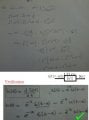
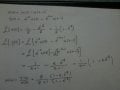
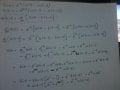
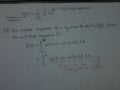
really i tried to find it but i have confused,, i attached photo with two examples A & B and assume that y(t) is an arbitrary function .
In example A ,, x(t) represents u(t):unit-step function so the Y(t) represents S(t)
==> H(t) = d/dt( S(t) ) = d/dt( exp(-t) ) = -exp(-t) Is it correct ??
In example B ,, x(t) represents the rect function u(t)-u(t-1) so the Y(t) represents S(t)-S(t-1)
==> H(t) = d/dt( S(t)-S(t-1) ) = ?? Is it correct ??
and Is there a General method to find H(t)??
,,,I'm studying the Convolution from Signals & systems course, usually i have X(t): input signal and h(t): response to find y(t)
utput signal of a systemas y(t) = x(t)* h(t) = ∫x(τ) h(t-τ) dτ = ∫h(τ) x(t-τ) dτ
But How we can find h(t) if we have x(t) & y(t)??
really i tried to find it but i have confused,, i attached photo with two examples A & B and assume that y(t) is an arbitrary function .
In example A ,, x(t) represents u(t):unit-step function so the Y(t) represents S(t)
==> H(t) = d/dt( S(t) ) = d/dt( exp(-t) ) = -exp(-t) Is it correct ??
In example B ,, x(t) represents the rect function u(t)-u(t-1) so the Y(t) represents S(t)-S(t-1)
==> H(t) = d/dt( S(t)-S(t-1) ) = ?? Is it correct ??
and Is there a General method to find H(t)??
Attachments
-
 78.5 KB Views: 41