Connecting multiple load cells in parallel ..#2

ericgibbs

Joined Jan 29, 2010
21,444
This could not be solved by trimming right ?
Hi Jim,
That is not the way to trim.
Did you read the Page #1 & 2 section in the PDF regarding trimming>
Once you have trimmed the LC's in that way, it will not matter where within the area of the load bearing plate you place the load.
The combined Vout of the 4 LC's will be an averaged value of the 4 LC's individual measured weights.
An important point to consider is that if for example the individual LC was specified as 10mVout at say 100kg its maximum load weight, the averaged Vout for a 100kg weight on the 4 LC scale would be 10mV/4 = 2.5mV.

Give me details of the LC types and the expected max load weight.
What are youe weighing?

BTW: when you say: object will drop
I would advise not to drop weights onto the baseplate that could over stress the LC's.

Also, it is advisable to carry out a Calibration weight test after construction, and adjust the Voffset and Span of the weighing scale

E
 

MisterBill2

Joined Jan 23, 2018
27,551
OK, now the situation is rather different! Dropping a mass onto a plate is totally different from applying a load to the plate.
At one job we did experiment with measuring the response of a motion sensing transducer onto an aluminum plate. The sensor was not a load cell, but a piezo-electric sensor with a frequency response well beyond the audible frequency range. It was effectively a contact microphone with response to over 35KHZ.
What we learned is that the impact produces a vibration whose amplitude varies many orders of magnitude across the surface of a non-damping material.
So it seems reasonable that the load cell responses to an impact will depend much more on the position relative to the impact than any other variable except the position on the plate. And also that the load cell amplifier frequency response will also have a very large effect.
 

LowQCab

Joined Nov 6, 2012
5,101
A further note ..........
If at all feasible,
the Plate should be a Triangle-Shape with a Sensor at each corner.

That means use only 3-Sensors.
The Plate can be some other shape, like square,
but try not to apply any force outside of the imaginary Triangle formed by the 3-Sensors.
The item to be measured may be placed in any position, even outside of the Triangle,
with zero change in the averaged-Output, until the limits of one of the Sensors is reached,
so this is not the ideal plan.

If a non-Triangular shape is used for the Table, the inevitable differences in static-Load
between each Sensor will still be automatically averaged-out,
but possibly at the expense of reaching the low or high limits of the Sensors.

If 4-Sensors are used, the absolute flatness and rigidity of the Table,
as well as the leveling of the Table and it's supporting structure, becomes critical,
and a big pain in the back-side, and a routine-maintenance/calibration item.
A Triangle-shaped-Table will not care at all about any of these factors,
and will retain it's "calibration" indefinitely.
( not withstanding deterioration of the Sensors themselves )
.
.
.
 

MisterBill2

Joined Jan 23, 2018
27,551
Four load cells wired in parallel are routinely used for weight measurement of the large process tanks in chemical manufacturing plants. The dead weight calibration is often done by the application of a known weight lowered into the tank. Thus the calibration is based on the total response, not some formula for adding individual responses. And in most chemical plants the required accuracy specifications are rather demanding.
 

Thread Starter

jimmygoatee

Joined Jul 1, 2024
6
Hi Jim,
That is not the way to trim.
Did you read the Page #1 & 2 section in the PDF regarding trimming>
Once you have trimmed the LC's in that way, it will not matter where within the area of the load bearing plate you place the load.
The combined Vout of the 4 LC's will be an averaged value of the 4 LC's individual measured weights.
An important point to consider is that if for example the individual LC was specified as 10mVout at say 100kg its maximum load weight, the averaged Vout for a 100kg weight on the 4 LC scale would be 10mV/4 = 2.5mV.

Give me details of the LC types and the expected max load weight.
What are youe weighing?

BTW: when you say: object will drop
I would advise not to drop weights onto the baseplate that could over stress the LC's.

Also, it is advisable to carry out a Calibration weight test after construction, and adjust the Voffset and Span of the weighing scale

E
Hi Jim,
That is not the way to trim.
Did you read the Page #1 & 2 section in the PDF regarding trimming>
Once you have trimmed the LC's in that way, it will not matter where within the area of the load bearing plate you place the load.
The combined Vout of the 4 LC's will be an averaged value of the 4 LC's individual measured weights.
An important point to consider is that if for example the individual LC was specified as 10mVout at say 100kg its maximum load weight, the averaged Vout for a 100kg weight on the 4 LC scale would be 10mV/4 = 2.5mV.

Give me details of the LC types and the expected max load weight.
What are youe weighing?

BTW: when you say: object will drop
I would advise not to drop weights onto the baseplate that could over stress the LC's.

Also, it is advisable to carry out a Calibration weight test after construction, and adjust the Voffset and Span of the weighing scale

E
I do look at the PDF, but what make me confuse is that this document only introduce "how" to do the trimming without saying "Why". So I am just wondering whether after the trimming process, will the location of the force apply ont the plate will affect the result.
Right now I am using four "tal220 10kg" loadcell and place it under a 500mm*500mm*5mm metal plate. The object to fall in the test is a pen-shape device which is only around 30 g.
Because I want to measure the impact while the object drop on the metal plate, so I use the ADS1256 ADC with arduino uno to retrive the weight data. But as @MisterBill2 mentioned, I am not very confident of the sampling rate. However, this is what I can build up due to the limitation of my budget.
 

MisterBill2

Joined Jan 23, 2018
27,551
My evaluation of the signal in the development of our system was done with direct connection to an oscilloscope with vertical amp response flat past 20 MHZ. So there was no sample-rate issue, as our investigations were limited to the frequencies below ONE MHZ. It is always important to understand the limitations of the DAQ hardware. And also to verify that there are no unintended connections present. (That relates to an interesting error that was part of this group's project.)
 

ericgibbs

Joined Jan 29, 2010
21,444
Hi jae,
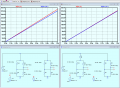
Look at this double image, I have set the sensitivity of the right side bridge to 9.5mV for max load.
The left side plot shows the error difference of a 10mV and the 9.5mV bridge,

The right-hand side of the image shows that I have added a 15R resistor in order to reduce the 10mV bridge to the same output as the 9.5mV bridge.

As you can see on the right-hand plot, the two bridges track OK from 0mV through 9.5mV

Do you see the purpose of the trimming?
E
EG57_ 1902.png
 

MisterBill2

Joined Jan 23, 2018
27,551
The load cell supplier who provided that information was HBM, originally known as "Hottinger Baldwin Manufacturing", I lost contact with them many years ago. They had published a paper describing how load cells connected in parallel worked and were accurate. It made sense to me at the time, several years into my career.
The cost of four matched load cells and one amplifier was less than the cost of four unmatched similar load cells and four amplifiers and a summing amplifier, and the accuracy was better. And the customers who got those systems remained satisfied even after a few years of the standard accuracy checks that were always a part of the QC program.
 

MisterBill2

Joined Jan 23, 2018
27,551
One additional comment, addressing dropping, is that application of a load beyond the specified safe load, which was always more than the rated linear operation rating, was stated as possibly causing both a permanent offset and a change in linearity. In other words: Do not impact the load cells ever!!!"
 
Top