Ah well that’s more than the typical hobbyist power supply and requires a different solution. Same idea though - you need a regulator.It says that the LM317 has a max. output of 1.5A, but my transformer will give 8.5A.
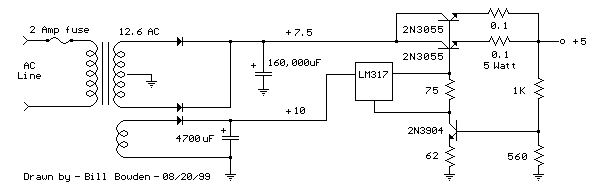
Wouldn't the addition of some "pass transistors" work? Like in the circuits shown here - http://www.bowdenshobbycircuits.info/page12.htm#317pass.gifAh well that’s more than the typical hobbyist power supply and requires a different solution. Same idea though - you need a regulator.
Sure, there are lots of ways to skin the cat. For an 8A charger, I'd look to a genuine lead-acid battery tending chip rather than a simple voltage regulator. Current limit while bulk charging, proper trickle for constant connection, that sort of thing. I thought the TS had a wall wart and that's why I brought up the LM317.Wouldn't the addition of some "pass transistors" work? Like in the circuits shown here - http://www.bowdenshobbycircuits.info/page12.htm#317pass.gif
![]()
He also made it clear that he was not familiar with how typical battery chargers work. This is a learning site, and the TS might choose differently once he understands the shortcomings of the simple approach.Aren't you all over-thinking this? The original poster just wants a simple power supply that he can use to charge a battery. Yes, there is a specific voltage/current profile that maximizes battery charge and life, but the OP just wants something simple.
Hadn't thought about that. Good point.We’re also not sure how big his batteries are. - - - If it’s motorcycle batteries or smaller, they’re at risk of serious overcharging.
Mostly the typical 12V "car" batteriesHadn't thought about that. Good point.
To the original poster; exactly what kind of batteries are we talking about?
I actaully planned to charge smaller batteries, like one used on my lawn mower, but it seems like a bad idea since I pretty much don't know it's voltage nor amperage.He also made it clear that he was not familiar with how typical battery chargers work. This is a learning site, and the TS might choose differently once he understands the shortcomings of the simple approach.
We’re also not sure how big his batteries are. If it’s car batteries, the 8A supply isn’t such a big deal. If it’s motorcycle batteries or smaller, they’re at risk of serious overcharging.
Thanks, clear and simple. But now when you mention it, my diodes used in the bridge are max. rated at 10A, would it be a issue since the supply will give a little less amps. (asking since you said "rated at 15 amps or greater" for the bridge)Aren't you all over-thinking this? The original poster just wants a simple power supply that he can use to charge a battery. Yes, there is a specific voltage/current profile that maximizes battery charge and life, but the OP just wants something simple.
OK, you have a transformer with the required primary and a 12 VAC 8.5 amp secondary. Connect that secondary to a diode bridge rated at 15 amps or greater, 50 V PIV or greater or equivalent individual diodes. Oh, and fuse the primary for safety and fuse the output lead at 10A in case you draw too much current on the output. And have spare fuse on hand.
If you want, you can connect that 2200 uF cap. If you want to use your new 15 volt power supply for other uses, then the cap would be helpful. The cap is not needed for battery charging.
Connect it to your battery, observing correct polarity. !! Important !! If you get the polarity wrong you might get some smoke, and will need to replace the output fuse. Turn it on.
If you have a voltmeter, observe the battery voltage, and when it get to 14.5 - 15 volts, or if the battery starts to bubble aggressively, turn off and disconnect the charger. The battery won't be 100% charged, but close. If you leave it on longer, you will be overcharging the battery and reducing its life.
Be careful with lead acid batteries. They do contain acid and can be chemically nasty that way. They also produce H2 gas when charging, and H2 is flammable/explosive, so no sparks near the battery - connect/disconnect the charger leads only with power off. Enjoy having made your won charger.