Configuring a bipolar junction transistor as a current source

WBahn

Joined Mar 31, 2012
32,852
Hello,

Part1:
But it seems like if Q2 (your diagram) has collector voltage of Vc, then the collector voltage of Q1 is already close to Vc+Vbe, so putting another transistor Q4 (as diode) into the collector of Q1 would just reduce the collector voltage of Q1, which means VcQ1=VcQ2 and that was the goal wasn't it?
I haven't actually tried any of this yet i was hoping Cruts felt like doing it with a simulation. I guess i can dive into it also.
The feedback mechanism that gives the Wilson mirror it's very high output impedance requires that the circuit be able to move the Vbe of Q3 up and down from it's nominal set point. The requires that the Vce of Q1 be high enough that it can move around by the needed amount without getting starved.

Part2:
If it was that easy to do why don't they do it that way, or do they? Could it be the overhead issues or the gain reduction.
It's done all the time. In discrete circuit design, you leverage the ability to get high accuracy and precision resistors and mitigate the inability to rely on well-matched transistors. In integrated circuit design, it's pretty much the reverse. You get decent transistor matching out of the box and can improve it significantly with good layout, but you have pretty poor control over the accuracy of resistors on the best days. The capabilities and limitations of different implementation environments forces differences in how you design circuits in those environments.

BTW as a side issue, the part i got from Maxim had a terminal voltage of 4.096 volts, and it read 4.095 volts with one $350 meter and 4.096 volts with one $450 meter. I thought that was pretty good (room temperature but it's well compensated).
Here you are talking about an integrated precision voltage reference. Not the same thing as a discrete current mirror. Different critter entirely.
 

MrAl

Joined Jun 17, 2014
13,707
The feedback mechanism that gives the Wilson mirror it's very high output impedance requires that the circuit be able to move the Vbe of Q3 up and down from it's nominal set point. The requires that the Vce of Q1 be high enough that it can move around by the needed amount without getting starved.


It's done all the time. In discrete circuit design, you leverage the ability to get high accuracy and precision resistors and mitigate the inability to rely on well-matched transistors. In integrated circuit design, it's pretty much the reverse. You get decent transistor matching out of the box and can improve it significantly with good layout, but you have pretty poor control over the accuracy of resistors on the best days. The capabilities and limitations of different implementation environments forces differences in how you design circuits in those environments.


Here you are talking about an integrated precision voltage reference. Not the same thing as a discrete current mirror. Different critter entirely.
Hi,

Actually what i meant was why don't they use that on the IC chip, but i guess you answer that.
I do have to agree though that i think it would help, I'm not saying that it won't.

Yes it's a voltage reference IC chip. When i look at good current regulators (also a little different) i also tend to think about good voltage regulators.
 

MrAl

Joined Jun 17, 2014
13,707
Hello again,

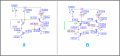
Here is a quick comparison of the three transistor vs the four transistor current mirror.

In the diagrams we can see that with Q4 shorted out (not functional at all then) the voltage on Q1 collector is 1.317 volts while the Q2 collector is at 0.658 volts, which is half as much as Q1 has. Thus the collector voltages are in fact quite different.

If we open the short across Q4 we see that the voltage at the Q1 collector is now 0.658 volts which closely matches that of Q2.
We also see that the collector of Q4, the added transistor, is now at 1.317 volts which is what Q1 had before. This means the overhead voltage requirement did not change that much.

Also, note the accuracy of the current setting. With Q4 shorted, we see 1.834ma vs 1.822ma, which is not that bad really, but with Q4 working normally we see 1.831ma and 1.831ma, which are the same, so we see some accuracy on the mirror current copy.
 

Attachments

Thread Starter

PeteHL

Joined Dec 17, 2014
580
There is one small problem with your statement. In an NPN BJT there is no such thing as the base to emitter current. There is base current, emitter current and collector current. KCL insists that:

\( I_C+I_B+I_E= 0 \)

Only voltage differences are expressed as occurring between two nodes.
George Stanley, an engineer with Hewlett Packard some time ago in a book of his writes the following about a PNP transistor configured as a common-emitter amplifier:

".......a leakage (reverse) current, termed Icbo or, simply, Ico, exists from collector to base."
 

MrAl

Joined Jun 17, 2014
13,707
There is one small problem with your statement. In an NPN BJT there is no such thing as the base to emitter current. There is base current, emitter current and collector current. KCL insists that:

\( I_C+I_B+I_E= 0 \)

Only voltage differences are expressed as occurring between two nodes.
Hi,

Don't we sometimes refer to the base emitter diode current?
That is the current that we sum with the collector current to get the emitter current,
Granted, we sometimes call it base current, but to be more precise we have to quote at least two nodes in a three terminal device or else how do we know what other lead the current flows out of.
 

LvW

Joined Jun 13, 2013
2,029
There is one small problem with your statement. In an NPN BJT there is no such thing as the base to emitter current.
Question:
If a current flows into one node of a three-terminal device, is there another node from which this current (or most of it) flows out again?
 

MrAl

Joined Jun 17, 2014
13,707
Question:
If a current flows into one node of a three-terminal device, is there another node from which this current (or most of it) flows out again?
Hi,

That was my question too. A three terminal device has three ways of possibly conducting current, but it always requires at least two leads.
I think maybe he was just trying to state that sometimes we call it the base current. That i guess is a very common thing, unless we have to consider the collector base leakage current, -- OR -- the collector base current when the transistor CE is saturated which would be much more substantial.
 

LvW

Joined Jun 13, 2013
2,029
Hi,

That was my question too. A three terminal device has three ways of possibly conducting current, but it always requires at least two leads.
I think maybe he was just trying to state that sometimes we call it the base current. That i guess is a very common thing, unless we have to consider the collector base leakage current, -- OR -- the collector base current when the transistor CE is saturated which would be much more substantial.
Yes - I agree.
Even in case of saturation where there is a remarkable base-to-collector current there is also "such thing as the base to emitter current".
 
Top