concerning differences in Vcc values

ronsimpson

Joined Oct 7, 2019
4,691
There are two types of numbers.
1). Voltages that will not cause smoke. " -0.5 to 20" Over that range the part will not work. Just will not smoke.
2). Operating voltage. 3.0 (more or less) AND 14.5 +/-0.5.
 

Papabravo

Joined Feb 24, 2006
22,082
didn't knew about this or that if could be possible .. thanks you :)
In the early days of electronics when vacuum tubes were in vogue it was not uncommon for any given tube to have an AC voltage to heat the filament and multiple DC voltages for the grid(s) and the plate. At the dawn of the integrated circuit era, multiple voltages ere often required to avoid having voltage and current regulation on each IC; it makes the overall system easier to design.
 

MisterBill2

Joined Jan 23, 2018
27,508
There are indeed two separate portions to the device, and thus two separate power sources required. One supply is probably related to the illumination portion, while a different supply powers the logic.
You need to read and understand the whole data sheet, not just the first part. And it is important to see a "typical application circuit" to fully understand what it all means. That does not appear to be included with the PDF attached to the post, but it should be available.
ALSO, the data seems to cover a whole family of displays, so you need information on the specific one you want. So mare data is needed before you could possibly make the display perform anything useful.
 

MaxHeadRoom

Joined Jul 18, 2013
30,658
Also it is wise to check to see if a common supply can be used for both, IOW have the same power common as in a supply providing the higher voltage with a voltage regulator to drop to the lower voltage requirement.
Max.
 

PaulNewf

Joined Mar 24, 2020
17
Avoid the "Absolute Maximum Rating". Circuit may work on bench for a while, but it will start randomly failing after hours/days/months if you go near those values (Feel free to try it, I did!)

Aim for the "Typical" under recommended values. That is where the component is intended to operate.
Try to select components with similar Typical operating voltage.
Later you can get into circuits with multiple power buses (i.e. MCU at 3V3 with USB at 5V and relays at 12V)
Paul
 

Thread Starter

walidantar

Joined Dec 21, 2019
17
oled-pdf_02.jpg

i'm sorry, i'm still didn't get it well

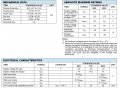
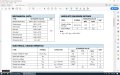
this is also i have, it's a 16x2, it's more simple, with one pin for power, hence it has only one power supply .. but still have two charts with different ranges, while they put a note (VSS = 0 V, VDD = 3.0 V/5.0 V) .. i need to know if i can power it with a 3.3v without a resistor to reduce the 3.3 to 3.0

what mostly confused me is that in the "Absolute Maximum Rating" chart the minimum is -0.3v white in the "Electrical Characteristics" chart the minimum is 3.0v and so the 3.3v is within the range

and another thing i want to ask related to it is these three pins

4 RS H: Data; L: Instruction code
5 R/W H: Read (MPU ← Module); L: Write (MPU → Module)
6 E H → L enable signal

where should i connect these with the headerss of arduino uno .. if somebody please help me with this too
 

Attachments

MisterBill2

Joined Jan 23, 2018
27,508
The Absolute maximum values are the limits of destruction for a device. Beyond those limits is permanent damage to the device. The operation voltage given under "typical" is the voltage to use. The 5 volts, or 3.3 volts, depending on the version that you have, is to power the logic portion as well as the digital interface area. You are welcome to want to feed it with a single supply voltage BUT that is not how it works. The actual display portion requires a higher voltage that is not mentioned in the partial data sheet attached to the recent post. The extended data sheet attached to the first post, pages 2 and 3 will describe the functions of the many pins, and what voltages get applied where. And I can not help with connecting this to an arduino, I do not work with them. And of course Nuts and Volts will not provide a single word about connecting to a product that they do not sell . But you should be able to find an actual typical use schematic circuit some place on the Vishay web site.
 
Top