There's something wrong on their web site, won't let you do a search on past articles. I'll see if I can find the dates in my old magazines. Might take a day or too though.
Do you know of any circuit that shows the use of a pwm instead of the r/c part?
That's my main concern at the moment once I have the basics of the circuit it will be easier to think in terms of how I should program it and such.
Is it still a linear psu with a mosfet setup instead of the r/c part?.
The wire machine he built in the magazine uses the same r/c power supply. The wire machine articles just show how he built the mechanical, working parts of the machine its self.
I can't understand the insistence of using pwm for this. Like I said before the r/c spark generator works fine for this. It actually may be better for DIY than a pulse generator. It will be self regulating as far as the number and length of pulses. R/c was used for decades in both sinker and wire. And when they finally went to pulse type it didn't happen over night, and more money than you or I would ever earn in our lifetimes combined was spent by many companies, over those decades. I mean it's up to you, but my quest for an EDM has taken too long, because I fell down the same 'rabbit hole' you're entering.
As I said, I will go the r/c way since I found some good resources on the schematics for that and I wont have any problems building the mechanical part, I think I would be able to build it in a reasonable time.
I can't seem to be able to find any transformers that size easily here in Sweden, maybe two smaller ones in series would work?
Can't wait to get the book so I know what types of components I need to finish the electronics.
Im trying to do a little list of things that i will need to complete the circuit.
As i can see it now its
For the PSU
A large transformer for the psu(or two smaller)
A bridge rectifier
A large capacitor
For the R-C part
A large resistor(or several smaller)
A capacitor for the pulse
The of course there is the wire, mechanics and guides but mostly concerned about the circuit now.
I have already asked about the transformer, but is there any chance you know what ratings i should look for on the other parts and if there is any place i can find them at a fair price?
Ok, I looked for the old magazines but no good. I have been keeping magazines of interest for years, but as I get older I've been getting rid of most of them(recycling). And in my doing this must have thrown the HSM boxes out. I can give you a hint on the years to look in the PDF you linked to from HSM. look in the years around 1995 on. The last one about sinker EDM was called "removing a broken stud", or something similar to that. Any of them talking about EDM or spark machinging after that should be about his wire machine. But I did find some stuff on line.
Here is a guy, Dan Mauch that sold a couple of books of plans for EDM. I bought the sinker one(~$40 at the time) but now he gives them in PDF form for free. http://heywhatsthebigidea.net/projects/electro-discharge-machining/
Didn't look at the wire plans, but his sinker plans were very basic at best.
Need some more information from you. What are the voltages there? I have a brand new Hammond transformer that I bought for this years ago, that I'm not going to use, don't remember the number off hand. I can look at it this afternoon and will give the number of it, will give you a good deal on it. It's heavy so shipping might be prohibitive.
I downloaded the book on wire edm that I gave the link to, looks pretty good, but didn't read it thoroughly. The link to the Jim glass build should give you some pointers on what problems he worked through. and give you a better prospective on what to avoid.
Thanks a lot!! Sounds really nice, the shipping from Antek was 73 usd
Probably cheaper if you would send yours.
We have 230v's in our outlets.
Great I will have a look at that!
Regarding the rectifier, I have read that for a linear psu it should be rated to at least double the voltage coming from the transformer, is it even more for edm?
And capacitors, do you have any clue what I would need?
My transformer wouldn't work for you. It's a 120V primary at 60Hz. And 5 amps at 60V secondary. I would say that what you have picked won't really work. One place that I differ with Langlois is his choice of discharge caps. There are better ones available that are called "discharge caps". Made just for doing just what they are called, and they don't over heat as much as an electrolytic cap.
Your going to have to do some figuring of what your parameters are going to be.
1.your target open circuit voltage at the wire
2.the amperage you want. this should be higher than you really want, because it can be controlled somewhat by output caps, switching a bank of caps in or out.
3. you need to also rate the amps of the transformer higher, then de-rate it with a power resistor. This is to keep the transformer from burning up if a short happens.
All of this is explained in the Langolis book. I know you want to jump into this, but really wait and read the book, and try to understand it before buying parts. Again giving you the benefit of my experience, and trying to save you grief and money. How do you think I have an expensive transformer to sell at a good price?
Did you download and read through the wire edm build book in the link? You can do that while waiting to get the other book. A lot of the same basics are in both.
Like I said earlier in the thread I spent most of my time using sinkers, and did my research into building a sinker. So I can give you what I know about them.
They use ~100V as an 'open circuit voltage', this means when no cutting is taking place. It's also called the 'strike voltage', what it takes to ionize the fluid and get the spark to start or 'strike'. After the 'strike', voltage drops to the 'cutting/burning voltage', this is where the actual metal removal is done. This is a variable voltage, set by the comparator that controls the gap distance, this is in between ~50V to 20V. This is where the current is transferred.
To be honest I don't know whether this is the same for wire. To find out if I was doing this I would search in a couple of places.
First and foremost go to the different companies selling commercial/industrial machines. They will have published specs on their machines, giving open circuit voltages and amps. The amps don't correlate into a small DIY machine, because you won't be cutting 12" thick parts. But the voltages do correlate, because the companies have found what it takes to make the process work, so use their years and many millions of dollars to your advantage.
Then spend some time down loading and reading what people have done as PHD thesis's. A Google search for 'wire edm thesis' will get more pages than you can imagine. Don't stop looking on the first few pages, those are the ones that just come to the top of the pile, and not always the best or ones with the most information. You don't have to print them all out but read them. After a while reading you'll see some area of numbers that start to be similar. Those are the 'true' findings. Being a thesis, the individual authors used a combination of opinion and real facts to get to there conclusions. The 'outlier' numbers are usually opinion. The 'reoccurring' numbers are usually what has proven to work over time.
I hope I'm not sounding condescending, or like I'm discouraging you in this, that isn't my intention at all. I'm trying, like said before, to give you the benefit of my experience. I've spent several hundreds of dollars on components that after researching farther found my ideas won't work like I thought. Also spent over a hundred on books about edm, that showed me I was wrong in my ideas. In the end, I'll help to explain what I have found, and help where I can, but you are going to do some of the research on this for your self, to find what a wire takes to work. I'm 69 years old and still don't have a finish machine, but do have the 'dream' of making it.
Another thought, as far as the mechanical side, stuff like wire guides and flush cups, do yourself a favor again and work with the stuff that the big companies have designed and make available on the market. Their 'spares' may seem expensive, but they have done all of the research and development, So use what works, that gives less work for you in the end.
I had some luck with getting in touch with the creator of the video i posted.
And he is answering many of my questions so my first machine will likely be quite similar to his.
I just have a little thought about the ratings of transformers, that maybe you could answer.
Say i have the 225va 2x36v transformer, by combining the outputs i get 72v and that times 1.414 gives around 100v
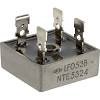
Here is a link that explains transformers better than I can, and in detail. http://www.electronics-tutorials.ws/transformer/multiple-winding-transformers.html Rectifying only changes the voltage not amperage. And I wouldn't use the bridge rectifier like the one you linked to, because it was a PCB through hole type. Your better of with one that has lugs for spade terminals. They handle amperage better. And they usually have a mounting hole in the center so it can be mounted to a heat sink. Like this one -
If you are talking about the one you linked to earlier, it is around 3amps output. If going that route I'd probably use two transformers. Wiring each one in series then connecting the in parallel. That would give you a higher amperage at the same voltage. Doing this because you will loose some amperage in the dropping/limiting resistor, that's needed to protect the transformer from shorts during a cut.
When talking to the guy i mentioned he said the transformer should do fine and also helped me with what values i need for the power resistor i ordered that one.
Since he has a working one he probably knows what hes talking about, im not saying your not or anything like that.
But it just seems like a good starting point following his advice for the first version then i can always make changes to it, but hes helping me with the resistor values that both protect the wire and the psu so it seems good to me!
Hopefully i can get one running soon so that you can use that design for a machine of your own!
Please, please keep this thread updated as you proceed with your project. I was trying to be honest with you that in that my work has been toward sinker not wire. while there are some basic inter actions of the two, there are some differences. That's why I spent time looking up some links for you, from those that have done it. There is so much more out there on DIY sinker than on DIY wire, that any thing you can report on what you find that works will help some one else down the road. Kind of a pay it forward type thing. And this in the end will be good for everyone involved. I guess in a nut shell, share what you learn, and since this thread already shows up on the web keep it going with new information so it stays coherent.

 Facebook
 Google
 GitHub
 Linkedin