Combo Circuit Help

Thread Starter

CybrWb

Joined Dec 4, 2012
14
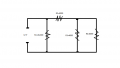
Ok I can figure out how to get Total resistances on this thing thing, and have had some success figuring out Voltage and Current on Combination circuits that begin in a Series but this particular diagram has been giving me a headache for about 3 weeks now, I already took the test that had this particular diagram and the semester is over I just need to figure this out for my sanity... can anybody help me?

In other words I want tot fill out a E I R chart for this circuit.
 

Attachments

JoeJester

Joined Apr 26, 2005
4,390
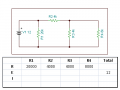
I'm assuming you want to fill in the blocks on the table.

You need to show what you have already done ... if you want to maximize your potential in this forum.

This is an exercise in Ohms law, Kirchoff's Current Law, and Kirchoff's Voltage Law.
 

Attachments

Thread Starter

CybrWb

Joined Dec 4, 2012
14
Thats exactly what I'm trying to do. For reference this is my first semester in Electronics, the class I took was entitled, The Mathmatics of Electronics, While we have covered Ohm's law, there was no Emphasis on Kirchoffs Laws yet.

That being said, I can figure out the tables for Series, Parallel, and some Combination circuits, however since R1 is parallel it's causing me a few problems. I have all the information in my table as you have although, I also have \(R_t=5000\) and \(I_t=2.4mW\) trying to find the rest has been killing me.
 

Thread Starter

CybrWb

Joined Dec 4, 2012
14
To clarify a little better, the class really was a math class more than it was an Electronics class, however it was as I said the Mathmatics of Electonics, so we did study basic concepts, next semester is where I begin to study DC and AC in depth, I just want to make sure I have the basics down solid before I jump in next semester.
 

JoeJester

Joined Apr 26, 2005
4,390
Rt is correct. It is not 2.4 mW, as Watts is not the expression for Current.

Looking at the schematic, what do you think the voltage is across R1? Then calculate the current through R1
 

Thread Starter

CybrWb

Joined Dec 4, 2012
14
Your right I got a little ahead of my self its 2.4 mA I want to assume the Voltage would be 12 as Voltage is equal in a Parallel circuit, therefore current across R1 would be 600 microAmps. so R2 wouldnt be 12 V also would it... See this is where I am having my problem, none of the examples in my book, nor none that I can find online start with a parallel resistance, they all start in series, if you get what I'm saying.
 

JoeJester

Joined Apr 26, 2005
4,390
Ok so you know that Voltage is the same acrossed parallel circuits and divides in series circuits.

You are correct with 12 V and 600 microAmps.

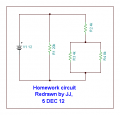
Next you have a series-parallel circuit. Since you already found the equvalent of R3 paralleled to R4, that equvalent and R2 has what voltage acrossed it and the current through them?
 

Thread Starter

CybrWb

Joined Dec 4, 2012
14
Thats were I'm not sure, I would assume it would look something like this.

\(R_{2,3,4}=6666.67\)
\(E_{2,3,4}=12V\)
\(I_{2,3,4}=2.4mA\)

Something tells me thats not what you were getting at though.
 

Thread Starter

CybrWb

Joined Dec 4, 2012
14
Ok, the reason the current wasn't correct was because I wasn't sure if my response was correct so I just put the total current, after doing the math on my last response though I get I=1.8 mA
 

JoeJester

Joined Apr 26, 2005
4,390
Why did you guess without doing the math?

You will notice that the current through this branch equals the total current minus the current through the other branch.

Now what is the voltage across R2 ....
 

JoeJester

Joined Apr 26, 2005
4,390
It's 4.8.

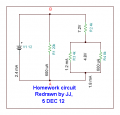
Kirchhoff's Voltage Law (KVL): "The algebraic sum of all voltages in a loop must equal zero"
We had 12 V (from the battery), 7.2 volts acrossed R2 leaving 4.8 for R3 or R4. 12 - 7.2 - 4.8 = 0.

For the final bits of information ...

What is the current through R3, then the current through R4.
 

Thread Starter

CybrWb

Joined Dec 4, 2012
14
I2=1.2mA I3=600microAmps,

Like I said we really didnt cover Kirchoff's law, So I was really only thinking in terms of Ohm's Laws.

So in a way we pretty much figured for R1 and then cut it out of the circuit (I know not really, I'm just saying in terms of "voltages in a loop") Sorry if that's a little confusing, I have a wierd way of visualizing things.

Thank you for your help I have really been having a hell of a time with that one. The way you redrew it definatly helped, I actually have seen that particular diagram online I just didn't put 2 and two, together.

Again thank you very much I know It's late in Texas.

-Wesley
 

JoeJester

Joined Apr 26, 2005
4,390
I'm not looking for I2, as we established that as 1.8 mA.

I3 and I4 are the proper terms.

Anyways...

Kirchhoff's Current Law (KCL): "The algebraic sum of all currents entering and exiting a node must equal zero"
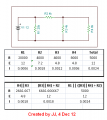
As you can see in the diagram below, with the voltage and current annotations, both Kirchoff's laws are satisfiied.

I would recommend you to start reading the ebooks listed above.
 

Attachments

Thread Starter

CybrWb

Joined Dec 4, 2012
14
I will make sure to go over the material during the break so I can ensure I have it down before next semester, again thank you.

If I may ask, is that a particular software program you are using to drae the circuit diagrams, If so could you tell me what it's called, I have a feeling I'll be needing somethign like that soon.
 

JoeJester

Joined Apr 26, 2005
4,390
The free version of that simulation program is called TINA-TI. The charts were done in Excel. The merging and annotations were done in paint.net ...
 
Top