Clampmeter Question

MrAl

Joined Jun 17, 2014
13,704
The downside of the AC/DC clamp on meters is that they require batteries for all functions, and the form factor for other uses is not so good. And the cheap ones that I have seen are not that durable.
I've had good luck with AC/DC clamp meters that were not real expensive, but then I never bought the cheapest ones on the menu either.

That's an interesting point about the use of batteries in clamp meters and meters in general. I've run into this myself several times in the past.
On the one hand, we can usually get better readings with battery powered meters. However, on the other hand if we intend to use them for monitoring purposes we've got some problems because we usually want the reading to stay showing for long periods of time, maybe hours or even days. That's actually impossible with some battery powered meters because they turn off after a certain period. After maybe 30 minutes (this varies a lot though) the dang thing turns off and then boom, no more monitoring until you turn it back on again, and for some meters that's not just a matter of pushing a switch, you have to rotate the knob down to 'off' then back up to your intended range. Even THAT is not possible sometimes because you can not afford to go through the ranges to get back to your intended range because it could damage the meter or blow the fuse. That means you'd have to disconnect the leads first, then turn the knob down, then back up, then reconnect the leads (at least one lead anyway).
Thankfully we have bench meters which plug into the wall and can run for hours and hours without turning off.
Analog meters are great for this, but of course we don't get the resolution that we get with digital meters with those.
 

MrAl

Joined Jun 17, 2014
13,704
What are the key considerations and techniques involved in using clamp meters for measuring current accurately, and how does the number of turns around the core affect the reading?
Hi,

As mentioned, the 3d spatial positioning for sensitive meters is important because the earth's magnetic field will interfere with the reading to a surprisingly large effect, depending on the sensitivity of the meter.

The turns around the core should be spaced evenly when possible. The number of turns also increases the reading by the number of passes the wire goes through the inside area of the core. If the wire goes 1 time though the core then the reading is 1:1 which means 1 amp will read as 1 amp. If the wire goes 10 times through the core then the reading will be 10:1 meaning 1 amp will read as 10 amps. That can be useful because if you are trying to read 1.05 amps with one turn it may actually read as 1.02 amps or 1.08 amps depending on how good the meter is. If the wire goes 10 times through the core though that 1.05 amps will read as 10.5 amps (ideally) and so you probably get a better reading, then you can divide by 10 in your head to get that 1.05 amps.

The best bet is always to first check with a regular meter using a test setup. Compare the readings to a good meter before trying to measure unknown quantities like current.
 

Ya’akov

Joined Jan 27, 2019
10,235
The downside of the AC/DC clamp on meters is that they require batteries for all functions, and the form factor for other uses is not so good. And the cheap ones that I have seen are not that durable.
I can’t see a reason why not needing a battery is a practical advantage, but so for as the form factor and durability, I think perhaps you‘ve not seen the rage of available options. I have recommended, and do again, the UNI-T product line.

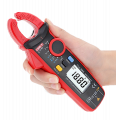
In particular the UT210E, which is a <$60USD small sized 100A AC/DC clamp meter with AC/DC voltage, full range resistance, capacitance, diode, frequency, temperature, and non-contact voltage (NCV). It is accurate and rugged and feels quite solid. It is my tool bag meter, and it’s been really quite brilliant in that rôle. I believe that @Ian0 would also endorse it.
It’s not perfect, but its warts are small and generally don’t make it ugly. The biggest one for me is the backlight timeout which is too short and not adjustable. But I have found it to be very useful, very reliable, and an excellent value. I’d recommend it to anyone that needs a meter for a tool bag or box to fill a general purpose rôle. I find it more useful than non-clamp meters for this application.
 

MisterBill2

Joined Jan 23, 2018
27,514
I said SOME, I did not say ALL. And it might be difficult to stand that meter shown so that the display was visible.
My clamp-on ammeter is seldom used and so the battery would be dead when i needed to use it. But it does have one voltage range, zero to 250 volts, which is what I require for mains wiring service.
Not every meter fits every person's needs, and I do not tell others how to run their lives, as a basic policy of mine.
 

MrAl

Joined Jun 17, 2014
13,704
I can’t see a reason why not needing a battery is a practical advantage, but so for as the form factor and durability, I think perhaps you‘ve not seen the rage of available options. I have recommended, and do again, the UNI-T product line.

In particular the UT210E, which is a <$60USD small sized 100A AC/DC clamp meter with AC/DC voltage, full range resistance, capacitance, diode, frequency, temperature, and non-contact voltage (NCV). It is accurate and rugged and feels quite solid. It is my tool bag meter, and it’s been really quite brilliant in that rôle. I believe that @Ian0 would also endorse it.
It’s not perfect, but its warts are small and generally don’t make it ugly. The biggest one for me is the backlight timeout which is too short and not adjustable. But I have found it to be very useful, very reliable, and an excellent value. I’d recommend it to anyone that needs a meter for a tool bag or box to fill a general purpose rôle. I find it more useful than non-clamp meters for this application.
Hi there Ya'akov,

You must have missed a post that mentioned the disadvantages of a battery operated meter of any kind #21.
Battery operated meters often turn off by themselves after a certain time period which makes them unusable for longer time monitoring purposes.
Getting them back online may require more than just pushing a button too, so if you go away for a minute and come back the meter may be off, then you have to rotate the knob to off then rotate back to the function you were using. You may have to disconnect one of the leads first too. If that's the current measuring mode you would have to interrupt the power to the device you were testing first because if you turn the knob you could end up blowing the fuse in the meter (if it is a directly current measuring meter not a clamp on).
To add to that, you may have to put up with several loud annoying beeps just before it turns off, to warn you it is turning off. Then the only way to stop it is to rotate the knob back and forth, which may also be a problem for certain measurements.

Notwithstanding, I use several battery operated meters of different types including current clamp on meters. They have their use that's for dang sure. When I need long term monitoring though I use a PC computer interface four channel measuring device or a bench meter. I should also say though that I use the battery operated meters more than the others because they are so handy. I do not need long term monitoring as much as I used to.

Of course, in this day and age we also now have a battery operated oscilloscope that has become quite common to see. I love that because it has one big giant advantage: it is totally and completely isolated from the line voltage or any other equipment being tested with it. I think you can even plug in the wall wart that charges the batteries because the wall wart is isolated, but you do not have to do that unless you need long term monitoring.

Analog meters of course have their disadvantages too. The resolution is always less than a digital. Their advantage is they never need external power of any kind. They can also respond faster than digital meters in most cases too. Some digital meters can take three seconds to take a reading, or at least get the digits to stabilize.
 
Analog meters of course have their disadvantages too. The resolution is always less than a digital. Their advantage is they never need external power of any kind.
Just to add, the major advantage of analog meters is the speed with which the viewer can assess what is happening - the major example being power plants and indeed entire power stations back in the day. Most vehicles (including aircraft) still use analog meters for the same reason, although they now mostly need power!
 

MisterBill2

Joined Jan 23, 2018
27,514
The advantage of my non-battery powered AC only clamp on is that it is never out of service because of a dead battery. It lives in the toolbox and does not get used very often. I make no other claims for other benefits.
 

MrAl

Joined Jun 17, 2014
13,704
Just to add, the major advantage of analog meters is the speed with which the viewer can assess what is happening - the major example being power plants and indeed entire power stations back in the day. Most vehicles (including aircraft) still use analog meters for the same reason, although they now mostly need power!
Hi,

Yes I used an analog meter in the car for years to monitor the battery voltage as the car was being started. That gives an indication of how the battery is doing. If it dips down too far the battery is getting too old.
The digital meters could never do this because the dip happens too fast and is over too quick.
 
Top