If your load is fixed then all you need is V^2. Just redraw the scale on the analogue meter. A scale that gives more accuracy at the low end is often more useful than a linear scale.
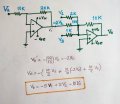
You are absolutely correct. What @JuliaSmith has created is NOT a multiplier but a linear combination which is certainly possible with just opamps and resistors.
Modern microcontrollers are very good with things that are very hard to do with analog parts. That is because they have a built in ADC and also built in PWM.
If you want to do math on nearly DC signals you can do that with a $1 (USD) chip.
You measure the two signals you want to multiply. That gives you two integers that you can convert to floating point.
You multiply the two numbers.
You use the result to generate a PWM signal that you filter to get an analog output. Alternately, you use a built in DAC to output a true DC output signal.
Some of them are fast too so you could even do AC signals of a reasonable frequency with a built in ADC and DAC.
Programming with an ADC and DAC would be very easy almost too easy.
Advantages are easy calibration, just about zero aging factors, reliability.
Some time in the distant past multiplication was also something to be considered when calculating the max power tracking point of a solar array. Not sure if they do that anymore though. Kind of a simple concept, you multiply the voltage times the current to get the output power at any given time.
I wouldn’t bother converting to floating point.
If it’s a 12 bit ADC multiply the two twelve bit numbers together to get a 24 bit result. Shift 12 places to the right and load into a DAC (assuming that it is also 12 bit).
One of the biggest advantages is not requiring ±15V supplies that most of the analogue multipliers require.
I wouldn’t bother converting to floating point.
If it’s a 12 bit ADC multiply the two twelve bit numbers together to get a 24 bit result. Shift 12 places to the right and load into a DAC (assuming that it is also 12 bit).
One of the biggest advantages is not requiring ±15V supplies that most of the analogue multipliers require.
Sure. I would think you only have to convert to float if you want to display some information about the process such as a measurement of some kind. If the inputs are floats, then a conversion would have to be done there too.
Hi Everyone new guy here who needs your help. I need a simple (?) circuit to produce an output voltage that is the product of two input voltages. I thought it would be easy using some op-amps but have been unable to come up with one. A search produced the standard summation and differiation circuits but no product circuits. The closest I found was using an analog computer to do the product.
Actually I would love to build an analog computer from a kit but found none available.
The integrated circuit, MC1496 is an analog multiplier device . The application notes provide a great deal of explanation as to how it works. It does indeed provide actual multiplication.
There are alternative methods of providing a similar function that are much easier to work with , though.
There is a good reason as to why you do not find much recent information about analog multipliers. They are a pain.
The one exception is when they are used in a frequency mixing circuit, and one of the signals is a constant-amplitude square wave.

 Facebook
 Google
 GitHub
 Linkedin

 26.5 KB Views: 20