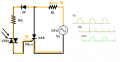
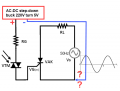
Circuit design SCR trigger with optocoupler

Thread Starter

giannigrd

Joined Nov 5, 2024
7
Hi,
I'm designing the trigger circuit of the triac couplers without zero crossing
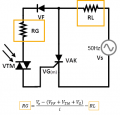
1751465283062.png
I use the MOC3023 that is powered by the mains voltage through the load, everything is fine as long as the load is stable.
The Resistor that limits the gate current RG depends on the load RL when the load changes I am forced to resize RG.
Can anyone tell me if there is a method to make the circuit independent of load variations?
The only possibility I found is to use a pulse transformer
 

Ian0

Joined Aug 7, 2020
13,097
What is the gate current of your thyristor? What is the value of Rg that you are using?
Choose Rg to give the maximum permissible current for the MOC3023 which is 1A (so 330Ω for a 230V supply), and make sure that your thyristor will withstand 1A gate current for at least 10us.
 

Thread Starter

giannigrd

Joined Nov 5, 2024
7
I made this reasoning:
IGT Power-SCR > I (my IG) < 70% ITSM Optotriac

the current in the trigger circuit must be greater than the minimum current necessary to trigger the SCR and less than the current that the optotriac can support : I use 700 mA
from which RG≈430 Ω with a load of 37 Ω

my problem is: if I connect a load of 150 Ω since the load is in series with the trigger circuit the RG should become: 310 Ω
I would like a solution that is independent of the load
 

Ian0

Joined Aug 7, 2020
13,097
I made this reasoning:
IGT Power-SCR > I (my IG) < 70% ITSM Optotriac

the current in the trigger circuit must be greater than the minimum current necessary to trigger the SCR and less than the current that the optotriac can support : I use 700 mA
from which RG≈430 Ω with a load of 37 Ω

my problem is: if I connect a load of 150 Ω since the load is in series with the trigger circuit the RG should become: 310 Ω
I would like a solution that is independent of the load
But at the point that the SCR is triggered, it is off, and there is no current going through the load,
and the SCR probably takes <50mA to trigger, so you have a permissible variation in R by a factor of 10.
 

Thread Starter

giannigrd

Joined Nov 5, 2024
7
opss ...
so it's me who doesn't quite understand the logic of the circuit !
I would have said that before the trigger (t<ton), when the LED is turned-on the optotriac starts conducting and since the trigger circuit is powered by AC the IG current flows through the load.
Then the SCR triggers (t>=ton) the anode of the SCR goes to (approx) 0 V interrupting the current in the trigger circuit
did I misunderstand?
1751475848229.pngfor the time it takes for the SCR to turn on (ton) I think that the IG current flows and this also passes through the load. Consequently, the RG must also be sized according to the load present at that moment. If I used a pulse transformer I think this problem would not exist. But what to do with an optocoupler?
 

Attachments

MisterBill2

Joined Jan 23, 2018
27,164
The alternative that is often used is to trigger the SCR from a point that is not dependent on the load resistance. That would be Vs in the drawing. CERTAINLY the gate current limiting resistor will need to be much larger, but it will not need to be adjusted.
 

Ian0

Joined Aug 7, 2020
13,097
opss ...
so it's me who doesn't quite understand the logic of the circuit !
I would have said that before the trigger (t<ton), when the LED is turned-on the optotriac starts conducting and since the trigger circuit is powered by AC the IG current flows through the load.
Then the SCR triggers (t>=ton) the anode of the SCR goes to (approx) 0 V interrupting the current in the trigger circuit
did I misunderstand?
View attachment 352097for the time it takes for the SCR to turn on (ton) I think that the IG current flows and this also passes through the load. Consequently, the RG must also be sized according to the load present at that moment. If I used a pulse transformer I think this problem would not exist. But what to do with an optocoupler?
You haven't let anyone know the specs for the thyristor, so we're guessing and giving you general information, rather than anything specific to your circuit.
 

Thread Starter

giannigrd

Joined Nov 5, 2024
7
Sorry, I do

As a power SCR I thought of using the TYN812 that triggers starting from 10 mA with an IGM of 1.5 A.
For the optocoupler I have the MOC3023 with ISTM of 1 A for 1 ms.
Now I have a completely resistive load available using from 0.3 A to 0.6 A.
I do the phase control with the TCA785.
I also thought of activating the SCR from a point that does not depend on the resistance of the load, but I do not understand how to do it.
 

Ian0

Joined Aug 7, 2020
13,097
the MOC3023 will only output a trigger pulse if there is less than 40V across it, so the lowest gate resistance can be 40Ω.
The highest will be 4k, so that gives you plenty of choice for the load resistance before you run into trouble.
How old is that TCA845?
 

Thread Starter

giannigrd

Joined Nov 5, 2024
7
The alternative that is often used is to trigger the SCR from a point that is not dependent on the load resistance[/QUOTE said:
yes it's true!

I also came to this hypothesis, but I still haven't figured out how to provide an external source that has the same 0 as the AC power supply as a reference.
Ohh sorry
of course I would replace the MOC3023 with an EL4N35 otherwise it would always stay on
1751486670026.png
then I think there is another problem that I have not mentioned: the circuit with the optotriac must work until the SCR trips, otherwise the RG resistor "cooks" and must dissipate a lot of energy
if SCR Start: E=i^2 * R * t=0,7^2 A * 430 Ω * 10 μs= 2,1 mj
if NOT Start : t=1ms (50 Hz) E= 219 mj
 

Attachments

Last edited:

Thread Starter

giannigrd

Joined Nov 5, 2024
7
"The TCA785 is obsolete"

True I saw that it is an old integrated circuit (like me ah ah ah)
but it is exactly what I needed and above all it is not SMD I can use it on a breadboard
 

Thread Starter

giannigrd

Joined Nov 5, 2024
7
the MOC3023 will only output a trigger pulse if there is less than 40V across it
ohh sorry
maybe you are referring to MOC3041/3043 zero crossing and they only work if the voltage is <40V if LED is ON.
I would like to use a "Random Phase" MOC301xx, MOC302xx because the trigger point is managed with the TCA785. I would like to be able to trigger with any angle so as to manage the power supplied to the load punctually.
So I find myself having to size the RG so that it works from about 0° (0V) to 45° (325V). I make sure that the minimum IG/VG available at about 6° is sufficient to trigger the SCR, while at 45° (325V) I try not to exceed the MAX values.
All this should work if the load is stable. If for some reason a Heated pitot tube (in my practical case) is interrupted, the absorbed current decreases and consequently the IG with the risk that the SCR does not trigger. This is why I would like to understand if there is a method to make the IG trigger current independent from the load using an optotriac as the trigger circuit.
 
Hi,
I'm designing the trigger circuit of the triac couplers without zero crossing
View attachment 352084
I use the MOC3023 that is powered by the mains voltage through the load, everything is fine as long as the load is stable.
The Resistor that limits the gate current RG depends on the load RL when the load changes I am forced to resize RG.
Can anyone tell me if there is a method to make the circuit independent of load variations?
The only possibility I found is to use a pulse transformer
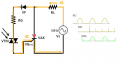
Simply, move the anode of VF diode to the other side of RL (direct to supply)... the gate circuit will be independent of load current .
 

MisterBill2

Joined Jan 23, 2018
27,164
Simply, move the anode of VF diode to the other side of RL (direct to supply)... the gate circuit will be independent of load current .
I made that suggestion back in post #6, it was ignored there. Evidently it was much too simple. Thanks for providing the second opinion to back it up!
 
Top