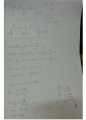
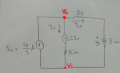
It looks like you are messing up your sign conventions here.
For example, you draw the arrow for Ix from left to right, yet you enter it differently in the equations, and you dont seem to show your definition of Ix correctly. It's hard to see what you are doing.
To start, the definition of Ix with the arrow as shown is:
Ix=(Vs-Vo)/1
which comes out to:
Ix=(30/s-Vo)/1=30/s-Vo
If we call the current though the two ohm resistor I2 and the current through the cap I3 we have:
Ix-I2-I3=0
where
I2=Vo/2
and
I3=(Vo-Vx)/(1/s)=(Vo-4*Ix)/(1/s)=(Vo-4*(30/s-Vo))/(1/s)=5*s*Vo-120
We can then use Ix-I2-I3=0 to get the final result.
It's as simple as that. The final result has a different denominator than your original solution.
If you often have trouble with your sign conventions it is better to do it this way where you define a 'main' equation like Ix-I2-I3=0 and then define each current, then as the last step substitute all the defined currents into the main equation. This helps to keep the signs correct.
It looks like you are messing up your sign conventions here.
For example, you draw the arrow for Ix from left to right, yet you enter it differently in the equations, and you dont seem to show your definition of Ix correctly. It's hard to see what you are doing.
To start, the definition of Ix with the arrow as shown is:
Ix=(Vs-Vo)/1
which comes out to:
Ix=(30/s-Vo)/1=30/s-Vo
If we call the current though the two ohm resistor I2 and the current through the cap I3 we have:
Ix-I2-I3=0
where
I2=Vo/2
and
I3=(Vo-Vx)/(1/s)=(Vo-4*Ix)/(1/s)=(Vo-4*(30/s-Vo))/(1/s)=5*s*Vo-120
We can then use Ix-I2-I3=0 to get the final result.
It's as simple as that. The final result has a different denominator than your original solution.
If you often have trouble with your sign conventions it is better to do it this way where you define a 'main' equation like Ix-I2-I3=0 and then define each current, then as the last step substitute all the defined currents into the main equation. This helps to keep the signs correct.
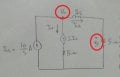
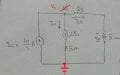
You got two voltages that are both labeled Vo - the node voltage at the top junction and the voltage across the 5Ω resistor. It can't be both so you need to re-label one of them to something else. I'll call the node voltage V1. I'll also assume that the bottom node is your common and is 0V.
It's good to see that you are at least figuring out the result at t=0 and t=∞, but that's not enough. You need to start asking if they make any sense.
Look at the circuit and figure out what the current in the inductor is at t=0-. What do you know then about the current in the inductor at t=0+? What does this mean for the Vo at t=0+.
Now look at your final voltage of 50V. What does that mean that Ix is? What does that mean that V1 and I1 are? Assuming that the coefficient on the VCCS is 2 V/A, what is V1 based on going up through the middle branch? Does this agree with your V1 based on the right branch?
You keep posting problems and asking for us to tell you if you are right (and, by the way, the quality of your work is improving), but you don't seem to be attempting to check your work yourself. That is a critical skill for an engineer because most of the time there will be no one to check your work for you -- that's why someone is paying you to solve the problem in the first place. One of the nice things about most engineering problems is that the validity of the solution can be readily determined from the solution itself -- if you make the effort to do so.
WBahn:
50v is the initial voltage, 31.25 is the final voltage. But that's for Vo at the top of the page. I suspect he wants Vo across the last 5 ohm resistor that's why he's saying the result is wrong i think.
full:
I think you want the voltage across the 5 ohm resistor on the far right? That would mean you have to solve for that "Vo" not the Vo at the top of the page.
You solved for Vo at the top of the page, and that looks correct. If you compare to Vo across the 5 ohm resistor it wont be the same so you have to solve for Vo there and then compare.
This second Vo should be easy to solve for now that you have Vo at the top of the page.
In the future you should use two different variables for two different voltages.
You got two voltages that are both labeled Vo - the node voltage at the top junction and the voltage across the 5Ω resistor. It can't be both so you need to re-label one of them to something else. I'll call the node voltage V1. I'll also assume that the bottom node is your common and is 0V.
It's good to see that you are at least figuring out the result at t=0 and t=∞, but that's not enough. You need to start asking if they make any sense.
Look at the circuit and figure out what the current in the inductor is at t=0-. What do you know then about the current in the inductor at t=0+? What does this mean for the Vo at t=0+.
Now look at your final voltage of 50V. What does that mean that Ix is? What does that mean that V1 and I1 are? Assuming that the coefficient on the VCCS is 2 V/A, what is V1 based on going up through the middle branch? Does this agree with your V1 based on the right branch?
You keep posting problems and asking for us to tell you if you are right (and, by the way, the quality of your work is improving), but you don't seem to be attempting to check your work yourself. That is a critical skill for an engineer because most of the time there will be no one to check your work for you -- that's why someone is paying you to solve the problem in the first place. One of the nice things about most engineering problems is that the validity of the solution can be readily determined from the solution itself -- if you make the effort to do so.
Here's the problem that both I and MrAl are pointing out:
You are using the same label for two different quantities. The one at the top is the voltage on a node, which is meaningless unless the reference node is indicated. Otherwise, if I tell you that the voltage is 2V, the obvious question is, "It's 2V relative to what?" No one knows because it isn't indicated. The one on the right is adequately specified, namely that it is the voltage at the top of that 5Ω resistor relative to the voltage at the bottom of that 5Ω resistor, so that's not a problem. But if I tell you that V0 is 4V, am I talking about the voltage on the top node (relative to some unspecified node) or am I talking about the voltage across the 5Ω resistor on the right? Who knows? Similarly, when you solve for Vo, which of those are you solving for? Who knows?
What I did was resolve these issues arbitrarily by doing the following:
I chose to relabel the node and node the voltage across the resistor because I had to guess which one you were actually solving for and the voltage across the resistor seems more likely (otherwise what is it labeled at all?).

 Facebook
 Google
 GitHub
 Linkedin