Choosing Between Polling and Interrupts: When and Why?"

Thread Starter

Kittu20

Joined Oct 12, 2022
511
First I would not use a 8051 Microcontroller unless it was an absolute requirement like a school mandated controller for a grade. The choice of controller is very important and the 8051 hardware architecture is archaic.
Its not about selecting a specific microcontroller; rather, it's about choosing the right communication method for uart : polling or interrupts. Use microcontrollers like PIC, AVR, or ARM, instead of 8051
 

nsaspook

Joined Aug 27, 2009
16,330
Its not about selecting a specific microcontroller; rather, it's about choosing the right communication method for uart : polling or interrupts. Use microcontrollers like PIC, AVR, or ARM, instead of 8051
It makes a big difference on how well those methods work with other processing happening on the controller like trying to send/receive high speed serial data from a Ethernet module while handling the other things you listed.
  • 8051 Microcontroller: Serves as the system's brain, controlling interactions between other components. It processes RFID data, manages RTC, EEPROM, and Ethernet communication, and controls the EMLOCK.
  • RTC (Real-Time Clock): Provides accurate time for scheduling access permissions based on time windows.
  • EEPROM: Stores user credentials, access rights, and event logs even during power loss
  • EMLOCK (Electromagnetic Lock): Electronically controlled lock for secure door access.
  • RFID Reader: Identifies users via RFID cards/tags.
The reason your question has no black and white answer is you can't wisely make that sort of calculated decision in isolation. You should consider all hardware and software resources and how they interact dynamically. For example if you only need to send a one byte serial command every second as a keep-alive to some remote device do you really need to use interrupts when all you need to do is to check the UART TX status to see if you can send one byte once a second.
 

Thread Starter

Kittu20

Joined Oct 12, 2022
511
The reason your question has no black and white answer is you can't wisely make that sort of calculated decision in isolation. You should consider all hardware and software resources and how they interact dynamically.
I've done my best to anticipate potential solutions and trade-offs for these scenarios, but I believe in the power of collective knowledge. I'm eager to learn from your experiences and expertise. Whether you've encountered similar situations, have valuable insights, your input would greatly enrich my understanding.

So, let's dive into these scenarios together and engage in a constructive dialogue.
Share any tips that could shed light on the best paths forward.

Thank you in advance for your contributions! I'm genuinely excited to learn from you all.
 

WBahn

Joined Mar 31, 2012
32,890
Its not about selecting a specific microcontroller; rather, it's about choosing the right communication method for uart : polling or interrupts. Use microcontrollers like PIC, AVR, or ARM, instead of 8051
But these choices are not separable! Unless you are in one of the relatively rare circumstances in which one choice is simply not workable or practicable, which one is more reasonable depends on a large variety of factors, including, but in no way limited to, the choice of controller.
 

MrChips

Joined Oct 2, 2009
34,829
When I was first introduced to minicomputer programming, all devices were handled with blocking poll of device flags.
Why? Because there was nothing else for the program to do.
The code waited for the user to press a key on the teletypewriter keyboard.
Then the program printed out a message on the printer. It always waited for the last character to be printed before sending another character.

Thus, polling is very effective and works well, if that is acceptable for the application.
In other words, it all depends on the application.
 

nsaspook

Joined Aug 27, 2009
16,330
I've done my best to anticipate potential solutions and trade-offs for these scenarios, but I believe in the power of collective knowledge. I'm eager to learn from your experiences and expertise. Whether you've encountered similar situations, have valuable insights, your input would greatly enrich my understanding.

So, let's dive into these scenarios together and engage in a constructive dialogue.
Share any tips that could shed light on the best paths forward.

Thank you in advance for your contributions! I'm genuinely excited to learn from you all.
I'm a believer that actually building things is how you learn in electronics. Constructive dialogue, when one party is not up to speed, is frustrating on both parties because I'm not a teacher, I'm primary a problem solver.
Stop talking and start building, testing and probing, then we can talk about what you have, problems and solutions.
 

Thread Starter

Kittu20

Joined Oct 12, 2022
511
When I was first introduced to minicomputer programming, all devices were handled with blocking poll of device flags.
Why? Because there was nothing else for the program to do.
The code waited for the user to press a key on the teletypewriter keyboard.
Then the program printed out a message on the printer. It always waited for the last character to be printed before sending another character.

Thus, polling is very effective and works well, if that is acceptable for the application.
In other words, it all depends on the application.
While I've got a good grasp of the theoretical explanations, I'm struggling a bit when it comes to making the right choice in practical scenarios. I'd be happy to hear your thoughts on example in post #6, #19 and whether you'd recommend using polling or interrupts
 

Thread Starter

Kittu20

Joined Oct 12, 2022
511
DMA is very important too.
This question is slightly different from the original question but you mentioned DMA so asking for clarification.

I've been pondering over a specific scenario and could use your expertise in making the right choice. Imagine this: you're sending data from a PIC16F877A microcontroller to PC/laptop via UART, with settings of 8N1, no parity bit, and a baud rate of 9600. RS232

The question is: in this context, would you recommend sticking to the traditional approach or exploring the use of Direct Memory Access (DMA)?
 

nsaspook

Joined Aug 27, 2009
16,330
This question is slightly different from the original question but you mentioned DMA so asking for clarification.

I've been pondering over a specific scenario and could use your expertise in making the right choice. Imagine this: you're sending data from a PIC16F877A microcontroller to PC/laptop via UART, with settings of 8N1, no parity bit, and a baud rate of 9600. RS232

The question is: in this context, would you recommend sticking to the traditional approach or exploring the use of Direct Memory Access (DMA)?
This is why the choice of controller is important. The PIC16F877A doesn't have DMA.
 

Thread Starter

Kittu20

Joined Oct 12, 2022
511
This is why the choice of controller is important. The PIC16F877A doesn't have DMA.
My bad, For example PIC32MZ2048EFH144, One of the PIC microcontrollers that offers Direct Memory Access (DMA) features is the "PIC32MZ" family of microcontrollers from Microchip Technology. These microcontrollers are equipped with DMA controllers that enable efficient data transfers between memory and peripherals without involving the CPU.
 

nsaspook

Joined Aug 27, 2009
16,330
My bad, For example PIC32MZ2048EFH144, One of the PIC microcontrollers that offers Direct Memory Access (DMA) features is the "PIC32MZ" family of microcontrollers from Microchip Technology. These microcontrollers are equipped with DMA controllers that enable efficient data transfers between memory and peripherals without involving the CPU.
That's a totally different class of controller. Very capable but it's 32-bit and more complicated to configure and program. A suitable 8-bit controller with a modern interrupt architecture, fast context switching and DMA would be something like the PIC18F47Q84 that runs up to 64Mhz. I'm using one my FM80 project. Even if you don't use DMA, the vectored interrupt architecture with shadow-registers will improve interrupt speed and reduce latency and the UART with FIFO receiver buffering reduces the possibilities of receive overflow conditions.
https://www.microchip.com/en-us/product/pic18f47q84
 
Last edited:

Ya’akov

Joined Jan 27, 2019
10,244
As @nsaspook is struggling to get you to grasp, the choice between polling and interrupts is not one that can be made outside a comprehensive specification of the system which will use one or the other. As @MrChips pointed out, this system even includes the programmer because familiarity and competency with one or the other technique will be one of the factors in choosing.

A naïve reduction of what is effectively an irreducible system will never serve as a platform for learning about the tools and techniques used to build it. The practical outcome of the irreducibility of the problem is that we must take an iterative approach.

Starting at a very high level with descriptions of functionality with the only implementation details being those that are actual constraints we iterate down into lower level descriptions that combine implementation details concerning methods, and continuing until we’ve reached things that are physical.

The question of polling vs. interrupts is several layers down into the design. All of the other parts that accumulated via the design process to that point figure in the decision. It is even possible that it will change when even lower level decisions are made, the impact propagating back into higher levels as often happens.

So, as is often the case with your questions, your “simplified” scenarios are made useless by the very fact that you don‘t know the answer to the question you are asking. A real answer requires a comprehensive description of the system in which the choice will be implemented.

The only way you are going to be able to do this is by choosing something that has been designed and implemented already, and where the choice has been made—and then working out why the choice was made in that real world case. You simply don’t know what needs to be present in your scenario to get a real answer.
 

Thread Starter

Kittu20

Joined Oct 12, 2022
511
While I've done some reading on both approaches, I'm finding it a bit challenging to decide which one is the better fit for my specific project Post #19.

I'm reaching out to you all because I believe your real-world experiences could offer valuable insights. Have any of you been in a similar situation before, where you had to choose between using interrupts or polling for your project? If so, could you share your decision-making process? What factors did you consider, and ultimately, what led you to choose one approach over the other?
 

Thread Starter

Kittu20

Joined Oct 12, 2022
511
You simply don’t know what needs to be present in your scenario to get a real answer.
Thank you for taking the time to respond. I apologize if my initial description lacked the necessary details. I'm committed to providing all the relevant information to you understand my project better.

could you kindly advise me on what specific aspects I might be missing that are crucial for determining whether interrupts or polling would be the more suitable approach for my project?

Your insights will be immensely valuable in helping me make an informed decision.

Thank you once again for your assistance.
 

Ya’akov

Joined Jan 27, 2019
10,244
Thank you for taking the time to respond. I apologize if my initial description lacked the necessary details. I'm committed to providing all the relevant information to you understand my project better.

could you kindly advise me on what specific aspects I might be missing that are crucial for determining whether interrupts or polling would be the more suitable approach for my project?

Your insights will be immensely valuable in helping me make an informed decision.

Thank you once again for your assistance.
I outlined a method at the end of the previous post. But I think you need to avoid posing artificial questions altogether and build something, then ask questions that arise organically. The idea of using case study solutions, as I mentioned in the previous post is a possible, if weaker, option.

In any case, sometimes what looks like a question isn’t one if you know other things, and can’t be answered without those things. So, look at the entire system not arbitrary parts whose boundaries are quite possibly illusory.
 

WBahn

Joined Mar 31, 2012
32,890
While I've done some reading on both approaches, I'm finding it a bit challenging to decide which one is the better fit for my specific project Post #19.

I'm reaching out to you all because I believe your real-world experiences could offer valuable insights. Have any of you been in a similar situation before, where you had to choose between using interrupts or polling for your project? If so, could you share your decision-making process? What factors did you consider, and ultimately, what led you to choose one approach over the other?
But how do you think that we all got that real-world experience?

By making decisions and trying them out. Not all of those decisions were good ones -- and it was from those decisions that we usually learned the most and that then informed later decisions.

Pick a simple project and do it both ways. Then ask yourself what was easy and what was hard about each way. Then do that on another, different project. And another. You will start getting a feel for when YOU want to use polling versus when YOU want to use interrupts.

As the saying goes, good judgement comes from experience, and experience comes from poor judgement.
 

dl324

Joined Mar 30, 2015
18,340
While I've got a good grasp of the theoretical explanations, I'm struggling a bit when it comes to making the right choice in practical scenarios.
Are you sure this is the case?

Some people "seem" to learn from books, but are never able to make the leap from book learning to actually being able to apply that knowledge in a practical application.

Some highly educated people don't know the difference between being able to use something like an opamp and actually being able to design an opamp. I came to understand this when I was talking to a guy who had a PhD in Computer Engineering and he was trying to impress me with his knowledge. He told me he liked to design opamps. I found that he knew nothing about actually designing opamps when he tried to engage me on that topic.
 

nsaspook

Joined Aug 27, 2009
16,330
I'll show you how odd ball requirements can change/mix-up the polling/interrupt choice.

For the Q84, the serial port does normal 8-bit receive/transmit interrupts but the odd ball FM80 serial data format is 9-bits, no parity and one stop 9N1. The 9-th bit high starts the data protocol packet.
https://github.com/jorticus/pymate/blob/master/doc/protocol/Protocol.md
The MATE protocol is implemented using 24V logic, where HIGH is >50% of Vsupply, and LOW is <50%. Data is big-endian (most significant byte first) NOTE: Arduino/AVR is little-endian. Serial format is 9n1, 9600 baud

The 9th bit is used to denote the start of the packet. The MATE is the master and will always drive the communication (the device cannot send any asynchronous responses or commands). Commands and response packets have different formats, and the length of the packet depends on what type of packet it is. There isn't an easy way to determine the length of a packet without knowing something about the protocol.
The Q84 and many controllers can handle 9N1 data but it's normally for parity or 9-th bit address detection as is seen in RS-485 systems.

I don't want parity 9-th bit emulation (other implementations have) and 9-th bit address detection doesn't work with this 9-th bit set protocol.
Asynchronous Address Mode
A special Address Detection mode is available for use when multiple receivers share the same transmission line, as seen in RS-485 systems. When Asynchronous Address mode is enabled, all data is transmitted and received as 9-bit characters. The 9th bit determines whether the character is address or data. When the 9th bit is set, the eight Least Significant bits are the address. When the 9th bit is clear, the Least Significant bits are data. In either case, the 9th bit is stored in PERIF when the byte is written to the receive FIFO. When PERIE is also set, the RXIF will be suppressed, thereby suspending DMA transfers allowing software to process the received address. An address character will enable all receivers that match the address and disable all other receivers. Once a receiver is enabled, all non-address characters will be received until an address character that does not match is received.
The solution was to use a timer that interrupts every 500us (also used to update 1ms software timers in the program) and to poll/set the UART data and 9-th bit flags in a function the timer calls during it's interrupt.
// in main
TMR4_SetInterruptHandler(FM_io);
TMR4_StartTimer();

// in mxcmd.c
/*
* serial I/O ISR, TMR4 500us I/O sample rate
* polls the required UART registers for 9-bit send and receive into 16-bit arrays
*/
void FM_io(void)
{
MISC_SetHigh(); // serial CPU usage signal

if (pace++ > BUFFER_SPACING) {
if (dcount-- > 0) {
IO_RB6_Toggle(); // GPIO scope trace
if (tbuf[dstart] > 0xff) { // Check for bit-9
U1P1L = (uint8_t) tbuf[dstart]; // send with bit-9 high, start of packet
} else {
UART1_Write((uint8_t) tbuf[dstart]); // send with bit-9 low
}
dstart++;
} else {
dstart = 0;
dcount = 0;
}
pace = 0;
}

/*
* handle framing errors
*/
if (U1ERRIRbits.RXFOIF) {
rbuf[0] = U1RXB; // read bad data to clear error
U1ERRIRbits.RXFOIF = 0;
rdstart = 0; // reset buffer to start
}

/*
* read serial data if polled interrupt flag is set
*/
if (PIR4bits.U1RXIF) {
IO_RB6_Toggle(); // GPIO scope trace
if (U1ERRIRbits.FERIF) {
// do nothing, will clear auto
}

if (rdstart > FM_BUFFER - 1) { // overload buffer index
rdstart = 0; // reset buffer to start
MLED_SetHigh();
}
if (U1ERRIRbits.PERIF) {
rdstart = 0; // restart receive buffer when we see a 9-th bit high
rbuf[rdstart] = 0x0100; // start of packet
} else {
rbuf[rdstart] = 0x00;
}
rbuf[rdstart] += U1RXB;
rdstart++;
}

timer_ms_tick(0, 0); // software timers update
MISC_SetLow();
}
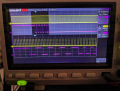
1692310017040.png
The yellow trace is the MISC scope trace gpio that times the function cpu usage and frequency. The Purple trace is the TX/RX uart register access IO_RB6 gpio scope trace toggles.
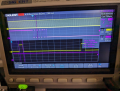
1692310734414.png
The polling cpu cost is 33us every 500us interrupt but reliable communications to the FM80 charge controller is the critical task of the board and there is plenty of extra time for other compute task to work with.

So here we have polling and interrupts used together as a system to send and receive UART data.
 

trebla

Joined Jun 29, 2019
599
While I've got a good grasp of the theoretical explanations, I'm struggling a bit when it comes to making the right choice in practical scenarios. I'd be happy to hear your thoughts on example in post #6, #19 and whether you'd recommend using polling or interrupts
For the example in post #19 i see one good reason to use interrupt if the MCU is put to sleep state in most time and wakes up from interrupt generated by detecting access card in reader. Other tasks can use polling or interrupt mostly with equal results.
 
Top