ChatGPT and AI related stuff

nsaspook

Joined Aug 27, 2009
16,503
https://news.berkeley.edu/2026/10/0...rodes-your-ability-to-persist-at-hard-things/

The findings backed up what anecdotes and surveys have increasingly found in recent years: An overreliance on AI for answers erodes our cognitive fitness. When AI produces answers in seconds, we get used to that speed; anything that takes longer feels inefficient. And relying on AI also removes what the team called “productive struggle,” which can lead people to find their research strengths and passions.

“We’ve built these systems to be helpful, but are they being helpful to us in a way that’s actually helping us?” Christian said. “We showed, ironically, that they are often helping us in ways that are kind of unhelpful.”
 

nsaspook

Joined Aug 27, 2009
16,503
Think of all the detail drafters who got lazy once CAD was generally available.
I think a lot of them enjoyed being lazy.

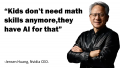
Most of us are not doing calculations by hand because we have calculator, but you absolutely need to understand the math itself. The AI induced lazy affects the foundation skills side of the equation.

1791665298818.png
 
Last edited:

WBahn

Joined Mar 31, 2012
33,309
Think of all the detail drafters who got lazy once CAD was generally available.
This was actually my first exposure to the erosion of skills that technology results in. When I was a sophomore, we had to take mechanical drafting. I had to drop out near the end of the semester to serve an active duty commitment and so I had to retake it when I returned three years later. In the meantime, they had switched from mechanical drafting to CAD (using AutoCAD 1.2). A large fraction of the students really struggle to do many of the assignments but I had very little difficulty at all because I just did them using the same concepts and constructions that I had learned in mechanical drafting. The one I remember most vividly was when we needed to divide a line into seven equal segments. There's a very simple construction to do that, so I did that while everyone else was trying to figure out what magic command to use to get the tool to do it for them. A couple people sitting near me saw me do something real fast to get it and asked me what I did, so I showed them and explained exactly how and why it worked, based on similar triangles, and neither of them could follow it. That really drove home how understanding the fundamental concepts of just about anything you do is so important to utilizing the tools, no matter how sophisticated they might be. It was also my first hint at something that I saw repeatedly over the next few years and that it took me many more years discover the cause, and that was how seriously hindered the math and reasoning skills were between people my age and people just a few years younger owing to the widespread adoption of calculator use in the classroom starting in first grade that occurred in the early 1970s.
 

nsaspook

Joined Aug 27, 2009
16,503
https://fion.ac/jellyfish.pdf

Artificial Intelligence in the Firm: Bottlenecks in Software Production

Abstract

We study the impacts of AI coding assistants and agents on software engineering work, using a novel proprietary dataset from an engineering analytics platform, covering 300 million work events — including GitHub coding activity, Jira issues, and Google Calendar events — across 718 firms. We use a staggered difference-in-differences design, exploiting variation in firmlevel adoption timing of AI coding assistants and agents. Both technologies increase coding productivity. However, productivity gains do not fully pass through to changes in software output or employment. For AI agents, this incomplete pass-through reflects a bottleneck from code review: review times increase, a larger share of code updates require revisions, and reviews involve more comments. We develop a model of software production to structure these results, in which AI affects both productivity and quality of intermediate outputs, and in turn can generate a review bottleneck and limit pass-through.

6 Conclusion
Generative AI has garnered significant attention in the software context, yet relatively little is known about how improvements in individual productivity translate into firm-level outcomes. Using novel data from an engineering analytics platform, we study the effects of firm adoption of AI coding assistants and agents on software production. We find that both technologies increase coding productivity, with larger effects for AI agents. Despite these gains, we find little evidence that firms increase software output or reduce employment. Instead, the productivity gains are absorbed by downstream constraints in the production process. In particular, code review becomes the bottleneck. Following adoption of AI agents, the code review process significantly increases in lengths, pull requests are more likely to require revisions, and reviewers leave more comments. Firms respond by reallocating labor towards code review. This bottleneck is not simply alleviated through adoption of AI code review tools — even after adoption, humans are still involved in the code review process. Our model structures these findings by showing that AI can have dual effects on production, by changing coding productivity as well as the bug rate of code. These findings have several implications for managers. First, measuring the returns to AI requires evaluating the entire production process. Many managers rely on intermediate productivity metrics, such as lines of code or commits; however, these may not accurately capture the true gains from AI adoption. Second, realizing the benefits of AI adoption requires complementary organizational investments. Changes in one production stage may shift the bottleneck to another, and hence necessitate reallocation of labor. More broadly, our findings suggest that the economics of AI adoption cannot be understood by studying automated tasks in isolation. Production processes consist of multiple complementary activities, and accelerating one stage often shifts the constraint elsewhere. Understanding where these bottlenecks arise — and how firms reorganize to address them — will be central to understanding the long-run effects of AI on productivity, organizational design, and labor demand.

https://arstechnica.com/ai/2026/10/ai-coding-agents-generate-more-code-but-not-more-software/
AI coding agents generate more code, but not more software
Study finds coding efficiency gains get “absorbed” by human review “bottleneck.”
 

Danko

Joined Nov 22, 2017
2,247
OpenAI Sued by 8 States Over ChatGPT Safety Concerns


Binance News


4h・Verified Binance official account


According to CNBC, eight states filed lawsuits against OpenAI on Wednesday, alleging that ChatGPT is an unsafe product that has harmed children and deceived parents.
Iowa, Kansas, Nebraska, West Virginia, Arkansas, Arizona, Idaho and Montana each sued OpenAI in their own state courts,
and Iowa Attorney General Brenna Bird said the state’s case seeks to protect Iowans affected by what she called OpenAI’s reckless and unlawful conduct.
OpenAI spokesperson Drew Pusateri said the company has built age-specific protections into ChatGPT and is working with states on policies for the broader AI industry.
He added that OpenAI will keep working with experts on additional safeguards, including parental controls, break reminders and age-appropriate model protections.
 
Top