Change which circuit connects to ground...

WBahn

Joined Mar 31, 2012
32,930
@dl324 - your circuit doesn't seem to work, in Every circuit, with the switch closed L1 uses 13.4mA and L2 0mA.

But with the switch open, L2 gets 13.5mA but L1 still gets 10.1mA.
This is because the drop in voltage across L1 is, just the difference between the saturation voltage of one transistor and the base-emitter voltage of the other transistor. Roughly speaking that is going to be about half a volt. With a 220 Ω resistor that is going to amount to a reduction of about 2.3 mA (you are seeing a reduction of 3.3 mA, which is well within that ballpark).

There is one thing is puzzling me. All the transistors for the "switches" are in parallel. So why does turning them on one at a time decrease the current draw across the LED's that are lit?

http://everycircuit.com/circuit/6146264910528512
As you draw more total current you get more voltage drop across the shared transistors and, therefore, less current.
 

Thread Starter

Jonathan David Bond

Joined Nov 10, 2015
25
Thanks.

I still don't "understand", but I now do have half a clue.

I need to scale this up to the full 24 LED's some how and test it to see the total difference between 1 on and all on, but I can't seem to expand the workspace, so I'm stuck with that limited example.
 

WBahn

Joined Mar 31, 2012
32,930
If the differences are important, you can just give each bank it's own pair of low-side transistors. As long as you have a sufficiently stiff supply, that should almost completely isolate the banks from interacting with each other.
 

dl324

Joined Mar 30, 2015
18,370
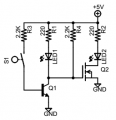
I see the error of my ways. This circuit will work, but it requires replacing one of the NPN transistors with an N channel MOSFET:
upload_2015-11-15_18-33-4.png
Since the MOSFET requires essentially zero current, LED1 can turn off completely.

This satisfies your minimum parts criteria, but requires a MOSFET to be introduced. But R4 can be eliminated.

Your choice. Swap a MOSFET for a transistor and remove a resistor, or add a PNP transistor and resistor.
 
Last edited:

Thread Starter

Jonathan David Bond

Joined Nov 10, 2015
25
Thank you, I'll have a go with that setup later @dl324 .

@WBahn - I understood something for once.

It's only 4 banks of 4, not 6. I cheated and used 1 resistor per parallel banks of LED's (don't worry, this is just to get the simulation working with the space I have, I will give each LED their own series resistor when it come to building), and its messy - because I still haven't figured out if the work space can be enlarged...

But, IT WORKS!

And thanks to the extra transistors, brightness levels stay the same whether 1 bank or all 4 at on.

Thank you.

Circuit is here...

http://everycircuit.com/circuit/6656051624542208
 

dl324

Joined Mar 30, 2015
18,370
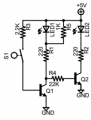
This is the solution Alec_t described in post #7, with R5 added for the dimly lit LED problem:
upload_2015-11-17_7-48-21.png
A range of values can be used for R4, but smaller increases "off" current in LED1. R5 shunts current from LED1 when it's supposed to be off and can be made smaller if the LED still lights.

The shunt idea came from @Jony130's solution to a flip flop question.
 
Top