Facebook
 Google
 GitHub
 Linkedin

What do you do with over 100 obsolete DEC mini banana jack cables?
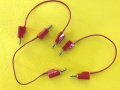
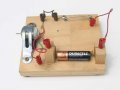
I have been using these to create modular breadboard circuits for children to experiment with simple circuits. I have modules of lamps, motors. pushbuttons, sound devices, etc.
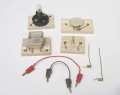
Recently, I revived this idea to make LED letters for my grandchild's birthday. My first attempt was to create the letters from wood. The letters are translucent 1.75 mm 3D printer filament illuminated by two or three coloured LEDs on the ends of the filament, to create a light pipe.
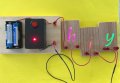
The letters are cut on my CNC machine. The "h" and "y" take three LEDs while the "i" uses two LEDs. The assembly is overlayed with a thin oak veneer, again, cut on the CNC machine. The entire production and assembly is very time consuming and finicky. The black box contains an XL6009 DC-DC boost converter to increase the 3 V to about 25 V. This is followed by an LM317 voltage regulator set up to give 10 mA constant current output.
Then I went to Version 2, which is to print the entire module on the 3D printer.
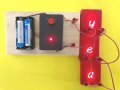
While the white LED is not as pretty, this solution has advantages.
1) The production is simple, efficient, and gives consistent results.
2) The letters are backed by a sheet of translucent plastic instead of having to lay tiny pieces of 3D filament.
3) Only one LED is needed in each module. This reduces the load on the PSU and the required maximum voltage.
For future production, I will try printing with a neutral colour or wood filament and try different LED colours.
Here are the interesting observations. The LEDs are driven at 10 mA from an LM317 constant current circuit. It was intended that the letters be connected in series. By measuring the PSU output voltage, one can observe that the voltage goes up as another letter is added, until the limit of the PSU is reached. At that point, the LEDs start to dim.
Surprisingly, you can also connect the letters in parallel (the red plastic letters). The measured output voltage stays fairly constant at 2.7 V, falling only by 0.02 V on every additional letter. There is a slight reduction of the letter brightness. (I think I can explain the observations but I just wanted you to think about it.)
Now, here is the final challenge for you.
Design a circuit so that the letters must be connected in series in the correct order in order to spell out the child's name and be lit.
Is there a simple solution even with an MCU?
I have been using these to create modular breadboard circuits for children to experiment with simple circuits. I have modules of lamps, motors. pushbuttons, sound devices, etc.
Recently, I revived this idea to make LED letters for my grandchild's birthday. My first attempt was to create the letters from wood. The letters are translucent 1.75 mm 3D printer filament illuminated by two or three coloured LEDs on the ends of the filament, to create a light pipe.
The letters are cut on my CNC machine. The "h" and "y" take three LEDs while the "i" uses two LEDs. The assembly is overlayed with a thin oak veneer, again, cut on the CNC machine. The entire production and assembly is very time consuming and finicky. The black box contains an XL6009 DC-DC boost converter to increase the 3 V to about 25 V. This is followed by an LM317 voltage regulator set up to give 10 mA constant current output.
Then I went to Version 2, which is to print the entire module on the 3D printer.
While the white LED is not as pretty, this solution has advantages.
1) The production is simple, efficient, and gives consistent results.
2) The letters are backed by a sheet of translucent plastic instead of having to lay tiny pieces of 3D filament.
3) Only one LED is needed in each module. This reduces the load on the PSU and the required maximum voltage.
For future production, I will try printing with a neutral colour or wood filament and try different LED colours.
Here are the interesting observations. The LEDs are driven at 10 mA from an LM317 constant current circuit. It was intended that the letters be connected in series. By measuring the PSU output voltage, one can observe that the voltage goes up as another letter is added, until the limit of the PSU is reached. At that point, the LEDs start to dim.
Surprisingly, you can also connect the letters in parallel (the red plastic letters). The measured output voltage stays fairly constant at 2.7 V, falling only by 0.02 V on every additional letter. There is a slight reduction of the letter brightness. (I think I can explain the observations but I just wanted you to think about it.)
Now, here is the final challenge for you.
Design a circuit so that the letters must be connected in series in the correct order in order to spell out the child's name and be lit.
Is there a simple solution even with an MCU?