Capacitance in a series circuit

Thread Starter

kevin monroe

Joined Nov 7, 2014
11
My electronics book says "Because the current throughout a series circuit is the same at any point, capacitors connected in series have the same number of coulombs (C) of charge (Q)."
Is this statement true without qualification? It seems like only capacitors of equal capacitance would have equal charge. Wouldn't the charge vary with the capacitance of the capacitor?
Thanks for any help.
 

Thread Starter

kevin monroe

Joined Nov 7, 2014
11
My electronics book says "Because the current throughout a series circuit is the same at any point, capacitors connected in series have the same number of coulombs (C) of charge (Q)."
Is this statement true without qualification? It seems like only capacitors of equal capacitance would have equal charge. Wouldn't the charge vary with the capacitance of the capacitor?
Thanks for any help.
Thanks! That's weird.
 

crutschow

Joined Mar 14, 2008
38,506
Thanks! That's weird.
Not really. Since Q = CV the voltage across different size capacitors in series will be different so they each has the same charge . For example if you apply 3V to a 1uF cap in series with a 2uF cap than the 1uf will end up with 2V across it and the 2uF will have 1V across it, giving the same charge transferred to each capacitor.
 

WBahn

Joined Mar 31, 2012
32,834
My electronics book says "Because the current throughout a series circuit is the same at any point, capacitors connected in series have the same number of coulombs (C) of charge (Q)."
Is this statement true without qualification? It seems like only capacitors of equal capacitance would have equal charge. Wouldn't the charge vary with the capacitance of the capacitor?
Thanks for any help.
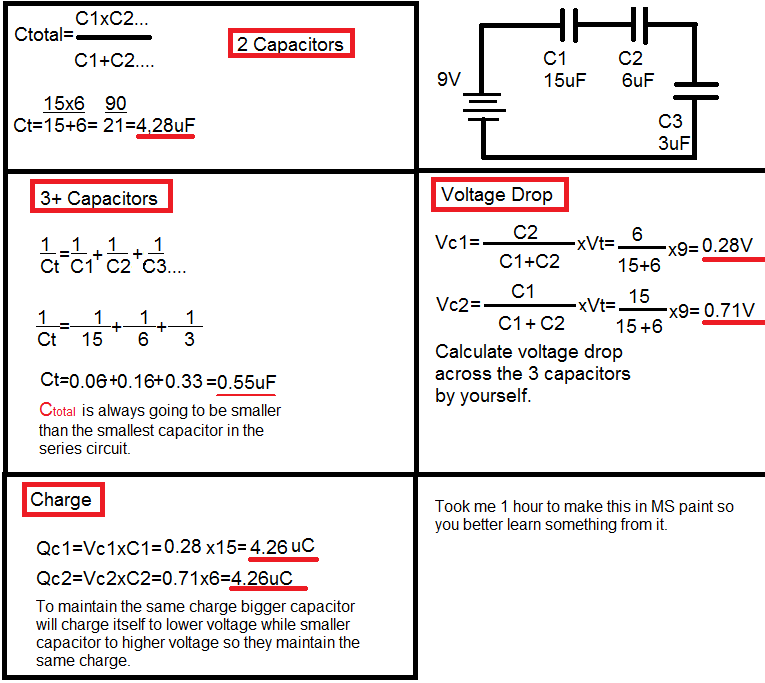
It's not true without qualification, because it is possible for the capacitors to start out with different amounts of charge on them and this difference will be preserved. Also, for real capacitors (particularly larger value and certain types of electrolytics) there will be a leakage current that will tend to discharge the caps at different rates. For this reason, putting capacitors in series in real circuits is generally discouraged. But on paper what your books says is correct in principle.
 

Thread Starter

kevin monroe

Joined Nov 7, 2014
11
It's not true without qualification, because it is possible for the capacitors to start out with different amounts of charge on them and this difference will be preserved. Also, for real capacitors (particularly larger value and certain types of electrolytics) there will be a leakage current that will tend to discharge the caps at different rates. For this reason, putting capacitors in series in real circuits is generally discouraged. But on paper what your books says is correct in principle.
thx
 
Top