capacitance -current flow in a swiched circuit with a capacitor

Thread Starter

sharanbr

Joined Apr 13, 2009
82
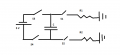
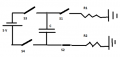
I would like to understand how the attached circuit with capacitance would behave.

Initially - S3 & S4 are closed. S1 and S2 are open.

Condition 1 - S3 & S4 are open. S1 is closed and S2 is open

Condition 2 - S3 & S4 are open. S1 is open and S2 is closed

Under condition 1 - electrons would flow from C and through R1?
Under condition 2 - would electrons flow through R2 and into C

How potential plays a role when S3 and S4 are open.
 

Attachments

BillB3857

Joined Feb 28, 2009
2,573
Do a little thought exercise and see if you can come up with the answer. What would be the voltage and polarity on the capacitor after the initial condition? What happens when condition 1 takes place? What is the current path for each condition? What is the current path for Condition 2? What happens then?

Are you sure you have the switches numbered properly?
 
Last edited:

dl324

Joined Mar 30, 2015
18,326
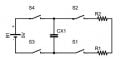
It might be easier for you to visualize current flow, or the lack thereof, by connecting the two points labeled as ground, and removing the ground connection because neither side of the battery or cap is grounded.

With the capacitor charged, S3 and S4 opened, and only one of S1 or S2 closed, can you see a path for current to flow? Note that I also flipped your schematic so the positive battery terminal is on top.
swQuest.jpg
 
Last edited:

Thread Starter

sharanbr

Joined Apr 13, 2009
82
Do a little thought exercise and see if you can come up with the answer. What would be the voltage and polarity on the capacitor after the initial condition? What happens when condition 1 takes place? What is the current path for each condition? What is the current path for Condition 2? What happens then?

Are you sure you have the switches numbered properly?
Dear Bill,

S1 closed; S2, S3, S4 - open

My initial assumption was that current flows in R1 -> C direction (and electrons in the opposite direction).
But after looking at the posts subsequently, I think no current can flow, as the other end of capacitor has no path to react to this changing status on the upper plate.

Assuming my interpretation above is correct, I have a follow-up question.

If S1 and S4 are closed; S2 and S3 are open, would it mean that circuit is complete and result in current flow across R1?

Similarly, if S1 & S2 are closed; S3 & S4 are open, would it result in current flow?
 

BillB3857

Joined Feb 28, 2009
2,573
Draw the circuit in each configuration you mention. Trace with a pencil and see if you have a complete path to either charge or discharge the capacitor.
 

Thread Starter

sharanbr

Joined Apr 13, 2009
82
It might be easier for you to visualize current flow, or the lack thereof, by connecting the two points labeled as ground, and removing the ground connection because neither side of the battery or cap is grounded.

With the capacitor charged, S3 and S4 opened, and only one of S1 or S2 closed, can you see a path for current to flow? Note that I also flipped your schematic so the positive battery terminal is on top.
View attachment 88094
Dear Dennis,

My understanding was (I am saying 'was' as I am seriously doubting it now) that S1 being closed is sufficient for current to flow.
Now, I realize that probably circuit has to be complete in some form.

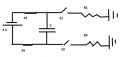
So, I have put another figure. Does this result in current flow?
 

Attachments

MikeML

Joined Oct 2, 2009
5,444
...

So, I have put another figure. Does this result in current flow?
Nope. There must be a conductive path from the positive terminal of the battery to the top of the resistor for any current to flow...

Repeat after me: "there must be a complete loop for current to flow".

I thought we dealt with this in your other thread?
 

Thread Starter

sharanbr

Joined Apr 13, 2009
82
Nope. There must be a conductive path from the positive terminal of the battery to the top of the resistor for any current to flow...

Repeat after me: "there must be a complete loop for current to flow".

I thought we dealt with this in your other thread?
Sorry about that. I will keep that in mind.
 

BillB3857

Joined Feb 28, 2009
2,573
If you start at a point and trace the circuit and don't wind up back at the starting point, you don't have a complete path.
 

WBahn

Joined Mar 31, 2012
32,823
I would like to understand how the attached circuit with capacitance would behave.

Initially - S3 & S4 are closed. S1 and S2 are open.

Condition 1 - S3 & S4 are open. S1 is closed and S2 is open

Condition 2 - S3 & S4 are open. S1 is open and S2 is closed

Under condition 1 - electrons would flow from C and through R1?
Under condition 2 - would electrons flow through R2 and into C

How potential plays a role when S3 and S4 are open.
Help people help you. Provide a sketch for each configuration along with your question. This doesn't take much time and greatly increases the chance that people will take the time to respond and greatly decreases the likelihood of miscommunication. For instance, something like the following:

I have a circuit in which S3 and S4 are closed while S1 and S2 are open:

upload_2015-7-5_17-16-14.png

I then have two conditions I want to ask about.

Condition 1: S3 and S4 are open, S1 is closed, and S2 is open:
upload_2015-7-5_17-18-32.png
Condition 2: S3 and S4 are open, S1 is open, and S2 is closed:
upload_2015-7-5_17-19-41.png

Under condition 1 - electrons would flow from C and through R1?
Under condition 2 - would electrons flow through R2 and into C

How potential plays a role when S3 and S4 are open.


See how much easier it is for someone to follow what you are saying and asking?
 

Thread Starter

sharanbr

Joined Apr 13, 2009
82
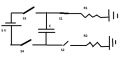
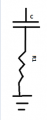
You Condition 1 basically comes down to the following:

View attachment 88119

Will current flow in this "circuit"?
Dear Bahn,

My answer in 2 parts ... (what & why)

what - i know that current would not flow through this as circuit is not complete

why - i don't know why this happens. I guess that for current to flow two nodes, they just have to be at different potentials
 

Thread Starter

sharanbr

Joined Apr 13, 2009
82
Help people help you. Provide a sketch for each configuration along with your question. This doesn't take much time and greatly increases the chance that people will take the time to respond and greatly decreases the likelihood of miscommunication. For instance, something like the following:

I have a circuit in which S3 and S4 are closed while S1 and S2 are open:

View attachment 88116

I then have two conditions I want to ask about.

Condition 1: S3 and S4 are open, S1 is closed, and S2 is open:
View attachment 88117
Condition 2: S3 and S4 are open, S1 is open, and S2 is closed:
View attachment 88118

Under condition 1 - electrons would flow from C and through R1?
Under condition 2 - would electrons flow through R2 and into C

How potential plays a role when S3 and S4 are open.


See how much easier it is for someone to follow what you are saying and asking?
Sure. Will do hereafter ...
 

WBahn

Joined Mar 31, 2012
32,823
Dear Bahn,

My answer in 2 parts ... (what & why)

what - i know that current would not flow through this as circuit is not complete

why - i don't know why this happens. I guess that for current to flow two nodes, they just have to be at different potentials
For current to flow between two nodes, they do not HAVE to be at different potentials, but this is usually the case. The counter example is a superconducting magnet.

But you DO have to have a complete circuit (there ARE cases where this is not strictly true, but you will almost never run into them).

I think I have recommended this to you before, but if so it appears you didn't read it.

http://forum.allaboutcircuits.com/xfa-blog-category/circuit-analysis.37/view-entries

If you have current flowing onto (or off of) one plate of a capacitor and not the other, it takes very little current to result in a net charge on the capacitor (as a whole) that will built up enough of a potential difference to start arcing.
 
Top