Facebook
 Google
 GitHub
 Linkedin

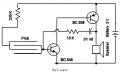
Hi. I am a beginner. I am just learning about transistors but am confused about this schematic at this website:
https://www.elprocus.com/top-10-simple-electronic-circuits-for-beginners/
It is a schematic for a Rain Alarm.
In the schematic, I see that there is a NPN transistor at the bottom and a PNP transistor at the upper right.
The NPN has the collector at the top leg and the emitter at the bottom leg.
The PNP has the emitter at the top leg and the collector at the bottom leg. Right so far?
Seems to me when there is no rain Prob acts like an open circuit? But when it rains it acts like a closed switch?
Then, current flows through the NPN emitter to base, as the emitter is connected to the negative terminal of the battery and the base is connected to the positive terminal of the battery.
This allows current to flow between the NPN collector and emitter. This is how a NPN transistor works?
When this happens, current flows out of the PNP base, right?
This is where I get stuck. As I understand it, when current flows out a PNP base, the flow between the emitter and collector stops? But then the circuit to the speaker will be disconnected? Then how can this alarm work? Seems like once current flows through Prob, current then flows through NPN, then next current flows through PNP and the speaker turns on? But I read that a PNP transistor normally allows flow between collector and emitter until current flows out the base. But looks like if NPN turns on, PNP should turn off, as the collector of the NPN is connected to the base of the PNP transistor? Help would be appreciated.
https://www.elprocus.com/top-10-simple-electronic-circuits-for-beginners/
It is a schematic for a Rain Alarm.
In the schematic, I see that there is a NPN transistor at the bottom and a PNP transistor at the upper right.
The NPN has the collector at the top leg and the emitter at the bottom leg.
The PNP has the emitter at the top leg and the collector at the bottom leg. Right so far?
Seems to me when there is no rain Prob acts like an open circuit? But when it rains it acts like a closed switch?
Then, current flows through the NPN emitter to base, as the emitter is connected to the negative terminal of the battery and the base is connected to the positive terminal of the battery.
This allows current to flow between the NPN collector and emitter. This is how a NPN transistor works?
When this happens, current flows out of the PNP base, right?
This is where I get stuck. As I understand it, when current flows out a PNP base, the flow between the emitter and collector stops? But then the circuit to the speaker will be disconnected? Then how can this alarm work? Seems like once current flows through Prob, current then flows through NPN, then next current flows through PNP and the speaker turns on? But I read that a PNP transistor normally allows flow between collector and emitter until current flows out the base. But looks like if NPN turns on, PNP should turn off, as the collector of the NPN is connected to the base of the PNP transistor? Help would be appreciated.