Facebook
 Google
 GitHub
 Linkedin
Hi forum.
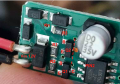
During the reverse engineering of a constant current small LED circuit driven by an IC I run into this "strange" schematic that I attach.
The IC (Infineon's IL6150) is a monolitic LED driver that has an internal PWM generator driven by an analog or digital voltage applied to PIN 2.
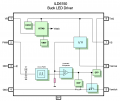
The input pin has an internal pull-up circuit to high level if not connected externally on PCB. Icc,PWM current is approx. -18uA
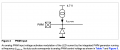
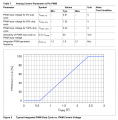
Driving it via a 0 to 4.5V analog voltage changes the PWM according to this table:
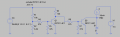
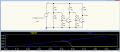
So on the PCB there is a polarization circuit I have simulated in LTSpice here:
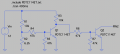
Two Common emitter NPN in series that should keep PIN2 IC voltage above 4.5V.
Note that this transistor has two internal series biasing resistor (R4,R5 and R6,R7) at the base and the emitter of 47k I needed to insert in the simulation otherwise they gave not the same voltages as measured.
Following logic, Q1 is on, in saturation mode, since V at nod R4,R2 is 4,5V so Q2 should be off.
No external polarization from the collector, so Q2 is off.
Vpin2 has been measured to be 8mV, no current flows out of Q2 collector, pin2 is held high by its internal circuitry.
So Why the heck did you need to implement this external biasing circuitry??
The designer should have something in mind I do not recognize, either because I am missing something or I am wrong in my consideration.
* First of all are my considerations right?
If the designer would have wanted to maybe change and keep at fixed PWM by changing the Vpin2 from 0 to 2.5V according to the datasheet and the PWM dutycycle, what kind of resistor should he have to change?
* Am I correct if I say, I need to turn on Q2 by letting Q1 return into linear mode?
Howto acheive the 0-2.5V voltage range?
Any suggestion howto make such a variable voltage 0-2,5 by a trimpot?
Best regards and thanks
During the reverse engineering of a constant current small LED circuit driven by an IC I run into this "strange" schematic that I attach.
The IC (Infineon's IL6150) is a monolitic LED driver that has an internal PWM generator driven by an analog or digital voltage applied to PIN 2.
The input pin has an internal pull-up circuit to high level if not connected externally on PCB. Icc,PWM current is approx. -18uA
Driving it via a 0 to 4.5V analog voltage changes the PWM according to this table:
So on the PCB there is a polarization circuit I have simulated in LTSpice here:
Two Common emitter NPN in series that should keep PIN2 IC voltage above 4.5V.
Note that this transistor has two internal series biasing resistor (R4,R5 and R6,R7) at the base and the emitter of 47k I needed to insert in the simulation otherwise they gave not the same voltages as measured.
Following logic, Q1 is on, in saturation mode, since V at nod R4,R2 is 4,5V so Q2 should be off.
No external polarization from the collector, so Q2 is off.
Vpin2 has been measured to be 8mV, no current flows out of Q2 collector, pin2 is held high by its internal circuitry.
So Why the heck did you need to implement this external biasing circuitry??
The designer should have something in mind I do not recognize, either because I am missing something or I am wrong in my consideration.
* First of all are my considerations right?
If the designer would have wanted to maybe change and keep at fixed PWM by changing the Vpin2 from 0 to 2.5V according to the datasheet and the PWM dutycycle, what kind of resistor should he have to change?
* Am I correct if I say, I need to turn on Q2 by letting Q1 return into linear mode?
Howto acheive the 0-2.5V voltage range?
Any suggestion howto make such a variable voltage 0-2,5 by a trimpot?
Best regards and thanks
Last edited:


 .
.