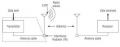
You need to look at the total system of the antenna (as a transducer of propagating EM signals/RF waves in a medium), transmission line (antenna feed of those captured signals from the antenna) and detector (as part of a receiver using the signals from the transmission line antenna feed)
Your question, as asked, is completely vague. Yes, No, Maybe ...
In radio normally the term detect is performed in the receiver. I can answer that by rewording the question a little.
Yes, a monopole when it is tuned to resonance, impedance matched and connected to a receiver having the required sensitivity.
Look for the receiver's sensitivity specifications. I have seen specs showing receiver sensitivity of 1uV.
A quality receiver does not need much help. Not all receivers are capable of sufficient gain and filtering. Where does the gain come from?
A low noise pre-amplifier (LNA) that will cover the frequency band can improve the signal strength. 18-32 dB, that gain is strong,
The added signal might be to overcome the loss of a notch filter for example removing industrial noise like 240 Hertz.
A monopole antenna for example can have a specified gain like 14 dB. So the location, the receiver, the pre-amp, the antenna and the ground
combined will improve the reception sensitivity.
Easily today with modern technology. The Deep Space Network is receiving signals in the range of a fraction of a femtowatt. DSN's 34-meter antennas can detect signals as weak as -160 dBm. That's like 2.2e-9 into a 50 ohm load.
An important point: µW and nW are not units of signal strength.
Signal strength is measured in V or dB. Watts are used to specify the output of a source but received signal strength is a matter of the E-Field (electric field, one half of the electro-magnetic radiation).
So, really the concern is field strength close to the antenna of the receiver. This is measured as volts per unit distance, specifically V/m. or dBµV/m (dB relative to 1µ/m).
This may seem pedantic but when analyzing cases like this it is important to make these distinctions since you can’t even ask a well formed question without the proper terminology.
Acquisition sensitivity represents the minimum power level at which a GNSS receiver can achieve a position fix. This is the minimum level to successfully perform TTFF under cold start. Cold Start is the TTFF condition where the GNSS receiver has no information about the satellites above. It needs to conduct a full search of the sky to find the satellites in view and obtain the almanac and ephermal data. Acquisition sensitivity is usually around -140 to -150 dBm.
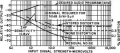
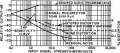
Picture from post #10. Look at the line STERO and the line MONO. If you reduce the bandwidth of the signal to 'old telephone' then there would be a line that much below. Every time you reduce the bandwidth you can detect a weaker signal. You must transmit slower. Morse code is sent very slow and can have a very limited bandwidth.
Because we don't know what you want to receive, we are just guessing. We don't know what frequency. Some have background noise and some not so much.
The best naval class receivers demanding no any surplus crygenic cooling of input semiconductors are able, typically to sense about 0.1 microvolt. Thus applying the guess that any antenna have impedance of 50 Ohms applicate the Ohms Law and get N=V^2/R=(1E-6)^2/50=2.0E-10 W or 0.2 nanowatts.
I think he means (judging from previous conversations with the poster), one's that don't require cryogenic cooling.
And there's no need. Today you can buy a room temp, sub 1.0 noise figure LNA. That's a equivalent noise temp of only a few tens of K, so you'd need Helium cryogenic cooling to be much better.
Room Temp LNA https://lownoisefactory.com/product/lnf-lnr1_15b_sv/

 Facebook
 Google
 GitHub
 Linkedin