Calculating transistor resistors

Thread Starter

Dritech

Joined Sep 21, 2011
907
Hi all,

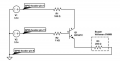
I need to use the circuit in the attached diagram where I will be driving the transistor base from a 3.3V GPIO. For the transistor collector I will be connecting a 5V supply instead af 3.3V.
What equation can I use to determine the resistors values (without assuming resistor values) ?
 

Attachments

Last edited:

ian field

Joined Oct 27, 2012
6,536
Hi all,

I need to use the circuit in the attached diagram where I will be driving the transistor base from a 3.3V GPIO. For the transistor collector I will be connecting a 5V supply instead af 3.3V.
What equation can I use to determine the resistors values (without assuming resistor values) ?
As its an emitter follower; you don't really need those extra resistors - the emitter will follow the base voltage, except that you lose 0.7V in the B/E Vf.

If you were running at 3.3V the Vbe drop might possibly prevent it working. Even at 5V you could be cutting it fine, in which case a common emitter stage would be better - if your load has to be ground referenced; you'd need a second (PNP) common emitter hanging from Vcc.

Then it starts getting complicated because the common emiter is inverting, but nothing that can't be sorted out with a few more posts.

A common emitter does of course require a resistor to limit the current into the base, find out the max current you micro can source and calculate the resistor taking Vout-high and subtractin 0.7 Vbe, and just perform Ohm's law on what's left.
 
Last edited:

AnalogKid

Joined Aug 1, 2013
12,128
If you want the maximum loudness from the buzzer, change the configuration to a common-emitter circuit:
Eliminate R1 and the connection to GPIO pin 1 (+3.3V).
Tie the emitter to GPIO pin 6 (GND)
Connect one end of the buzzer to the collector.
Connect the other end of the buzzer to +5V.
Note: the buzzer might have polarity markings. If so, connect the + pin to +5V and the - pin to the collector.

ak
 

ian field

Joined Oct 27, 2012
6,536
If you want the maximum loudness from the buzzer, change the configuration to a common-emitter circuit:
Eliminate R1 and the connection to GPIO pin 1 (+3.3V).
Tie the emitter to GPIO pin 6 (GND)
Connect one end of the buzzer to the collector.
Connect the other end of the buzzer to +5V.
Note: the buzzer might have polarity markings. If so, connect the + pin to +5V and the - pin to the collector.

ak
As far as I can see; the TS is asking how to calculate the resistor values AS IF a common emitter were being used, I think they'll have voltage overhead problems with the emitter follower.
 
Top