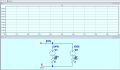
Calculating the voltage between A and B with kirchoff

Thread Starter

kanayan

Joined Oct 6, 2024
8
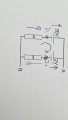
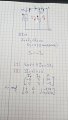
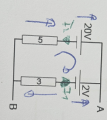
I'm not sure where to start, usually with kirchoff i have 3 currents and then i have to solve for equations. Now i have two and i have to calculate the voltage. I'm quite sure that I1 = I2 is false and that i am doing something wrong, please help me get on the way i don't understand.
 

Attachments

Thread Starter

kanayan

Joined Oct 6, 2024
8
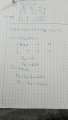
I3 is 0 because there's no current where there's no resistance right? But an extremely high voltage yes?
 

Jerry-Hat-Trick

Joined Aug 31, 2022
782
At the risk of getting shouted down, I’ve always thought that (1) Kirchhoff’s laws are so obvious that it’s a mystery why anyone was ever given credit for them, and (2) the only problems they are used to solve are artificially created impractical circuits. For this problem, for example, if you assume, without loss of generality, that the voltage at A is 20V then you know the voltages on the negative side of both batteries so you can work out the voltage between the resistors, i.e. point B, as a potential divider. Credit to Georg Simon Ohm. Where does Gustav Kirchhoff get involved?
 

WBahn

Joined Mar 31, 2012
32,714
I'm not sure where to start, usually with kirchoff i have 3 currents and then i have to solve for equations. Now i have two and i have to calculate the voltage. I'm quite sure that I1 = I2 is false and that i am doing something wrong, please help me get on the way i don't understand.
1728249924145.png

Your diagram is very ambiguous. I have five blue arrows on it and none of them are labeled. Are these currents? Voltages? What? Then you have two green labels and it looks like they are associated with green arrows with the top one pointing to the left and the bottom one presumably pointing to the right. You need to make it clear what your notations mean.

I'm going to guess/assume that I2 is current flowing to the left in the top branch and I1 is current flowing to the right in the bottom branch (and it's never good to force someone reviewing your work (like, say, the grader) to have to guess what you mean).

If I1 = I2 is false -- meaning that they are not equal -- then where does the unaccounted for current go?

Let's say that I1 turns out to be 10 A and I2 turns out to be 7 A. That means that 10 A is entering the node labeled A, but only 7 A is leaving it. What is happening to the other 3 A of current? Since nothing else is connected to 'A', whatever comes into it on one branch has to leave on the other, right?
 

WBahn

Joined Mar 31, 2012
32,714
Of course, here is my best attempt. I stopped at the end cuz i realised the currents dont meet the law of Kirchoff
You've changed the circuit by adding a short circuit across A and B.

Change the circuit, and any answers you get are for the changed circuit, not the circuit you were given.

I3 is 0 because there's no current where there's no resistance right? But an extremely high voltage yes?
No. If there is no resistance and there is a voltage across it, then (in theory) an infinite current flows. In reality, the current goes to a high enough value that something else imposes a limit, such as a fuse.

A short circuit imposes the constraint that there is zero voltage across the short, but no constraint on current.

An open circuit imposes the constraint that no current can flow, but no constraint on the voltage.
 

MisterBill2

Joined Jan 23, 2018
27,214
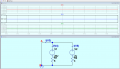
For the circuit shown, with two batteries and two resistors, and an OPEN CIRCUIT between A and B, the solution is simple: The sum of the voltages around the loop is zero! so adding the voltages, +20 to -2=18 volts. 5 ohms plus 3 ohms =8 ohms. so the current in the loop is 18Volts/8 ohms=2.25 amps. And the currents in every part of the loop are the same value, but the sign depends on which way you are looking.
The voltage between point A and point B will be 20 volts minus 2.25A x 5 ohms=11.25 volts, with point "A" being positive.
AND, the external resistance across points A and B is INFINITE, not zero.
 
Top