Calculating the radius of a nut

Thread Starter

Wendy

Joined Mar 24, 2008
23,797
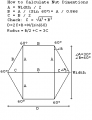
Part of the things I have to do using my 3D printer is calculate the radius of a nut using a Polygon:
eNut problem.png
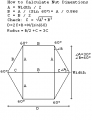
this diagram shows my work to date.I believe the equation is C=B/ 2(.866) Radius=3C
Here's my problem if I'm trying to calculate polygon radius for 0.25 screwdriver bit I get:
Width 0.25" A=0.125 B= A/0.866, B=0.1443, C=0.1443/2=0.72,, Radius=3 x 0.072, 0.216
When I determine the radius empirically using 3D prints I get 0.16"
What am I missing?
 

Attachments

Last edited:

Papabravo

Joined Feb 24, 2006
22,084
For starters - angle A is 60°, and angle C is 30°. Angle B does not appear in the triangles, it is the side of the hexagon.
 

WBahn

Joined Mar 31, 2012
32,936
The problem is in your last line where you say that

Radius = B/2 + C = 3C

But two lines above that, you say that C = B/2

If that's the case, then B/2 = C and you can make that substition to get

Radius = B/2 + C = C + C = 2C

While true, it doesn't really help you because you don't know what C is in terms of W.

Since you DO have B in terms of W, so instead of eliminating B, eliminate C.

Radius = B/2 + C = B/2 + B/2 = B

At which point you might recall that a hexagon is composed of six equilateral triangles and so the radius (of the circumscribed circle) is the same as the length of each side.

You already have the relationship between B and A, namely

B = A/sin(60°) = W/(2·sin(60°))

sin(60°) = (√3)/2

which yields a final result of

Radius = W/√3 = 0.5774 * W

So if W = 0.25", then the radius is 0.14", which is pretty close to what you measured.
 

Thread Starter

Wendy

Joined Mar 24, 2008
23,797
Going from another premise:

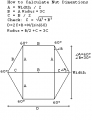
Nut problem.png
0.25" =Radius of 0.188"
A=0.125" C=3 * 0.0625"
Emperical Radius = 0.16
 
Last edited:

Thread Starter

Wendy

Joined Mar 24, 2008
23,797
The problem is in your last line where you say that

Radius = B/2 + C = 3C

But two lines above that, you say that C = B/2

If that's the case, then B/2 = C and you can make that substition to get

Radius = B/2 + C = C + C = 2C

While true, it doesn't really help you because you don't know what C is in terms of W.

Since you DO have B in terms of W, so instead of eliminating B, eliminate C.

Radius = B/2 + C = B/2 + B/2 = B

At which point you might recall that a hexagon is composed of six equilateral triangles and so the radius (of the circumscribed circle) is the same as the length of each side.

You already have the relationship between B and A, namely

B = A/sin(60°) = W/(2·sin(60°))

sin(60°) = (√3)/2

which yields a final result of

Radius = W/√3 = 0.5774 * W

So if W = 0.25", then the radius is 0.14", which is pretty close to what you measured.
So
if W=0.25" W=W/1.732 =.25/1.732 =0.144"
 

Ramussons

Joined May 3, 2013
1,569
Part of the things I have to do using my 3D printer is calculate the radius of a nut using a Polygon:
eView attachment 311394
this diagram shows my work to date.I believe the equation is C=B/ 2(.866) Radius=3C
Here's my problem if I'm trying to calculate polygon radius for 0.25 screwdriver bit I get:
Width 0.25" A=0.125 B= A/0.866, B=0.1443, C=0.1443/2=0.72,, Radius=3 x 0.072, 0.216
When I determine the radius empirically using 3D prints I get 0.16"
What am I missing?
Look at it this way.
A Hexagon is 6 Equilateral Triangles put together. The Diameter is same as the Side.
 

MrAl

Joined Jun 17, 2014
13,722
Thank you, I want to understand how to do it.
Hi,

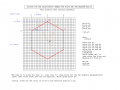
This solution is from analytic geometry with little need for preconceived notions about what a hex shape is. The only thing we really need to know is one of the angles from the horizontal to one of the vertexes when the hex is drawn with one of the points up.

This involves simply using the point-slope form of a line:
y=m*x+b

and solving for m and b for the lines a, b, c, and d, although you don't really have to solve for all of them because we know the middle of the hex is located at x=1 (in that drawing).

Once we find the slope 'ma' for line 'a' we know the slope for line 'c' is -1/ma, and the slope for line 'd' is -1/mb, and mb=-ma.
We can then solve for the y intercepts as needed (ba, bb, bc, bd), then solve for the solution to line 'c' and line 'd', which is the center of the hex. We then have two 'y' values, y1 and y3, then we just subtract y1-y3 and that equals the radius.

Note that once we have either line c or line d we know that the center must be at x=1 so we can use that instead to find the last point in the center, which gives us y3 and thus we can solve for the radius from that and y1 as before.

To find lines 'a' and 'b' we can also use the two-point form of a line.

I thought I would show you this method because it does not need much input about what the hex is, and it's kind of interesting to do it this way.
 

Attachments

Last edited:

panic mode

Joined Oct 10, 2011
5,037
spotted typo...

when two lines are perpendicular, product of slopes is -1

so m2=-1/m1

but you wrote mc=1/mb and md=1/ma (both are missing negative sign).
 

MrAl

Joined Jun 17, 2014
13,722
spotted typo...

when two lines are perpendicular, product of slopes is -1

so m2=-1/m1

but you wrote mc=1/mb and md=1/ma (both are missing negative sign).
Oh yes typo thanks. Also you can swap slopes but that's less intuitive. Oh wait I may have done that.
In any case when you plot the four equations you should see the two orange lines in the diagram as shown.
Corrected and also added note about using the two-point form of a line.
 

Attachments

Last edited:

Ron H

Joined Apr 14, 2005
7,063
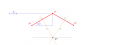
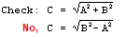
As others have said, decompose it to 6 equilateral triangles. The radius is 2*B.
Here is, I think, one thing that threw you off. I don't know if someone else already pointed this out.Nut radius.png
 
Top