Calculating SPL of three identical speaker drivers in parallel

Thread Starter

PeteHL

Joined Dec 17, 2014
585
A horn tweeter will be much louder (on axis) than a dome tweeter and the horn causes it to sound like a horn.
It will need attenuation to match the lower level of the woofer.

A woofer sounds "tight" (without resonances) when connected directly to the extremely low output impedance of a modern amplifier. Then three woofers in series are allowed to resonate and sound boomy like a bongo drum.
Good point which I hadn't considered, but what I've planned is three of two drivers connected in series, and the series-connected pairs of drivers connected in parallel to the output terminals of the amplifier. I think that is correct that connecting a pair of drivers in series would double Qes of both drivers.
 
Last edited:

BobTPH

Joined Jun 5, 2013
11,609
In any case , you will not increase the SPL per Watt. They will produce higher output power in the same ratio as higher input power.

Since that was your goal, you cannot succeed.
 

Thread Starter

PeteHL

Joined Dec 17, 2014
585
These are reasonably high-performance, and reasonably High-Fidelity Speakers.
They are useful for Mid-Bass / Midrange usage only.

Since You have 9 of them,
I would recommend building a Corner-mounted 4-Woofer "Line-Array",
with your existing Tweeter mounted in the center of the 4.
The "Corner-Loading" will increase their efficiency quite a bit,
and might let You get away without a Sub-Woofer for casual listening.

If You plan on pushing your luck with the Power and Bass-Frequencies,
a Crossover-Network that starts rolling-off the Low-Frequencies at around ~60hz will be required.
This Crossover can be Active, or Passive, or both,
using both is recommended for high-Power operation.

These Speakers will not reproduce Low-Bass Frequencies without damage at high-Power-Levels.
If You keep the power low, they will satisfactorily reproduce Low-Bass-Frequencies with lots of EQ.

Four 8-Ohm Speakers will allow a 2-in-series, plus, 2-in-series, connection
which will provide an 8-Ohm-Load for your Amplifier and Crossover-Components,
and will also double each Cabinet's maximum Power-Handling capabilities up to ~100-Watts RMS,
and also provide increased Efficiency, and Power-Handling by way of increased Cone-Area.

The 4 Woofers,
including the Tweeter which is mounted in the center of the Line-Array of Woofers,
should be spaced no more than around 1/2 inch apart.

The Tweeter should be roughly at "Head-Height" under the usual listening conditions.

The Cabinets should be Triangular in shape to fit tightly into the corners of the room.

For best Fidelity, including best "Transient-Response",
the Cabinets should be of Sealed-"Acoustic-Suspension" design and tightly packed
with "Rock-Wool" Building-Insulation, ( available at Home-Depot and Lowes ).

If You decide to go with Ported-Cabinets, you're on your own.
They will wind-up being "Boom-Boxes", with zero Low-Bass response.
I don't recommend this design for these Speakers.

A Sub-Woofer is highly recommended with these proposed Line-Arrays.
.
.
.
That's an interesting design, but unfortunately the corners in my listening room aren't open for placing loudspeaker systems there. My primary goal was to achieve high sensitivity so the fact that the f3 of the unassisted woofer couldn't be lower than about 80 Hz is beneficial as then that results in a less electrical wattage in driving it. Basically I'm just interested in seeing what the reproduction would be like and having a battery- powered stereo system for when there is a power outage. I currently have a stereo that I like very much in my listening room running on house current of course.
 

Thread Starter

PeteHL

Joined Dec 17, 2014
585
In any case , you will not increase the SPL per Watt. They will produce higher output power in the same ratio as higher input power.

Since that was your goal, you cannot succeed.
If we are considering two identical speaker drivers where W and P equal respectively the wattage and sound pressure developed by each of the drivers individually, and they are connected in parallel circuit across the output terminals of the amp and positioned a quarter wavelength apart or less, then

sensitivity of the pair = (2P)^2 / 2W = 4P / 2W = 2P / W

that is, twice the sensitivity of each of the drivers alone. Of course this assumes that the pressure waves produced by each driver sum together perfectly which can only be closely approached. So probably the improvement of sensitivity usually will be less than 6 dB and greater than 3 dB.

You are correct that I have been neglecting the fact that the pair of drivers connected in a parallel circuit are consuming twice the electrical power of a single driver. So at best, (wattage) sensitivity is improved by 3 dB.

See the Q & A by Linkwitz, Q21-Why does SPL increase by 6 dB for two drivers in parallel, when the electrical power consumed only increases by 3 dB?
https://www.linkwitzlab.com/faq.htm#Q21
 
Last edited:

MisterBill2

Joined Jan 23, 2018
27,976
Check out the "Sweet Sixteen" speaker from Popular Electronics", back about 1963, I think. the claim is that a whole bunch of speakers work as one for bass sound and as individuals for the higher frequencies. SPL was not part of the discussion and power efficiency did not matter.
I never built one, nor tried out the concept. But the idea is not new, and somebody claimed it worked.
 

LowQCab

Joined Nov 6, 2012
5,101
You originally stated that your goal was ~100db at 1w/1m ........
You are starting-out with a Speaker, ( or speakers ), rated at ~91db at 1w/1m ........

This would seem to indicate that You are attempting to get the
most Sound-Pressure for the least Wattage consumed from "Batteries"
This complete flips this Thread on it's head.

More Voltage, and less Current,
equaling the same Power, is usually more EFFICIENT.


A standard Cone-Speaker is a very-poor, and very mismatched, "Impedance-Transformer",
so the trick to better efficiency is to improve the
Impedance-Match from the Amplifier's Output to the surrounding Air.

You are starting-out with a "Tweeter" of unknown design / part-number.
This Tweeter is either 4 or 8-Ohms, neither of which is a good-start for the stated goal.
Skip the Tweeter altogether since this Speaker-System is designed for
Emergency use only, not High-Fidelity-Reproduction.
It will just waste precious Power.

Next,
Create a 4-Driver-Ported-Boom-Box, ( in a Line-Array configuration ),
that is specifically mis-Tuned to the Resonant-Frequency of the Speakers, ( 55Hz ).
This is actually a lower-Frequency than would be ideal, but it will be the most efficient tuning.
Now, wire the Speakers in Series, creating a ~32-Ohm Load to present to the Amplifier.

No Crossover-Network is needed or wanted,
the Amplifier will have rather severe Low and High-Cuts built-in
to reduce unnecessary Power consumption.

There should be NO sound damping materials added to the Cabinet,
let it resonate all it wants to.

Without building a properly designed Horn-Loaded-Cabinet
this is the best that You can do with the existing Speakers that You have as far as Efficiency goes,
( unless You want to build a ~4-foot tall Cabinet ).
This would improve the Impedance-Match tremendously, this is why Horns work so well.

If You want to throw-in some free High-Frequency-Response, ( 2Khz to 20Khz )
then purchase and install a single Piezo-Electric-Tweeter, they draw inconsequential Current.
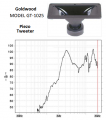
Piezo-Tweeter
.
.
.
 
Last edited:

BobTPH

Joined Jun 5, 2013
11,609
sensitivity of the pair = (2P)^2 / 2W = 4P / 2W = 2P / W
I don’t know what P and W are supposed ti be in your equation. But, no the sensitivity dos not increase.

With two speakers in parallel, the power driving them is doubled. And the output power is doubled. 2/2 = 1. I.e. no increase in power out per watt.
 

MisterBill2

Joined Jan 23, 2018
27,976
By far the most efficient speaker system is actually HEADPHONES. that is because very little sound energy is sent beyond the listener's ears. NOT my favorite at all, but certainly the most efficient and most effective.
AND the higher impedance available in many headphones makes electrical matching simpler.
 

Audioguru again

Joined Oct 21, 2019
6,826
Most modern amplifiers have their power rated to drive speakers that are 2 ohms to 8 ohms. Then for your series speakers, the amplifier must have a power rating much higher than you need for the amplifier output voltage to be high enough.

A Sweet 16 speaker will sound as bad as one of its cheap speakers, only louder.

The piezo tweeter (squeaker?) has an awful frequency response:
 

Attachments

LowQCab

Joined Nov 6, 2012
5,101
Audioguru again
Audio-Amps really don't care if the Impedance is "too-high", they will work just fine, and more efficiently.
The objective here is making Batteries last a long time while providing a reasonable listening volume.

A Class-D Digital-Amp would go a long way towards achieving this goal.

There are plenty of small, inexpensive, Speakers available with excellent Fidelity,
and they can be regularly found in "close-out" sales for ~$2.oo to ~$3.oo each in quantity.

The Output of a Piezo-Tweeter is virtually "free" as far as Power-Consumption is concerned,
and low Power-Consumption would now appear to be the main theme of this project,
and,
there are slightly more expensive versions of this Tweeter-design
that have much flatter Frequency-Response if that's important to You.
And,
the one listed is also almost "cost-free" at only ~$3.oo each,
that's less than a cup of Coffee now days.

Ultra-Flat-Frequency-Response is not a requirement for this project.
.
.
.
 

Thread Starter

PeteHL

Joined Dec 17, 2014
585
I don’t know what P and W are supposed ti be in your equation. But, no the sensitivity dos not increase.

With two speakers in parallel, the power driving them is doubled. And the output power is doubled. 2/2 = 1. I.e. no increase in power out per watt.
Did you see the link in my post #25 to what Siegfried Linkwitz had to to say about the matter? He shows that there is a 3 dB improvement of power sensitivity. I think that my equation in that post is maybe off in some way, but I did define P as the sound pressure generated, and W as watts consumed by, one of the two identical drivers.
 

Thread Starter

PeteHL

Joined Dec 17, 2014
585
You originally stated that your goal was ~100db at 1w/1m ........
You are starting-out with a Speaker, ( or speakers ), rated at ~91db at 1w/1m ........

This would seem to indicate that You are attempting to get the
most Sound-Pressure for the least Wattage consumed from "Batteries"
This complete flips this Thread on it's head.

More Voltage, and less Current,
equaling the same Power, is usually more EFFICIENT.


A standard Cone-Speaker is a very-poor, and very mismatched, "Impedance-Transformer",
so the trick to better efficiency is to improve the
Impedance-Match from the Amplifier's Output to the surrounding Air.

You are starting-out with a "Tweeter" of unknown design / part-number.
This Tweeter is either 4 or 8-Ohms, neither of which is a good-start for the stated goal.
Skip the Tweeter altogether since this Speaker-System is designed for
Emergency use only, not High-Fidelity-Reproduction.
It will just waste precious Power.

Next,
Create a 4-Driver-Ported-Boom-Box, ( in a Line-Array configuration ),
that is specifically mis-Tuned to the Resonant-Frequency of the Speakers, ( 55Hz ).
This is actually a lower-Frequency than would be ideal, but it will be the most efficient tuning.
Now, wire the Speakers in Series, creating a ~32-Ohm Load to present to the Amplifier.

No Crossover-Network is needed or wanted,
the Amplifier will have rather severe Low and High-Cuts built-in
to reduce unnecessary Power consumption.

There should be NO sound damping materials added to the Cabinet,
let it resonate all it wants to.

Without building a properly designed Horn-Loaded-Cabinet
this is the best that You can do with the existing Speakers that You have as far as Efficiency goes,
( unless You want to build a ~4-foot tall Cabinet ).
This would improve the Impedance-Match tremendously, this is why Horns work so well.

If You want to throw-in some free High-Frequency-Response, ( 2Khz to 20Khz )
then purchase and install a single Piezo-Electric-Tweeter, they draw inconsequential Current.
Piezo-Tweeter
.
.
.
How does the 32 Ohm load to the amplifier cause the amplifier to have built-in low and high (frequency) cuts? How did you arrive at a resonant frequency of 55 Hz? My horn tweeter is an old Pioneer AHE60-51F.
 

LowQCab

Joined Nov 6, 2012
5,101
1) How does the 32 Ohm load to the amplifier cause the amplifier to have built-in low and high (frequency) cuts?
2) How did you arrive at a resonant frequency of 55 Hz?
3) My horn tweeter is an old Pioneer AHE60-51F.
.
1) It doesn't,
one has nothing to do with the other.
"" the Amplifier will have rather severe Low and High-Cuts built-in "" ( after You put them there )
"" Now, wire the Speakers in Series, creating a ~32-Ohm Load to present to the Amplifier. ""
These are 2 separate statements, in 2 separate paragraphs,
how did You manage to conflate the two ?
They are completely different concepts.
"Low and High-Cuts" refer to Electronic-Filtering-Circuitry designed-in as part of the Amplifier-Circuitry.
A "32-Ohm-Load" is the "Load", ( or Impedance ), that the Amplifier will be driving,
substantially reducing it's Current-consumption from the Battery, for longer Battery-Life.

2) From the list of Specifications for your Speakers on the Parts-Express-Website.

3) I'm not concerned about your Tweeter, or it's model-number,
it is a poor choice for a Battery-Powered Project because of it's very Low-Impedance value.
A ~$3.oo Piezo-Tweeter will do the job with a very High-Impedance,
making it a good choice for a Battery-Powered Project.

There's no free lunch,
making your Speakers as EFFICIENT as possible is the main solution to increasing Battery-Life,
a very small "Class-D" Digital-Amplifier would be the next best step.

Skip all the Math-Equations on this problem,
Speaker performance is only an "approximation", and certainly not engraved in stone.
Speakers act very "mushy" in a way that must be extensively "experienced" to understand it.
This is because a Speaker is EXTREMELY INEFFICIENT, and a very poor "Impedance-Transformer".
.
.
.
 

MisterBill2

Joined Jan 23, 2018
27,976
The most efficient speaker is a paging trumpet, but it sounds so very terrible that you can not imagine it. Seriously horrible because of no bass and no treble. vastly more offensive than 10% harmonic distortion. So the question becomes how important, actually, is running on batteries when there is a power failure??
How often do power failures happen in your area of the world??
In my area power failures of more than a few minutes happened maybe once a year until O bought my standby generator set. Then it became once every 2 1/2 years.. And when the power fails I have more important activities than playing music.
A six speaker column with close spaced speakers might sound OK if the speakers are run at not over half their rated power.
But getting 100dB SPL is rather loud by most standards.
 

LowQCab

Joined Nov 6, 2012
5,101
The ~100db per-Watt @ 1-Meter is a standard method for stating the efficiency of a Speaker.

This means that ~100 Milli-Watts of Amplifier-Power will provide
enough Sound-Output for a comfortable listening Volume-Level.
.
.
.
 

Thread Starter

PeteHL

Joined Dec 17, 2014
585
If each loudspeaker system has six woofers, and I make it a closed-box design, is there any reason why I couldn't have a single common closed-box for all six woofers? It I did this then I would make volume of the box equal to six times whatever volume it is that results in my desired Qtc with respect to Vas of a single driver.
 

LowQCab

Joined Nov 6, 2012
5,101
It's completely acceptable to use a "common" single Box-Volume.

In this type of application,
don't be too concerned about all the various Driver-details.
You are looking for maximum SPL.

Find the Resonant-Frequency of the Speakers that You will be using,
then make the Box a practical-size, ( bigger is almost always better ),
then tune the Port in the Box to the Resonant-Frequency of the Speakers,
this is called a "Boom-Box" alignment,
and will result in the most amount of Output for the least amount of Power.

A "Sealed-Cabinet", AKA, an "Acoustic-Suspension" Cabinet,
is far superior for maximally-Flat-Frequency-Response,
and, most importantly, minimum Transient-Distortion.
They are not as efficient as a Ported-Cabinet, but have much lower Distortion.
But, in your application, Distortion is not an important consideration, however, Efficiency is.
.
.
.
 

Thread Starter

PeteHL

Joined Dec 17, 2014
585
A horn tweeter will be much louder (on axis) than a dome tweeter and the horn causes it to sound like a horn.
It will need attenuation to match the lower level of the woofer.

A woofer sounds "tight" (without resonances) when connected directly to the extremely low output impedance of a modern amplifier. Then three woofers in series are allowed to resonate and sound boomy like a bongo drum.
This isn't true, at least in the case where two woofers are wired in-series. For two woofers wired in-series, Qts of the pair is the same as Qts for a single driver. This is also the case for two woofers wired in parallel. In building my speaker system this was experimentally confirmed for me. Also see the paper that I'm providing a link to by King.

https://vdocuments.mx/method-found-...ivers-in-one-enclosure-using-the-mathcad.html
 

LowQCab

Joined Nov 6, 2012
5,101
I have built Cabinets, ( based on an old ( ~1975-ish ) ElectroVoice design ),
that contained 4 - 15" Woofers in each Cabinet,
there were a total of 4-Cabinets,
each Cabinet was internally wired in series for a nominal-Impedance of ~32-Ohms,
all 4 Cabinets were then wired in parallel to present a nominal ~8-Ohm-Load to a
single Bridged-Amplifier rated at ~1000-Watts.

That's 16 - 15" Woofers powered by a single 1000-Watt rated Amplifier, with only 2 - 10-Gauge-Wires.

This setup had absolutely mind-blowing Efficiency.
It routinely produced over 100-Acoustic-Watts ( in excess of ~140db ) of Output,
from ~30hz to ~150hz with extremely low distortion,
and no Equalization was required for a very flat Frequency-Response.

Nobody could believe that the Subs were powered by only a single BGW-Amplifier.

For the purposes of the Speaker being discussed in this Thread,
any minor loss of high Frequency-Response caused by Series-Wiring of multiple-Drivers
will be largely undetectable to the average person,
and well worth the increase in overall-Efficiency.
.
.
.
 
Top