Calculating resistors for Relay/ transisto

Thread Starter

popeman

Joined Dec 15, 2017
9
Hi,

This is my first post so hopefully I'm posting in the right section.

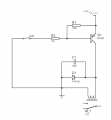
I would like to modify this circuit in order to be able to use a 24V supply on a 24V relay. Could you please tell me what would be the correct values for R1 and R2?

Thank you very much! :)
 

Attachments

MrChips

Joined Oct 2, 2009
34,850
Welcome to AAC!

You do not have to change anything except perhaps the transistor. You may want to select a transistor with higher power rating.
What is the current requirement of the relay?

Where did you get that circuit?
There may be a better way to design that circuit.
 

Thread Starter

popeman

Joined Dec 15, 2017
9
Thank you very much indeed MrChips!

I can't remember where I got this circuit from. It's been a while since I found it somewhere online. I had a long break since then and now I found some time to spend on this one again.

All I'm trying to do is to drive the relay from a 24V supply I already have, although TBH I'm not quite sure why I need a transistor in this case.

"You may want to select a transistor with higher power rating."
Are sou saying that the bc560 won't work in this case?

"What is the current requirement of the relay?"
the datasheet states that the Nominal operating Power for the 24V relay is 200mW(24V), so I believe that'll be around 9mA?
(Minimum operating Power is 85mW)

There may be a better way to design that circuit.
I;m always open to new suggestions as you have probably fighured by now that I'm far from an expert in electronics :)
 

ElectricSpidey

Joined Dec 2, 2017
3,335
You only need a transistor if the relay is to be controlled by some sort of signal.

Just place the switch in series with the relay if are using it without a signal.

(keep the diode) I don't know about the cap.
 

MaxHeadRoom

Joined Jul 18, 2013
30,684
Is there any reason you chose a sourcing control, over the more traditional sinking mode?
Your switch could control with the relay direct, so really no need for a transistor.
Max.,
 

Thread Starter

popeman

Joined Dec 15, 2017
9
Well, I'll be using quite a lot of LEDs and other relays so maybe it's more wise to keep the transistor in place?

I don't know. I'm just thinking out loud :)

You only need a transistor if the relay is to be controlled by some sort of signal.
In fact, this is the case. So it is most likely needed.

So, coming back to the original question. Do I need to change the resistor values and the transistor?

Once again, many thanks for your help :)
 

MaxHeadRoom

Joined Jul 18, 2013
30,684
In fact, this is the case. So it is most likely needed.

So, coming back to the original question. Do I need to change the resistor values and the transistor?
If controlling from any kind of high impedance source, it may pay to look at Mosfets including logic level gate versions in the future.
Max.,
 

ElectricSpidey

Joined Dec 2, 2017
3,335
Your relay driver circuit would depend on what kind of signal you provide, and therefore the values as well.

All your circuit shows is a switch.
 

Thread Starter

popeman

Joined Dec 15, 2017
9
The plan is to use this circuit for a DI (Direct injection) box. So, once I plug my audio Jack connector (from a guitar) into the box, the relay will be automatically triggered, if that makes sense.

I'll use a female Jack similar to this


ElectricSpidey

Joined Dec 2, 2017
3,335
It makes perfect sense.

Do these jacks have an isolated set of switch contacts?

How will you produce the “signal” when you plug into these jacks?
 

Thread Starter

popeman

Joined Dec 15, 2017
9
There 3 pins on each side that are connected in pairs (from the top as shown). Once you plug the male Jack, the connection between the pairs "breaks", so the 3 pins on the left side are isolated from the ones on the right. The idea is to have the ground (of the relay crircuit I posted) connected and once the jack is insert the ground will be disconnected and triggers the relay.

Sorry but it's pretty hard to explain it any better because I'm not native English speaker.

It's pretty common technique. I just need to figure out whether this relay circuit will work as is with 24V supply.
 

MaxHeadRoom

Joined Jul 18, 2013
30,684
The phono jack is perfectly capable of switching 24v.
In fact I am using one as a 'commutator' in the middle of a rotating table as a DC 24vdc power pickup.
Max.
 

Thread Starter

popeman

Joined Dec 15, 2017
9
OK thank you gents!

I won't change the circuit as per your suggestions but just for educational purposes, what is the formula for calculating R1 and R2 under different conditions? For example, I remember seeing an almost identical circuit but with 100K and 47K resistor instead.
 

MrChips

Joined Oct 2, 2009
34,850
OK thank you gents!

I won't change the circuit as per your suggestions but just for educational purposes, what is the formula for calculating R1 and R2 under different conditions? For example, I remember seeing an almost identical circuit but with 100K and 47K resistor instead.
Now we are getting technical here.

R1 is a bleeder resistor to ensure that the transistor is turned off when the switch is open.
R1 should be at least 10 times greater than R2, which you have in this case. R1 = 100k is ok.

R2 determines the base drive current.
With 24V supply, the maximum current the base can have is 24V/10k = 2.4mA
In order to ensure that the transistor is turned on fully, we assume a current gain of 10.
Hence the transistor collector to emitter current is 24mA.
If the relay only needs 10mA, you are good to go.

So you are ok all around.
R1 = 100k
R2 = 10k
 
Top