Calculating Power of a signal

Thread Starter

Bhope691

Joined Oct 24, 2016
38
Hi,

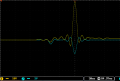
I have this output signal (attached) where I am trying to work out:
1. The instantaneous Power
2. The average power

However, I am a little bit stuck and don't quite understand how to go about doing this. Could someone point me in the direction of the calculation and how to solve the equations if possible (maths isn't my strong point). The exact answer is not necessary a ball park figure and the method used to calculate will be more than useful. If I wanted a piece of equipment to calculate the Voltage RMS and Current RMS what would be a good choice?

Channel 1 is the yellow signal and is the voltage. They are 10V increments and max voltage can be taken to be 40V.
Channel 2 is taken by a current clamp and is set to 100mV = 1Amp. Max current can be taken to have a reading of 1.4V (14Amps?). They are 1V increments.
The signal repeats every 4ms. (250Hz)
The time scale is 50us.
The voltage is taken across a 1 ohm resistor and the current clamp is placed before the 1 ohm resistor.
Output.png

Thanks.
 

crutschow

Joined Mar 14, 2008
38,324
The instantaneous power is simply the peak voltage times the peak current at the same instant.

You could roughly calculate the average power by assuming that pulse is a half sinewave and calculate the RMS value as 0.707 times the peak for both the voltage and current.
You then calculate the average RMS power by multiplying the RMS voltage times the RMS current, and then multiply that by the pulse width (at the base) divided by the pulse interval (4ms).

This can be done more exactly with a digital oscilloscope that can perform waveform arithmetic.
 

MrAl

Joined Jun 17, 2014
13,667
Hi,

I have this output signal (attached) where I am trying to work out:
1. The instantaneous Power
2. The average power

However, I am a little bit stuck and don't quite understand how to go about doing this. Could someone point me in the direction of the calculation and how to solve the equations if possible (maths isn't my strong point). The exact answer is not necessary a ball park figure and the method used to calculate will be more than useful. If I wanted a piece of equipment to calculate the Voltage RMS and Current RMS what would be a good choice?


Channel 1 is the yellow signal and is the voltage. They are 10V increments and max voltage can be taken to be 40V.
Channel 2 is taken by a current clamp and is set to 100mV = 1Amp. Max current can be taken to have a reading of 1.4V (14Amps?). They are 1V increments.
The signal repeats every 4ms. (250Hz)
The time scale is 50us.
The voltage is taken across a 1 ohm resistor and the current clamp is placed before the 1 ohm resistor.

View attachment 131624

Thanks.

Hi,

There are several approaches to this if you dont have something that can do it for you.
The first thing you should do though is flip your current meter orientation because it is connected backwards, then take another reading (graph).

The first is the curve fitting method. This isnt that simple when you do it manually but is very possible if it is important enough. The idea here is to do each waveform separately.
To start, read the graph for the voltage waveform and pick out as many points as you can and record their amplitude and time position. You can then use a curve fitting strategy to create a polynomial that closely matches the original waveform. A typical method is the sum of squared errors which provides a statistically similar waveform.
That's becomes your wave v(t).
Do the same for the current waveform, that becomes your wave i(t).
Do the math:
Pavg=(1/T)*integrate(v(t)*i(t),dt,0,T)
which is an integration of the product of voltage and current over the time period of one complete cycle T, or if you skip the parts that are zero in the wave fitting, then you just integrate over time from t1 to t2 but still use (1/T) as the multiplier out in front.
Note that both v(t) and i(t) have the same sign for a resistive element like a 1 ohm resistor.

The second method is a little easier. We approximate the waveform as a series of steps, where each step is as small as we can do keeping it practical. This method is also faster. The idea is to use those step amplitudes and time periods to come up with a reasonable approximation.
The step amplitudes will have both amplitudes and duration, so you'll get two numbers for each step like 2,0.1 or something.
For your voltage waveform, say the peak is at 4 volts, and lets say that we approximate the duration of that to be 0.001 seconds. For the current wave at that time say the peak is at 2 amps (once the current sensor is flipped). So we have voltage 4 volts and current 2 amps and time 1ms. This means we do next:
p1=4*2*0.001=0.008

Now lets say that just to the right of that we have an amplitude of 3.8 for the next 1ms, and thus current of 1.9 amps. We then have:
p2=3.8*1.9*0.001=0.00722 but to keep this simple lets say it was 0.007 only.

After we do all the points p1, p2, p3, ..., pN, then we sum up all the results:
Ps=p1+p2+p3+...+pN

and now since we have times when there is zero voltage, we find the ratio of the non zero times to the zero times, and say the wave is non zero for 1/3 the total time period. We then note the total time period is unity which is 1, so we have:
D=(1/3)/1=1/3

so we multiply the sum Ps above by 1/3 and that gives us the total average power:
Pavg=Ps*D=(0.008+0.007+...)*(1/3)

If we only had those two measurements we would get 0.015/3=0.005 for example.

If you keep the time spacings all the same (such as 0.001 second as above) it makes it a little simpler but i presented this method in case you want to use different time periods for different parts of the wave.

A key point is that the RMS value changes more for higher amplitude parts of the signal than for lower amplitude parts, so if you use better care and precision for the high peak than for the lower peaks you should get a reasonable estimate.

There are other methods, this last one is the simplest unless you have or can create your own software. The next simplest by hand method is the trapezoidal method which just has an extra step that averages every two points.

If you have a theoretical model of the system we can use that to check our numerical results. That model would have to be capable of creating that same voltage wave and current wave. We could then do a very precise calculation and compare it with measurements and the approximate average power calculation above.
 
Last edited:
Top