Calculating a rectifier's resistance in a PSU

Thread Starter

richard3194

Joined Oct 18, 2011
193
Are you averaging the forward voltage divided by the forward current for the small part of the AC cycle where the diode conducts, or is the average being computed for the entire period of one AC cycle?
I'm trying to figure out what a diode's effective resistance is, as seen by a circuit, when it's in operation, so that would be for a complete cycle.

Of course, post 12 shows that circuit (more or less).
 
Last edited:

Thread Starter

richard3194

Joined Oct 18, 2011
193
It seems reasonable that if you take the mean voltage across a diode, and the mean current thru it, that will give you it's effective rsistance.

But, in my PSU Designer II program, with 150V RMS source, a 1N4006, feeding 1800R, shunted by 8uF, approximately: Vd = -136V average, Id = 75mA average. That gives an effective diode resistance of 1813R That cannot be right?
 

alfacliff

Joined Dec 13, 2013
2,458
and then it all goes out the window =if the filament (heater) of the rectifyer isnt regulated. the emmission of the tube will change with cathode or filament temprature. something that solid state rictifiers arent subject to.
 

#12

Joined Nov 30, 2010
18,224
It seems reasonable that if you take the mean voltage across a diode, and the mean current thru it, that will give you it's effective resistance.
False. The effective resistance of a rectifier can be found by finding the amount of voltage across the rectifier at the peak current for that circuit. The PEAK voltage is diminished by the PEAK voltage lost in the rectifier. The resulting change of the voltage at the filter capacitor is the PEAK voltage minus the PEAK loss in the diode.

You can keep seeking the MEAN voltage as long as you want. It will not reveal the voltage on the filter capacitor.
 

#12

Joined Nov 30, 2010
18,224
But, in my PSU Designer II program, with 150V RMS source, a 1N4006, feeding 1800R, shunted by 8uF, approximately: Vd = -136V average, Id = 75mA average. That gives an effective diode resistance of 1813R That cannot be right?
Are you having difficulty with your simulation program? Are you accounting for the PEAK to PEAK ripple voltage on the filter capacitor?
 

Thread Starter

richard3194

Joined Oct 18, 2011
193
Let's just take it from a simpler circuit, where only a diode is across a source of 10V RMS.

In we had linear diodes, (which we don't), and put one marked "100R forward resistance "across the supply, and you measured the current, you would find it's effective resistance is 200R, because there is no volts for half of a cycle.

Now, lets put a real diode across the same supply. There will be an effective resistance, this time the value of which is circuit dependent. Let's say the current came out the same, and thus the effective resistance is calculated at 200R. Is it correct to say, that under these circuit conditions the forward resistance is 100R? I'm thinking it is. Because I'm thinking 200R is correct for the effective diode resistance.

Let's deal with this first. Thanks.
 

MikeML

Joined Oct 2, 2009
5,444
Let's just take it from a simpler circuit, where only a diode is across a source of 10V RMS.

In we had linear diodes, (which we don't), and put one marked "100R forward resistance "across the supply, and you measured the current, you would find it's effective resistance is 200R, because there is no volts for half of a cycle.

Now, lets put a real diode across the same supply. There will be an effective resistance, this time the value of which is circuit dependent. Let's say the current came out the same, and thus the effective resistance is calculated at 200R. Is it correct to say, that under these circuit conditions the forward resistance is 100R? I'm thinking it is. Because I'm thinking 200R is correct for the effective diode resistance.

Let's deal with this first. Thanks.
Nope. With a ideal diode with a series resistance of 100Ω, the average voltage across the diode for the full cycle is zero. The average current is 45mA. So by your reckoning, the effective resistance is R = Eave/Iave = 0/45m = 0 The voltage across the diode is a signed quantity whose average is zero for any full cycle.
 

Thread Starter

richard3194

Joined Oct 18, 2011
193
(I'm talking to myself here-ish):

If the voltage was 10V RMS across the diode, that's simply an expression of equivalence. 10v RMS is equivalent to 10V DC, in terms of the heat produced in a pure resistance. Okay, got that. RMS is not a statistical average of the voltage, if it was, all AC voltages would amount to 0. The negative half cycle is in a sense flipped, so RMS values are akin to pulsating dc, with no gaps in voltage. That gets rid of the mathematical average voltage, which is 0.

A supply of 10V RMS, across a 100R resistor, produces a current of 100mA RMS. Average voltage across the resistor is 0. Average current is zero. An RMS current of 100mA flows one way, then the same value of current flows the other way.

There is an average value of a voltage for a sine wave. It's 0.637 times peak. That is the voltage, on average, on either the positive or negative side of the wave form. It's not meant to amount to an equivalence of dc voltage.

If you wish to refer to the average voltage of an AC sinewave voltage, (a waveform that is perfectly symmetrical around zero) how do you express it? Or, if I say there is a sinewave voltage of 9V average across a 100R, should it be reasonably implied that it is equivalent to 10V RMS?

So, a sinewave voltage of 9V average is terminated by a fictitious linear diode of 100R forward resistance. The average current is 45 mA, the effective resistance is 200R. This is the same as saying a sinewave voltage of 10V RMS is terminated by a fictitious diode of 100R forward resistance. The RMS current is 50 mA, and the effective resisance is 200R. Why single out the first as inapproriate as incorrect?
 
Last edited:

Thread Starter

richard3194

Joined Oct 18, 2011
193
Even if it's true, it isn't useful for most circuits.
True. The thing is, my AVO tube tester tests rectifier/diodes, I think, in terms of average current. It's that what has got me into talking about average voltages and currents. I ought to take a look at a rectifier data sheet (such as U52 or 5R4) and see if it's rms current or average current that is quoted in the parameters. Probably rms.

Actually, all the meter does really, on my AVO VCM MKI, is produce a reading. It's not calibrated current, rms or average. On rectifier tests, you set the range. Such as 60mA. That loads to rectifier under test such that if the rectifier is good, if emission is good, it should cause 60 mA of current to flow in the test circuit.

In this thread, in an effort to get a more accurate reading of my 5R4 I was wanting to explore things deeper. And part of that was seeking to determine how you could establish the effective resistance of a rectifier.

Clearly, the effective resistance is circuit dependent for the 5R4, because we are dealing with real rectifiers, not fictitious ones. With a fictitious "linear diode", where only resistances are involved, it seems clear that the effective resistance is given by a measure of voltage across the diode, divided by the current thru the diode. And it's twice the diode's forward resistance. The effective resistance is not circuit dependent in that fictitious case.

So, if we only have resistors in circuit, will a measure of the voltage across a real diode (rms or average), divided by the current through it, give it's effective resistance. I assume so. Of course, I'm thinking in terms of the full cycle of voltage.

Once I understand the case with resistance only, then I might be able to grasp what's going on when capacitance is added, which alters the waveforms.

Effective resistance is tricky, in terns of mathematical calculation, because a diode has no single value. It's down to the circuit. But, it's a simple thing to determine if (repeat - if) effective resistance is voltage across the diode divided by the current through it, irrespective of circuit configuration. Well, if that is the case, I don't need to know too much about what is going on with C added.
 
Last edited:

MikeML

Joined Oct 2, 2009
5,444
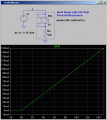
Here is an "ideal diode" with a forward resistance of 100Ω. I plot the I vs V, which show this conclusively. Note the slope. The ideal diode is modeled as a voltage-controlled switch; on if the voltage across it is >0V, off if the voltage across it is <=0V.

200s.gif

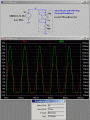
Now, if we connect it across a 10Vrms (14.14Vpeak) 50Hz voltage source, we can plot the current through the diode.

200ac.gif

I am using the built-in function in LTSpice to show us both the average value of the current =45mA, and the root mean square (RMS) value of the current = 70.7mA. Note that you cannot get the known "effective resistance" (i.e. 100Ω) by dividing Vrms by Irms. 10/70.7m not= 100!

Here is how to build a tester that can measure the effective resistance of a dual diode (like a 5R4 :D): Suppose we start with a center-tapped voltage source (like a center-tapped plate transformer). Suppose each half of the winding puts out 10Vrms. We combine the outputs of two diodes in the usual way. I plot the current through a sense resistor, and use a true-rms meter to measure the current. Note that for several complete cycles, Irms is now 100mA, and we know that the applied voltage (per diode) is 10Vrms, so 10/0.1 = 100Ω (what we started with).
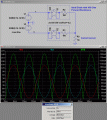
200h.gif

I suspect that is what your tube tester is doing, even though they are unlikely using a true RMS current measurement. More likely, they are using the average current, but note for this waveform, the error is a fixed ratio, so likely can be calibrated out...
 
Top