Buzzing/Distorted Sound on Technics SX PR603 Electric Piano

Thread Starter

soundmasterdee

Joined Dec 28, 2019
24
Hi Mr Chips, thanks for the insightful analysis. Obviously the UK AC is set to 220VAC. The specified voltage as per the service manual should be way below what I found on the +VCC and the -VCC. I'll double check to see if the transformer is the right type, and whether a 240VAC / 120VAC switch has been triggered by any chance.
 

Thread Starter

soundmasterdee

Joined Dec 28, 2019
24
Hi Mr Chips, I only recently inherited the piano from someone who was giving it away. The transformer looks like the original one, and there's no indication that it has been changed. I'm therefore tempted to believe that the power circuitry has the original components. I cannot say that with 100% certainty but there's no indication of any work having been carried out on the piano.
 

MrChips

Joined Oct 2, 2009
34,984
Ok. That is what I suspected.
Look for the model number written on a plate anywhere. There should be a letter after the PR603 for designated countries.

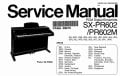
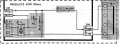
Technics SX PR603 Keyboard Service Manual.jpg

Perhaps the piano was meant for 120VAC and someone simply changed the power cord.

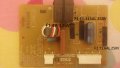
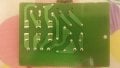
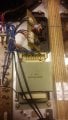
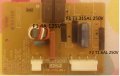
Take a photograph of the ACP board top side so we can see how the transformer is configured.

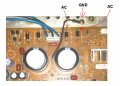
Technics SX PR603 Keyboard ACP board.jpg
 

MrChips

Joined Oct 2, 2009
34,984
It definitely appears that the transformer is configured incorrectly.
I cannot see anything wrong with the connections. I will have to look at it more carefully.
 

Ylli

Joined Nov 13, 2015
1,092
It does look like it is configured for 220/230/240 input voltage. Does the transformer seem to get unusually hot? If so there may be shorted turns in the primary.
 

Thread Starter

soundmasterdee

Joined Dec 28, 2019
24
The transformer hardly gets warm. Its actually two transistors on a heat sink (see right of the two big power capacitors) which gets quite warm. There are four similar transistors on the speaker side but they hardly produce any heat at all.
 

MrChips

Joined Oct 2, 2009
34,984
As far as I can tell, you have the correct transformer (QTPG1M053A) for UK.
The ACP power input board looks correct with AC on CN2 pin-1 (blue) and pin-3 (red).
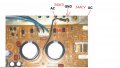
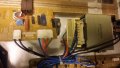
Can you show a photo of how the four wires from CN2 enter the transformer?
We should be seeing this.

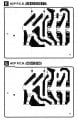
Technics SX PR603 Keyboard AC Power Input2.jpg
 

MrChips

Joined Oct 2, 2009
34,984
With the piano unplugged from AC mains, measure the DC resistance at CN2 between:

1-2
1-3
1-4
2-3
3-4

while the transformer is connected to CN2.

Then disconnect the connector at CN2 to the transformer and measure again at the transformer side of the connector.

Technics SX PR603 Keyboard AC Power Input3.jpg
 

Thread Starter

soundmasterdee

Joined Dec 28, 2019
24
=======
DC Resistance at CN2 (With AC mains Unplugged and transformer connected to CN2)
1-2 = 06.8
1-3 = 23.8
1-4 = 21.0
2-3 = 17.3
3-4 = 03.1

* Multimeter set at the 200 Ohm reading
========
DC Resistance at transformer side (with Transformer disconnected from CN2)
1-2 = 06.9
1-3 = 23.7
1-4 = 21.0
2-3 = 17.3
3-4 = 03.1

* Multimeter set at the 200 Ohm reading
========
 

MrChips

Joined Oct 2, 2009
34,984
Ok. Thanks for all of that. It looks like there is a short in the primary windings somewhere between 1 and 2.
Here is the catch.
1) We don't know if this assessment is correct.
2) We don't know if the buzz problem is a result of overvoltage.
3) We don't know if reducing the input voltage will correct the problem.
4) We don't know if parts of the circuit have already been compromised by the higher than normal voltage.

We do know that the unit has internal +15V and -15V regulators which presumably are doing their job and drives the headphones with ok sound.

Where do we go from here?
Here are some options:
1) Find a 2:1 step down transformer (240 to 120VAC) and test.
2) Find a power variac set to 50% and test.
3) Buy a replacement transformer.

I would prefer to do the tests first to know that reducing the AC voltage fixes the problem.
My thoughts.

Edit: Another option is to remove the transformer and have someone knowledgeable test it by applying AC power to the primary windings at different connections.
 
Top