Facebook
 Google
 GitHub
 Linkedin

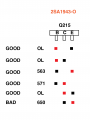
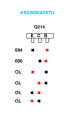
On a good transistor, you'll get something around 700mV (576mV is close enough) when the junction is forward biased (red lead on the anode, black lead on the cathode), and open circuit when it's reverse biased. Having two good junctions isn't sufficient. You need to do a test across the collector-emitter to see if it's short.As an example it gives me me a reading of 576mV voltage drop with the -ve on the base and the +ve on the Collector. Am I missing something.
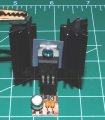
I managed to kill a 2N3442 transistor (with no heat sink) when I was doing a load test on a transformer with a 56VAC secondary. I had been testing lower power transformers earlier and forgot to be mindful of power dissipation in the transistor. It blew the fuse in my test setup and realized I was trying to make it dissipate several hundred watts (the transformer ended up being capable of 4.5A). Both junctions appear to test good, but there's a C-E short.