Bulk Capacitor choice- LED DMX Dimmer Design

Thread Starter

Sensacell

Joined Jun 19, 2012
3,780
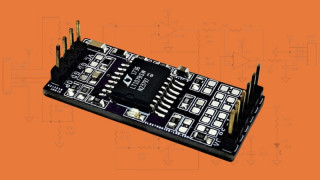
I am designing a DMX LED dimmer that runs on 24 V DC, the LED's draw about 5 A at full load.

These dimmers are often installed long distances (100 feet) from the DC power source. In this situation, the inductance of the long wires can cause voltage fluctuations at the dimmer,
if these fluctuations are large enough, the voltage can drop below the LED stack voltage and cause nasty flicker.
A large 'bulk' capacitor can help this - but how do I calculate the value of this capacitor, keeping in mind these are large and expensive?

My PWM Freq is about 400 Hz. (2.5 mS. period)


The usual approach is to consider the time constant of the capacitor supplying current, but this does not factor the wire inductance at all?

Thoughts?
 

LowQCab

Joined Nov 6, 2012
5,101
You can not add Capacitance to a DMX-Control-Signal-Cable.

The manufacturer of the DMX-Controller will state a
maximum-length, and type, of Cable that will work reliably.

You may need to look into a DMX to Ethernet Extension-Box,
this will allow You to add up to ~300-feet between your DMX-Controller and your Lights,
using Cat-6 Ethernet-Cable, which is reasonably inexpensive.
.
.
.
 

Thread Starter

Sensacell

Joined Jun 19, 2012
3,780
You can not add Capacitance to a DMX-Control-Signal-Cable.

The manufacturer of the DMX-Controller will state a
maximum-length, and type, of Cable that will work reliably.

You may need to look into a DMX to Ethernet Extension-Box,
this will allow You to add up to ~300-feet between your DMX-Controller and your Lights,
using Cat-6 Ethernet-Cable, which is reasonably inexpensive.
.
.
.
I was not clear in stating: This is about the DC power input, not the DMX lines.
 

Ian0

Joined Aug 7, 2020
13,122
If you have that much voltage drop on the cable, then flicker is the least of your worries. You need to be thinking about FIRE.
What is the prospective fault current? Is it sufficient to clear whatever protection deivce (fuse, MCB) is at the supply end?
Your local wiring code will have something to say about cable voltage drop, and you will probably find that it requires the supply cables to be larger to ensure safety. Otherwise the installation will be illegal and your building will not be insured.
 

LowQCab

Joined Nov 6, 2012
5,101
I was not clear in stating: This is about the DC power input, not the DMX lines.
.
DC-Power-Input into what, and from what ?
The LEDs should be supplied locally by
independent AC-Mains-Input-Power-Supplies that Power each Light-Fixture individually,
not though a skinny DMX-Control-Cable.

Please be more specific in describing
exactly what problem(s) that You are assuming that You are experiencing,
and why the Lights are ~100-feet away, and exactly how the Lights are Powered.

Also, are these "LED-Printed-Circuit-Strips" ?, or High-Power-LED "Stage-type" Effects-Fixtures ?
.
.
.
 

Thread Starter

Sensacell

Joined Jun 19, 2012
3,780
These are custom designed mid-power fixtures (120 watts max)

In some installations it's just not possible to co-locate the power supply with the fixture, long cable runs happen - forced by architecture.
Usually the DC is supplied by #12 AWG wire, while the DMX runs over twisted pair. (CAT6 cables)

The DC circuits are fused for the #12 wire gauge.

The voltage problems are not at DC, the wire is sized to be large enough for the average DC load, it's the fast edges of the PWM current that
cause problems- the solution is a bulk capacitor that keeps the cable current changes small enough to avoid ringing or transients.

This is where it get complicated- it's no longer a simple calculation of current and capacitance.
I usually fiddle around experimentally, but it's hard to mock this up physically to reproduce the exact conditions.
 

Ian0

Joined Aug 7, 2020
13,122
The DC circuits are fused for the #12 wire gauge.
There's no such thing as fusing for a certain wire gauge. The prospective fault current also depends on the length and the supply impedance.
The voltage problems are not at DC, the wire is sized to be large enough for the average DC load, it's the fast edges of the PWM current that
cause problems- the solution is a bulk capacitor that keeps the cable current changes small enough to avoid ringing or transients.
It sound more like that the transients are interfering with your control circuit. I can't imaging a transient lasting longer than half a cycle at 400Hz. If your bulk capacitance can supply the total load current for one cycle (2.5ms) with low enough voltage drop and has some hf decoupling across it, then that should be enough.
 

Thread Starter

Sensacell

Joined Jun 19, 2012
3,780
There's no such thing as fusing for a certain wire gauge. The prospective fault current also depends on the length and the supply impedance.
This statement makes no sense to me.

Fire protection in wiring is all about limiting the power dissipation per unit length of wire, a series connected fuse limits the current so the wire insulation does not melt or catch fire.
For a given gauge of wire, there is a rated maximum current which keeps the wire below the safe temperature- fusing below this current level is standard practice.
 

LowQCab

Joined Nov 6, 2012
5,101
The largest "practical-sized" Capacitor that You can fit
should be installed on each end of your long DC run.
And another one in the middle of the run wouldn't hurt.

Multiple smaller Capacitors will be more effective.

I would experiment with different sizes and quantities of Capacitors
until your problem goes away, but this may not address the problem.

Are You powering a DMX-Receiver, and the associated LED-Controller with the same DC-Power-Supply ?,
if so,
You may need to do some decoupling/regulating between the individual units at the end of the run.
.
.
.
 

Ian0

Joined Aug 7, 2020
13,122
This statement makes no sense to me.

Fire protection in wiring is all about limiting the power dissipation per unit length of wire, a series connected fuse limits the current so the wire insulation does not melt or catch fire.
For a given gauge of wire, there is a rated maximum current which keeps the wire below the safe temperature- fusing below this current level is standard practice.
You need to make sure that there is enough current in the faulty circuit to clear the fuse within a certain time. That depends on the length of the wire.
The current rating of the wire varies according to how it is installed: in fibreglass insulation in a loft in amongst a bunch of other wires gets a much lower rating than clipped to a wall on its own.
 

Thread Starter

Sensacell

Joined Jun 19, 2012
3,780
The largest "practical-sized" Capacitor that You can fit
should be installed on each end of your long DC run.
And another one in the middle of the run wouldn't hurt.

Multiple smaller Capacitors will be more effective.

I would experiment with different sizes and quantities of Capacitors
until your problem goes away, but this may not address the problem.

Are You powering a DMX-Receiver, and the associated LED-Controller with the same DC-Power-Supply ?,
if so,
You may need to do some decoupling/regulating between the individual units at the end of the run.
.
.
.
I was hoping there was some magic math I could apply to determine the minimum capacitance required for a given set of design parameters, cut and try makes me cringe a bit.

The dimmers can be made very slim and slinky with SMD parts- the electrolytics become hateful warts on the boards - haha.
Loading the boards up with ceramic caps can keep the design slender, but at a high cost, and the low ESR is not the best for damping.

In the past, I usually omit these bulk capacitors in my dimmer designs- for short wire runs, it's not an issue.
If the wire runs get longer, there can be other physical spots along the wire run to add additional capacitance- but the client needs to understand this up-front.
The idea of having enough capacitance on board for 98% of situations seems like a good call

Maybe fiddling with LT spice is called for at this point.
 

Ian0

Joined Aug 7, 2020
13,122
Why don't you either use a higher voltage (48V) or put fewer LEDs in a string. That gives a wider margin. If you are using a constant current driver which is a buck regulator it should withstand a wide range of input voltages.
If you are implementing colour-changing by PWM, better keep quiet about it before Philips' patent lawyers find out.
 

Thread Starter

Sensacell

Joined Jun 19, 2012
3,780
Why don't you either use a higher voltage (48V) or put fewer LEDs in a string. That gives a wider margin. If you are using a constant current driver which is a buck regulator it should withstand a wide range of input voltages.
If you are implementing colour-changing by PWM, better keep quiet about it before Philips' patent lawyers find out.

I am always faced with different design problems, never the same light twice.
Higher voltage is an obvious choice for lower line currents for a given fixture power.

It's sad that we have to consider those silly patents in this day and age.
I hate the patent system- everything about it.
 

LowQCab

Joined Nov 6, 2012
5,101
I studied the Patent-System back in the early '80's,
and even did some extensive, in person, searches in Washington-DC.
The Patent-System has now reached the status of 100% fraudulent, garbage.
Thank goodness it's going away soon.

Any large corporation can ruin You financially
if they decide that you are cutting into their profits,
regardless of any Patents, or lack thereof.
But, You have to be rather prominent in their field of interest to get their attention.
.
.
.
 

Ian0

Joined Aug 7, 2020
13,122
I am always faced with different design problems, never the same light twice.
Higher voltage is an obvious choice for lower line currents for a given fixture power.

It's sad that we have to consider those silly patents in this day and age.
I hate the patent system- everything about it.
That Color Kinetics patent can’t be far off its 21 years expiry date by now.
 
Top