buffer for digital signals

Thread Starter

electronicsenjoyer089

Joined Feb 24, 2025
182
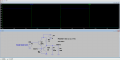
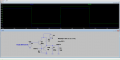
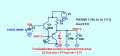
Hello all, i was simulating a buffer for digital signals , and i had some questions, if someone could help, thanks.

First of all the first stage made of npn basically does this: I got a pulse wave that goes from 0 to 5V as VIN, and as output i got the same wave but with a drop of 0.7V ( so from 0-4.3V, for now the output doesnt see the capacitive load, so everything is fine, beside that i got this voltage drop)

Now lets pass to second stage: in the second stage im giving a square wave that goes from 0 to 4.3V , what the pnp does? he shifts the wave up by 0.7

so what im gonna see is a wave that goes from 0.7 to 5V, now my question is: is this way correct to analyze circuit? im looking at right things? am i missing something?

Second question: why does the simulation dont show the distortion in the second stage vout? the stage with the capacitor?, when pulse wave goes low from 5V-->0V the voltage drops and the 100pF discharges via the 10k resistor with a tau given by tau=R*C, but in that way i shouldnt see a perfect square wave, cus it goes ''slowly'' to 0V or im wrong?


Thanks for whoever gonna answer and sorry if im a bit newbie, but trying to learn as much as i can :D
 

Attachments

MrChips

Joined Oct 2, 2009
34,680
Digital circuits are not linear amplifiers. The transistors are either in cut-off mode or saturation mode. Hence the shape of the input pulse does carry through to the output.

The bipolar junction transistor will have a voltage drop between the collect and emitter. Hence the output cannot reach the supply rail (Vcc or GND) when the transistor is in saturation mode.

When in cut-off mode, the transistor output will reach the supply rail because there is zero voltage across the load resistor.
 

Thread Starter

electronicsenjoyer089

Joined Feb 24, 2025
182
Digital circuits are not linear amplifiers. The transistors are either in cut-off mode or saturation mode. Hence the shape of the input pulse does carry through to the output.

The bipolar junction transistor will have a voltage drop between the collect and emitter. Hence the output cannot reach the supply rail (Vcc or GND) when the transistor is in saturation mode.

When in cut-off mode, the transistor output will reach the supply rail because there is zero voltage across the load resistor.
"Hence the shape of the input pulse does carry through to the output."
Hmm yes, by applying the pulse wave, we are using the transistor in saturation- cut off mode,but my question is kinda different i guess.

i say when we got the cap charged ( so its going to 5V almost ). When he discharges the voltage fall with some time, and the square wave in output should be distorted no?
 
Last edited:

ericgibbs

Joined Jan 29, 2010
21,412
hi 089,
My advice to you would be to consider actual real life circuitry that you want to perform a specific function, rather than posting 'what if circuits'

You will never learn electronics using your present approach to learning the subject.;)

E
 

Thread Starter

electronicsenjoyer089

Joined Feb 24, 2025
182
hi 089,
My advice to you would be to consider actual real life circuitry that you want to perform a specific function, rather than posting 'what if circuits'

You will never learn electronics using your present approach to learning the subject.;)

E
ah so i simulate the circuit and kinda ''accept it as it is?'' its too hard to learn things when i ask myself ''what if''? thats how u learn electronics?
 

Thread Starter

electronicsenjoyer089

Joined Feb 24, 2025
182
hi 089,
My advice to you would be to consider actual real life circuitry that you want to perform a specific function, rather than posting 'what if circuits'

You will never learn electronics using your present approach to learning the subject.;)

E
like i try to learn the configuration and modify it and ask myself what if i add this or what if i want it like that etc
 

ericgibbs

Joined Jan 29, 2010
21,412
like i try to learn the configuration and modify it and ask myself what if i add this or what if i want it like that etc
Hi,
There is nothing wrong in learning a configuration, the problem is with the 'what if or what' part of your thinking.

Once you have understood a circuit, try to consider an actual alternative application and then work out what the required changes have to be to achieve the application.

E
 

Thread Starter

electronicsenjoyer089

Joined Feb 24, 2025
182
Hi,
There is nothing wrong in learning a configuration, the problem is with the 'what if or what' part of your thinking.

Once you have understood a circuit, try to consider an actual alternative application and then work out what the required changes have to be to achieve the application.

E
Yeah but for me it isnt enough to know that a configuration does that thing, i need also to know why, and then if i know why, in case i change something in a circuit how it gonna change my output? and why so? thats the way
 

atferrari

Joined Jan 6, 2004
5,004
With all due respect to the OP, let me tell you that I experienced along one full year the annoying attitude of a classmate who every time we were explained a new circuit (basic topologies) he immediately asked a routinely question like "what if I eliminate that resistor?".

He never gained any understanding but wasted everybody's time and confused many students in way.

Tiring excercise in futility.
 

Thread Starter

electronicsenjoyer089

Joined Feb 24, 2025
182
With all due respect to the OP, let me tell you that I experienced along one full year the annoying attitude of a classmate who every time we were explained a new circuit (basic topologies) he immediately asked a routinely question like "what if I eliminate that resistor?".

He never gained any understanding but wasted everybody's time and confused many students in way.

Tiring excercise in futility.
ok but then how can i gain experience and do even more than ''basic topologies'' and understand what happens if i add this to the circuit etc and what i can do to make it work better?
 

Papabravo

Joined Feb 24, 2006
22,062
but u guys when u answer to me, u seem to know what gonna happen in the certain parts of the circuit, what voltage to expect, why etc, i wanna be that good, u get what i mean?
Except, in a career spanning half a century, I've never ever approached a circuit the way you do. I'm not sure of the genesis of your approach, but I find it both bizarre and amusing.
 

Thread Starter

electronicsenjoyer089

Joined Feb 24, 2025
182
Except, in a career spanning half a century, I've never ever approached a circuit the way you do. I'm not sure of the genesis of your approach, but I find it both bizarre and amusing.
ahah, maybe its bizarre, but i feel like its the way u get to know everything about a circuit, like entirely how things really work.

But i guess ur right this may take too much time
 
Top