Boost converter to step up voltage for pump/motor

Thread Starter

ieustrilyn

Joined Jun 6, 2024
5
I have a pump that I am powering with a 12V DC power supply but there is a pretty long cable in between the two that I'm assuming is introducing power loss resulting in less than 12V across the pump (ended up with around 8V). So I used a boost converter (XL6009 module) set at 12V between the long cable and the pump. But for some reason I'm actually getting even less than 8V across the pump now. Anyone knows why?

I know the boost converter is working since if i use a 5V power supply and boost it to 12V for the pump, it works fine (without the long cable). The power supply is also capable of supplying upwards to 12A so i dont think its current limitations.
And do provide alternative solutions if you know any
 
Last edited:

ericgibbs

Joined Jan 29, 2010
21,390
Hi ieu,
Welcome to AAC.
The voltage drop in the long cable will be higher when you draw a higher current
Also the booster will have less than 100% efficiency.
You cannot boost the energy at the motor.
Are you familiar with Ohms law?
E

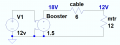
Depending upon the 12V supply and the specification of the Booster you could place the booster at the 12v power supply end of the cable, raise the drive voltage to the cable, to say 18V

Example:
EG57_ 1791.png
 
Last edited:

Thread Starter

ieustrilyn

Joined Jun 6, 2024
5
Hi ieu,
Welcome to AAC.
The voltage drop in the long cable will be higher when you draw a higher current
Also the booster will have less than 100% efficiency.
You cannot boost the energy at the motor.
Are you familiar with Ohms law?
E

Depending upon the 12V supply and the specification of the Booster you could place the booster at the 12v power supply end of the cable, raise the drive voltage to the cable, to say 18V

Example:
View attachment 323954
But this way, if i add another motor in parallel in the future or change the cable lengths, etc, i'd have to recalculate the required boosted voltage right? I still don't really get why my configuration doesnt work, it will draw a higher current and the voltage drop across the long cable will be higher but so will the voltage drop across the booster hence boosted voltage no?
 

ericgibbs

Joined Jan 29, 2010
21,390
Hi,
The cable resistance will remain the same as will the motor resistance, so increasing the 12V input to18V will drive more current through the cable/motor loop.

Use Ohms law.
E
 

Thread Starter

ieustrilyn

Joined Jun 6, 2024
5
Hi,
The cable resistance will remain the same as will the motor resistance, so increasing the 12V input to18V will drive more current through the cable/motor loop.

Use Ohms law.
E
" if i add another motor in parallel in the future or change the cable lengths, etc, " If i were to say extend the cable to twice the distance, so 12ohms, would i not need to increase the voltage to 24V to get the 12V across the motor? And for example, if i were to add another motor in parallel with that current motor, resulting in half the effective resistance, the voltage across that parallel motors would decrease no?
Hence the reason why i want to place the converter right before the motors is so that regardless of how many motors i add or how much i extend the long cables before it, the boosted voltage will remain the same, albeit higher current required from psu. But if this doesnt work, what else can i do to get a similar result?
 

ericgibbs

Joined Jan 29, 2010
21,390
Hi,
You did not mention adding more motors or extending the cable length in your original post.

Use the correct copper gauge size for your cable run, one that will suit any further changes you plan.

E
 

dendad

Joined Feb 20, 2016
4,634
Feed 24V or more down the cables and use a buck converter at each motor.
Or can you use mains and put the 12V power supply at the pump?
 

Thread Starter

ieustrilyn

Joined Jun 6, 2024
5
Feed 24V or more down the cables and use a buck converter at each motor.
Or can you use mains and put the 12V power supply at the pump?
Cant move mains so yeah. Also if tht works then why doesnt my current config work? Why can you use 24V down the long cable and use a buck converter to lower it for the motor but not the opposite, as in use 12V down the long cable and use a boost converter to increase it for the motor?
 

dendad

Joined Feb 20, 2016
4,634
You can but the losses will be less when you run a higher voltage supply as the current through the cable will be less. That is why the mains transmission lines run at many KV.
If you could run 36V or 48V it would be better.

Using a boost converter at the pump will actually cause the cable current to be even higher than just trying 12V.
For example, if the load is 12V at 12A, that is 144Watts.
Then, if the voltage drops to 8V at the pump, adding a 8V to 12V boost converter, the supply current for 144W now will be 144/8=18Amps. (Actually higher as this is ignoring the regulator losses. That extra current will actually cause the voltage to drop further.

Going to a higher power supply voltage will help a lot. The higher the better for efficiency in this case.
The idea is to reduce the current in the cable as much as practical.

Also, you could run 24VAC (or higher) down the line and install the rectifier, capacitors and regulator at the pump.
 

Papabravo

Joined Feb 24, 2006
22,058
Cant move mains so yeah. Also if tht works then why doesnt my current config work? Why can you use 24V down the long cable and use a buck converter to lower it for the motor but not the opposite, as in use 12V down the long cable and use a boost converter to increase it for the motor?
The cable has limited the power input to the converter, so it is unable to provide the required power output.
 

BobaMosfet

Joined Jul 1, 2009
2,211
I have a pump that I am powering with a 12V DC power supply but there is a pretty long cable in between the two that I'm assuming is introducing power loss resulting in less than 12V across the pump (ended up with around 8V). So I used a boost converter (XL6009 module) set at 12V between the long cable and the pump. But for some reason I'm actually getting even less than 8V across the pump now. Anyone knows why?

I know the boost converter is working since if i use a 5V power supply and boost it to 12V for the pump, it works fine (without the long cable). The power supply is also capable of supplying upwards to 12A so i dont think its current limitations.
And do provide alternative solutions if you know any
Yes- the motor requires current. Think of Voltage like gravity, and current like the whole river. Voltage is the rate at which the water wants to move, current is the quantity that moves. Every motor requires energy at a given voltage and current so that it can do the work required.

Boost converters are designed around the balance of voltage AND current it is expected to output. If the load (ie, the motor) requires more, the boost converter won't be able to support it. What does the sticker on the motor say it requires?
 

Thread Starter

ieustrilyn

Joined Jun 6, 2024
5
Yes- the motor requires current. Think of Voltage like gravity, and current like the whole river. Voltage is the rate at which the water wants to move, current is the quantity that moves. Every motor requires energy at a given voltage and current so that it can do the work required.

Boost converters are designed around the balance of voltage AND current it is expected to output. If the load (ie, the motor) requires more, the boost converter won't be able to support it. What does the sticker on the motor say it requires?
the motor only requires 400mA at 12V, the boost converter is rated at 4A max, PSU rated at 12V 12A. When all is connected, voltage across motor is only 8V (while boost converter set at 12V) and the PSU current draw is only around 800mA iirc
 

Reloadron

Joined Jan 15, 2015
7,855
Post #7 and #14 cover your problem. Use a suitable wire gauge for your load(s). You make no mention of wire gauge used or pump current? A simple Google of wire ampacity will bring up charts telling you the wire resistance which you multiply X2 for round trip. Your voltage loss is a result of your wire resistance * your load current.

Ron
 

ronsimpson

Joined Oct 7, 2019
4,646
I have motors. In the manual they say small wires will burn out the motor. The startup current will be 5x or 10x normal run current. If the motor can't get started the high current condition will continue. This is very hard on the motor.
 
Top