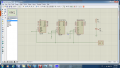
Thank you for reply. I understood your idea. One clock,one counter, and some gatesFirst let's think of a way to blink a LED continiously. If you want 10 times in 30 seconds a clock of 1/3 Hz will do this. A '555 can make close to a square wave so you can use that as the "time base."
Now make a counter, 4 bits wide so it can count up to 10. When it reaches 10 you want to stop counting and stop the LED blinking; that signal is simply an AND gate to go hi on the count of 10, or 1010 in binary. A singly 2-input AND will do this as all you need do is test when the 2nd and 4th bits are high.
Use that signal to both inhibit the clock to the counter and the signal to the LED. Note the logic for both is the same so the same gate can do both, just don't deive the LED and counter directly; use something for a driver for the LED so you don't load the logic. OR... load down the logic all you want but just use two gates, one for the clock and one for the LED.
You don't say how this thing is supposed to start, either by a button or by turning it on. Both have complications, like what is it supposed to do when the power goes on (with a button you may not want a blink at first). Either way, if you have a RESET to the counter you clear that to start a new sequence. Alternatively, you can LOAD a value of 10 to keep the counts off.
There are some ideas to get you going. One clock, one counter, and some gates.
It never ceases to amaze me how some people reach for a micro just to blink a LED!The loop is just another way of incrmenting or decrementing a counter,and the 8051 non-zero test is the same as decoding the output of a counter to see when to reset it; gates do it in both cases. If you don't want to go through that, you can use a 4017 decade counter. It has a different construction, and can reset itself on any count without external gating.
ak
Especially when you can buy these:It never ceases to amaze me how some people reach for a micro just to blink a LED!...
we can design circuit in different way. I am not really going to make LED blinking project without MCU. I am asking for basic concept . how to incrment or decrement a counter, ? when we make LED project using 8051 MCU they use counter , and two registers.The loop is just another way of incrmenting or decrementing a counter,
.
ak
At Digikey, single quantity I can get an LM555 for 45 cents. For another nickle I can get a PIC and not worry about the RC timing network.It never ceases to amaze me how some people reach for a micro just to blink a LED!
Someone even had a project published in one of the magazines (may have been the April issue) to programme a PIC to emulate a 555.
There are a few things a 555 can do that a micro can't. If you think outside the box you can get the 555 to do tricks its designer never imagined. A micro is far less robust generally and won't take much in the way of abuse.At Digikey, single quantity I can get an LM555 for 45 cents. For another nickle I can get a PIC and not worry about the RC timing network.
You do the math.
Ha, you beat me to it.At Digikey, single quantity I can get an LM555 for 45 cents. For another nickle I can get a PIC and not worry about the RC timing network.
You do the math.
A PIC can be as small as a SMT transistor, albeit with at least 5 pins - its horses for courses, obviously the capabilities of a flash micro leave a 555 in the dust, but I've done projects that simply wouldn't have happened with a micro.Ha, you beat me to it.
I do, however, empathize with Ian's point.