Hello,
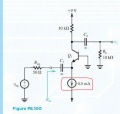
How should I treat a current source in DC and AC transistor analysis, does it have resistance and is the current source forcing the current in the collector to be the same as the current from the current source?
Thank you
DC sources of any kind have the normal output for the DC analysis and zero output for the AC analysis. For a voltage source, that's 0 V (i.e., they behave like a short) and for a current source, that's 0 A (i.e., they look like an open).
The emitter current of Q1 will be 0.5 mA or 500 µA and the emitter voltage will be ≈ -0.7V or one Vbe drop below ground. If you have a datesheet for Q1 you might get a better estimate of the Vbe drop.
Also note that there is no obvious evidence that the other side of the current source is at any particular voltage, but I don't think that matters.
Current sources (real world) have almost infinite output impedance and in your circuit force the emitter current to be equal to the current source's output. As a result the collector current will be the output of the current source times the alpha of the transistor.
In your circuit, without additional signal input there will be very close to 5 volts DC across the 10k resistor.
That's correct, it doesn't matter since the current source will develop whatever voltage is needed to keep the DC emitter current at the programmed current.
The emitter current of Q1 will be 0.5 mA or 500 µA and the emitter voltage will be ≈ -0.7V or one Vbe drop below ground. If you have a datesheet for Q1 you might get a better estimate of the Vbe drop.
Also note that there is no obvious evidence that the other side of the current source is at any particular voltage, but I don't think that matters.
Theoretically the current source does not need a voltage reference for the 'open' terminal, but in practice of course it does. If the open end was not at some negative voltage the circuit would never work because real life current sources need the correct operating voltages too. That is, the most basic current source which usually is just a current regulator. If the practical current source had its own internal voltage supply that would be different, but then the minimum I would think would be the open end would have to be connected to ground.
Theory is often nicer than practice because you don't have to worry about these things
Theoretically the current source does not need a voltage reference for the 'open' terminal, but in practice of course it does. If the open end was not at some negative voltage the circuit would never work because real life current sources need the correct operating voltages too. That is, the most basic current source which usually is just a current regulator. If the practical current source had its own internal voltage supply that would be different, but then the minimum I would think would be the open end would have to be connected to ground.
Theory is often nicer than practice because you don't have to worry about these things
The only thing the current source needs is some kind of connection to make a complete circuit. The details are not important. It does NOT need a voltage reference. It will generate whatever voltage is needed to produce the programmed current. You can tie it to any place that can absorb the 0.5 mA without disturbing the circuit, which means you can tie it to ground, to the +9 V supply, or to the output of Vsig, if you really wanted to. As long as there is a DC path back to the transistor collector and base, life is fine.
In absolute theory, you COULD leave the other end of the current source open. What would happen is that, internally, the source would move charge from the connected terminal to the unconnected terminal at the rate of 0.5 coulombs per second, resulting in the open end of the supply becoming more and more positively charged, without bound. In reality, you could actually make such a source that would behave that way for a very short duration (think Van de Graaf generator).
Yes, but a simulation is not the same as pure theory, and it is also not a constant current regulator. I thought i made the distinction clear.
Also, other simulators will allow the current source that appears to be open in that diagram to actually not be connected to anything.
The only thing the current source needs is some kind of connection to make a complete circuit. The details are not important. It does NOT need a voltage reference. It will generate whatever voltage is needed to produce the programmed current. You can tie it to any place that can absorb the 0.5 mA without disturbing the circuit, which means you can tie it to ground, to the +9 V supply, or to the output of Vsig, if you really wanted to. As long as there is a DC path back to the transistor collector and base, life is fine.
In absolute theory, you COULD leave the other end of the current source open. What would happen is that, internally, the source would move charge from the connected terminal to the unconnected terminal at the rate of 0.5 coulombs per second, resulting in the open end of the supply becoming more and more positively charged, without bound. In reality, you could actually make such a source that would behave that way for a very short duration (think Van de Graaf generator).
I think you are thinking in terms of a mix of theory and real life, if I understand you right.
In your first paragraph you are talking about a real-life current source, but it would have to have its own internal power source to do everything you are saying it can do there.
In your second paragraph (theory only), you do say you can leave the other end open, but it doesn't matter because you don't have to analyze that end to get the circuit results. A simple example is connecting a current source to a diode to test the diode forward voltage at some current like 1 amp. The other end of the source can be open, yet you can still read the forward voltage. No need to analyze the open end.
There are a few cases we've been discussing.
First, pure theory, we don't really have to know where the current comes from unless it affects another part of the circuit, and hence the open circuit is ok there. If the source connects to something else, then it will affect that part of the circuit also, but we don't care about that right now because we are talking about an open-ended current source.
Then there is the practical circuit, which can either be a constant current regulator (not really a current source but acts like one) and that needs to have the RIGHT voltage levels to work right. An example is an LED driver operated from a battery. If the battery is 5v and the LED is 3v and the constant current regulator regulates the current, if the 5v battery runs down to 3v it can no longer regulate the current, so the only way it can work is if it has enough 'overhead' voltage.
Another practical example would be a constant current regulator that has its own battery. If the LED battery runs down now, the constant current regulator could supply current, until of course its own battery runs down too far. Since it is a practical circuit the source can not be open ended.
I just tried this in LTSpice and, to my surprise, it did allow it. Sort of. It threw an error complaining about the floating node connected to the current source, but it allowed the simulation to proceed and produced the correct result.
So why is it an "error" and not a "warning", since the usual distinction is that errors prevent further processing, while warnings allow it to proceed, but with possibly incorrect results.
I think it also underscores that SPICE simulators are not charge-conserving, something that seldom causes problems unless you are working with circuits that rely on that properly for their operation -- the reason I know this is because some of the circuits we designed did just that, and we had to jump through all kinds of hoops to get simulations that were sufficiently faithful.
I think you are thinking in terms of a mix of theory and real life, if I understand you right.
In your first paragraph you are talking about a real-life current source, but it would have to have its own internal power source to do everything you are saying it can do there.
Of course it has its own internal power source -- there is a reason it is called a "source", after all. Just like a voltage source has an internal source of power, so does a current source. It doesn't matter whether you are taking theory or practical, a power source is a source of power.
A simulation is certainly not the same as pure theory on several different levels.
First, a simulation uses approximate math to find results, and that math is limited by the precision of the math engine. In pure theory, we can have virtually unlimited precision and that can even include plus and minus infinities. Also, depending on what solution method is chosen we could get different numerical results from the different methods with some being more accurate than others. Pure theory also does not have to deal with time increments that are "too small" to provide a solution because of that infinite precision.
A spice current source does not actually have to regulate anything because it is a given constant. A regulator has to deal with changing situations in the circuit which have to be measured while in operation.
Microcap allows open ended constant current sources. You can 'measure' the forward voltage of a diode by connecting one end of the source to the diode anode and the diode cathode to ground, leaving the other end of the source completely open.
In the actual circuit under consideration, it may complain of a "no DC path to ground" situation with just the cap and the current source with one open end, but i think it would find that path when we include the emitter of the transistor with the transistor base connected to ground.
Of course it has its own internal power source -- there is a reason it is called a "source", after all. Just like a voltage source has an internal source of power, so does a current source. It doesn't matter whether you are taking theory or practical, a power source is a source of power.
Well then we are talking about different things, that's all.
A constant current regulator in real life does not usually have its own internal power source.
A current source in spice or in theory is a constant value that never changes even if the main power source goes to zero. In theory it might be represented as Ipeak/s in the Laplace domain. In a practical circuit it would have to measure the current to determine if it needed to make adjustments to its own current using a feedback loop.
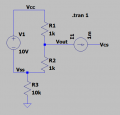
The issue in LTSpice appears unrelated to charge conservation. Consider the following circuit:
If R3 is removed and the bottom of V1 connected to ground, the simulation runs (with the "error" about Vcs being floating) and says that Vout is 4.5 V, which is the result you get by performing an analysis in which 1 mA of current is being sucked off of the Vout node, never to return, and there being a current of 5.5 mA in R1 and 4.5 mA in R2.
But with R3 in the circuit, the voltage at Vout becomes -5.5 V, which is due to the missing 1 mA flowing upward in R3, making Vss = -10 V.
So, even though it says that Vcs is floating, the simulator is, in fact, implicitly tying it to Node 0. If, instead, you explicitly tie it to EITHER Vcc or Vss, then Vout is once again 4.5 V because the other side of the current source is tied to a node that can source/sink arbitrary current without affecting the rest of the circuit (which is NOT the case with Node 0 in this circuit).
If R3 is removed and the bottom of V1 connected to ground, the simulation runs (with the "error" about Vcs being floating) and says that Vout is 4.5 V, which is the result you get by performing an analysis in which 1 mA of current is being sucked off of the Vout node, never to return, and there being a current of 5.5 mA in R1 and 4.5 mA in R2.
But with R3 in the circuit, the voltage at Vout becomes -5.5 V, which is due to the missing 1 mA flowing upward in R3, making Vss = -10 V.
So, even though it says that Vcs is floating, the simulator is, in fact, implicitly tying it to Node 0. If, instead, you explicitly tie it to EITHER Vcc or Vss, then Vout is once again 4.5 V because the other side of the current source is tied to a node that can source/sink arbitrary current without affecting the rest of the circuit (which is NOT the case with Node 0 in this circuit).

 Facebook
 Google
 GitHub
 Linkedin