Best way to test through-hole components?

Thread Starter

d11palmer

Joined Jun 3, 2025
4
Hi All,
I'm working on a jig that will allow operators to quickly test different inductors before mounting to a PCB.

The idea being the operator doesn't need to connect to individual pins, and perform multiple measurements. They can just insert the device and press a button to get a Go/No-Go.

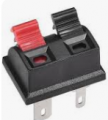
Is there any normal type of connections for test-connections of through-hole components?
or different search terms I haven't thought of?

I'm basically looking for the inverse of a PogoPin
Stuff like female pin headers typically only rated for 10-100 mating cycles.

Thanks in Advance
 

BobTPH

Joined Jun 5, 2013
11,463
I know this is not what you are asking, but…

I would question the utility of testing an inductor before installing it. Are you experiencing a high failure rate with these parts?
 

Thread Starter

d11palmer

Joined Jun 3, 2025
4
I believe its to do with tuning, I'm not an expert as its for some kind of antenna and radio stuff is not my forte.

The inductors look like the larger RM10 style and have some custom windings if I recall.
 

jaclement

Joined Apr 15, 2009
60
If you want to measure the value of an inductor, you should measure it at a frequency range in which it will be used, as the characteristics of the core of a toroid or other core materials are frequency dependent. I use a NanoVNA with various home built rigs depending on the type of inductor to measure inductance. If the inductor is a coil that can be coupled to a grid dip meter you can connect it to a known capacitor and find the resonate frequency, and calculate the inductance. All this is for RF. With speaker crossovers, any of the inductance meters available should work .
 

Thread Starter

d11palmer

Joined Jun 3, 2025
4
If you want to measure the value of an inductor, you should measure it at a frequency range in which it will be used, as the characteristics of the core of a toroid or other core materials are frequency dependent. I use a NanoVNA with various home built rigs depending on the type of inductor to measure inductance. If the inductor is a coil that can be coupled to a grid dip meter you can connect it to a known capacitor and find the resonate frequency, and calculate the inductance. All this is for RF. With speaker crossovers, any of the inductance meters available should work .
Cheers, its not so much about how to test the inductor itself. As they have suitable LCR meters etc. already.

More how to make the process simpler for the operators, so they don't have to faff connecting probes
 

Irving

Joined Jan 30, 2016
4,996
How many pins on the DUT?

One option might be to acquire some phosphor bronze strip and form 2 U-shape contacts. 3D print a holder for them with a sliding plunger that squeezes the contacts closed and simultaneously presses a microswitch to initiate the measurement
 

panic mode

Joined Oct 10, 2011
4,864
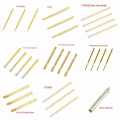
we have used pogo pins for decades. we have tons of custom testers used on assembly lines of automotive manufacturers. styles include both manual and auto-docking option. for example seat testers have bunch of connectors that get plugged into new product every 1-3minutes 24/7/360. that is a lot of pins and cycles some circuits use currents up to 20A.

pins do get damaged after while but they are easy to replace if you use socket/sheath (pull old contact out, press new one in). and you can choose right head type for your needs. low impedance/high current circuits we usually would go for crown style head with multiple points (claw) or conical (head with V-shaped cavity)

you need to talk to sales guy, show him what you are trying to connect to, state the specs (voltage, current, life...)

here is image found in internet.
1749752785441.png
 
Last edited:

MisterBill2

Joined Jan 23, 2018
27,181
Mostly inductor components with only two leads are either OK, or open circuit, or the wrong part. A very quick resistance check will catch open or shorted devices. That does require a dual limit resistance checker. THAT package is a separate discussion.
 
Top