Best method to generate and read resistance based on distance

Beau Schwabe

Joined Nov 7, 2019
186
This is kind of a "way out there" thought. What about using resonant acoustics? As the mass changes so will the resonant characteristics. Use two piezo transducers in a feedback loop configuration. Similar to the squeal from a microphone and speaker. The frequency should alter depending on the mass. You don't need to constantly ping the piezo, just on occasion.

I had a similar project for an ice machine to determine if the bags of ice were low inside of the machine. The ice machine chamber ws essentially an acoustic resonator ( Helmholtz resonator) that alters its resonance based on how many bags of ice are inside of the machine.
 

Ya’akov

Joined Jan 27, 2019
10,262
How about a weight or pressure sensor? The sensor goes underneath the spring and wires are fed out from a hole in the bottom cap. In effect, the sensor would be measuring the compression force in the spring.
This is a good idea. But how about just using a counting scale calibrated to tare the magazine. That should work like a charm.
 

Thread Starter

reverendalc

Joined Sep 17, 2023
20
If I’m understanding correctly, you’re suggesting to use a scale to weigh them to determine their contents? That’s a decent idea for reloading day, but dozens of these get tossed into a 5gal bucket and carried about. I’m looking for a field solution. Thanks!
 

Ya’akov

Joined Jan 27, 2019
10,262
If I’m understanding correctly, you’re suggesting to use a scale to weigh them to determine their contents? That’s a decent idea for reloading day, but dozens of these get tossed into a 5gal bucket and carried about. I’m looking for a field solution. Thanks!
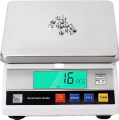
There are scales that are used for part counting.

1695150459246.png
This one is under a hundred bucks and runs from 4AA cells.
 

Jon Chandler

Joined Jun 12, 2008
1,627
Weight/pressure could be effective with one big but.... the spring force may not (is probably not) be the same in each cartridge, and I assume than an empty cartridge is randomly replaced with a full one.

A simple test/calibration step is to measure the force with the cartridge empty and full, from which pressure vs. number of disks can be calculated. It may be that the cartridges are similar enough that the measurements will be close enough to be useful.

I don't know if the question of how you're going to read the signals and what you're going to do with the result has been addressed. It may be possible to include a means of calibration with each cartridge, or to compensate in "the back end" whatever it is.
 

MrChips

Joined Oct 2, 2009
34,954
Another idea is to put an optical bar code along the track. A photo detector mounted on the underside of the platform reads the code and determines the position of the platform.
 

BobaMosfet

Joined Jul 1, 2009
2,211
Thanks for the ideas! The discs are fed into a pneumatic tool. There is some physical shock involved so I’m a little concerned about moving parts. The tool isn’t used in egregiously cold temperature, hopefully never wet, and while heat *may* be generated, there’s no appreciable amount.

I’m not sure of the composition of the spring, it’s just a pretty standard coil spring. My father told me about some apparatus that can measure the tension of a spring, but(while I admit I know nothing of it) it sounds like 4mm decompressions would require a very special and/or expensive spring.

between my controller, lcd display, and some other incidentals, I’m already at about $12/hopper. Since I have between 150-200 to equip, I’d really like to keep them under $20. I probably could’ve done way better than a raspberry pico, but again I’m a little out of my element here.

I’ll have a look at these string/slide pots!

am I way off, thinking about measuring resistance across a highly impedant piece of metal? I’ve already bought the picos.

thank you all so much
What are the discs made of, and what is the tube/carrier they are in made of? I ask because I'm wondering if simply putting an insulator (paper) around the tube, and then wrapping the tube in wire (an inductor) couldn't be used to measure how many 'slugs' are in, based on inductance changes.
 

Thread Starter

reverendalc

Joined Sep 17, 2023
20
Discs are brass and tube is steel, spring is some metal and the follower is plastic of some sort. The screw on bottom cap is some sort of metal.
 
Top